
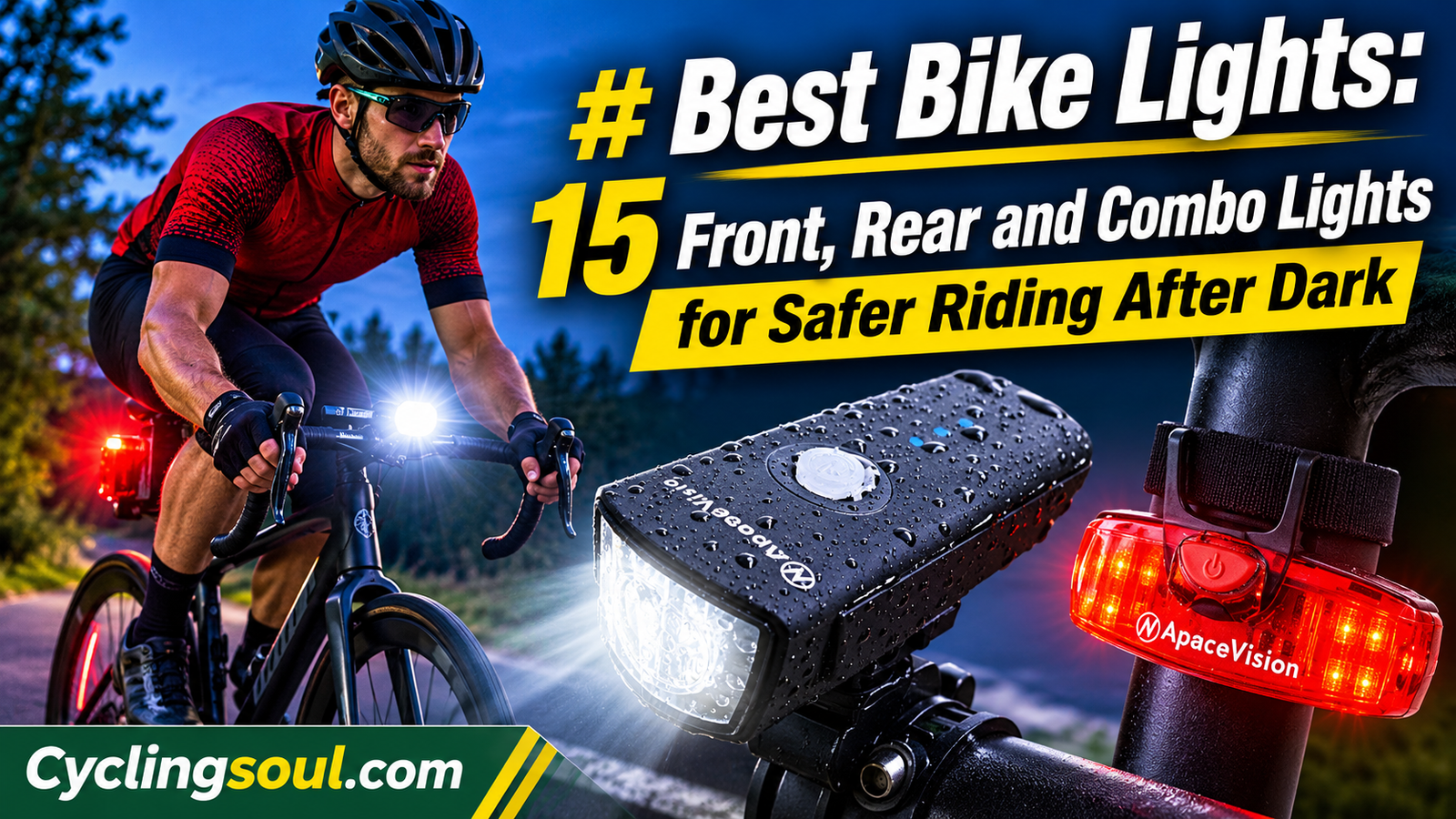
Bike lights are the one piece of cycling equipment that protects you twice: once by lighting the road ahead so you can read surface conditions, potholes and debris, and again by making you visible to everyone else using the road. Nothing else in your kit does both jobs at once, which is why choosing them deserves a little more thought than grabbing whatever is cheapest at the checkout.
The market is genuinely confusing. Lumen numbers on packaging often tell only part of the story, since a wide flood beam and a narrow spot beam with the same output behave completely differently on the road. Runtime claims depend heavily on which mode you use. Mounting systems vary from excellent to infuriating. And a light that is perfect for a lit city commute is close to useless on an unlit rural lane at speed.

Rear lights are small but consequential — being seen from behind is the single biggest safety gain most riders can make.
To cut through the noise, we grouped fifteen lights into three families: dedicated front lights, dedicated rear lights, and front-plus-rear sets that solve the whole problem in one purchase. Each has its own review below with the features worth knowing, honest pros and cons, and a clear verdict on who should buy it. Around those reviews sits a complete buying guide covering output, beam shape, battery technology, weatherproofing and mounting, so you can evaluate any listing with confidence.
If you are new to riding or rebuilding your kit from scratch, our guide to how to start cycling and the complete what to wear cycling breakdown are good companion reads — visibility is as much about clothing and positioning as it is about electronics.
The Short Version
Buy a front light and a rear light as separate jobs. Front lights need enough output and a beam shape that reaches far enough for your speed; rear lights need to be bright, steady or flashing, and mounted high. A combo set is the best value for commuters and casual riders; dedicated lights are better for fast night riding on unlit roads.
01Quick Comparison: Our Top Picks
All fifteen lights appear below with the details that separate them. Figures are the ones published in each product listing; always check the current listing before buying, as specifications are updated over time.
| # | Image | Product | Key Specs | Verdict | Check Price |
|---|---|---|---|---|---|
| Top Pick 1 |
 |
Knog Blinder 1000Best Overall Front Light |
|
Small, clean and powerful enough for almost every ride. | Check Price on Amazon |
| 2 |  |
Cygolite Dash Pro 600Best Budget Front Light |
|
Smart value pick with a proven commuter heritage. | Check Price on Amazon |
| 3 |  |
Fenix BC26R Rechargeable Bike LightBest High-Output Front Light |
|
Serious output for riders who need distance and punch. | Check Price on Amazon |
| 4 |  |
NiteRider Lumina Micro 1150Best Compact USB-C Light |
|
Big light performance in a genuinely pocketable body. | Check Price on Amazon |
| 5 |  |
CATEYE 800 Rechargeable HeadlightBest Trusted-Brand Headlight |
|
Dependable, well-sorted lighting from a bike-light specialist. | Check Price on Amazon |
| 6 | |
Garmin Varia RTL515Best Overall Rear Light |
|
Not just a light — it tells you what is approaching. | Check Price on Amazon |
| 7 |  |
ROCKBROS Rechargeable Rear Tail LightBest Value Rear Light |
|
Long-running rear light that reacts when you slow down. | Check Price on Amazon |
| 8 |  |
Ascher Ultra Bright USB Rechargeable Light SetBest Budget Combo Set |
|
Covers both ends of the bike for very little money. | Check Price on Amazon |
| 9 |  |
BX-500 NP NIGHT PROVISION USB-C SetBest USB-C Combo Set |
|
Modern USB-C convenience with solid weather protection. | Check Price on Amazon |
| 10 |  |
APECYC USB-C Rechargeable Light SetBest Battery Display |
|
Always know exactly how much charge you have left. | Check Price on Amazon |
| 11 |  |
SUYIWEE 1200LM Wide Angle Light SetBest Wide-Angle Coverage |
|
Side visibility is the standout for busy junctions. | Check Price on Amazon |
| 12 |  |
BLITZU Bike Lights with BellBest Set With Bell |
|
Lights and an audible warning in one tidy package. | Check Price on Amazon |
| 13 |  |
Cuvccn Rechargeable Bicycle Light SetBest Mode Selection |
|
Rear mode variety for riders who want to stand out. | Check Price on Amazon |
| 14 |  |
Apace Vision XPRO-LUME Light SetBest for Long Rides |
|
The one to pick when you cannot risk running flat. | Check Price on Amazon |
| 15 |  |
Energizer X400 Rechargeable Bike LightBest Clip-On Versatility |
|
Clips anywhere — ideal for bags, jackets and helmets. | Check Price on Amazon |
Compare Bike Lights Side by Side
Filter by output, beam type and weather rating.
Check Price on Amazon
02Why Bike Lights Matter More Than Almost Any Other Upgrade
Cyclists tend to spend their first gear budget on things you can feel immediately: a comfortable saddle, decent shorts, tyres that roll well. Lights tend to fall further down the list, which is backwards when you consider what they actually do. A light is safety equipment first and a convenience second, and the evidence for riding lit is not subtle.
There are two separate jobs happening at the same time. Being seen is about making your presence obvious to drivers, pedestrians and other riders from a distance and from multiple angles. Seeing is about projecting enough light onto the road surface to read what is coming — potholes, gravel, wet leaves, drain covers, glass. Many riders assume one light does both. In practice, a rear light does the first job brilliantly and the second not at all, while a front light does both to varying degrees depending on its beam shape.
Visibility Is Not Just About Darkness
The most dangerous moments are often not the darkest ones. Dusk, dawn, overcast afternoons and rain all reduce contrast dramatically, and drivers’ eyes are adjusting to different light levels at exactly the moment you are filtering past them. Riding lit in poor daylight conditions is one of the simplest safety decisions available, and modern LED efficiency means there is essentially no penalty for doing it.
Legal Requirements Vary, but the Principle Does Not
Rules about front and rear lighting differ between regions and countries, including whether flashing modes are permitted and what brightness levels are expected. Rather than getting tangled in local statutes, the practical approach is simple: always run a white light at the front, a red light at the rear, and consider reflective elements as a backup layer. If you are commuting in traffic, our guides to the best cycling helmets and best cycling sunglasses cover the rest of the head-level protection story.
Lights and Clothing Work Together
A bright rear light on an unlit bike is far less effective than a bright rear light paired with reflective clothing, because the light marks a single point while reflective material outlines your whole body and communicates that you are a moving cyclist. If you are building out your kit, our what to wear cycling guide covers layering for low-light and cold conditions, and our best cycling jerseys roundup highlights options with reflective detailing.
Pointing a high-output front light straight ahead instead of slightly downward. An angled beam lights the road surface where you need it and avoids dazzling oncoming road users, which is both courteous and safer for everyone.
Stay Seen From Every Angle
Shop reflective gear and visibility accessories for low-light riding.
Check Price on Amazon03How to Choose a Bike Light
Marketing numbers make bike lights sound far more complicated than they are. Once you understand four or five core ideas, you can evaluate any listing in under a minute — including lights we have not reviewed here.
Understanding Lumens (and Why They Are Not Everything)
Lumens measure total light output. Higher is not automatically better, because output only matters in combination with how that light is distributed. A thousand lumens thrown into a wide, shallow flood will light up a junction beautifully but will not reach far down a fast descent. The same output in a narrow spot beam throws light a long way but leaves your immediate surroundings dark. The best designs blend both, and that blend matters more than the headline number.
Beam Shape: Spot, Flood and Combination
Spot beams reach far and are the right choice for fast riding on unlit roads where you need to see obstacles early. Flood beams spread light widely at shorter range, ideal for slow technical trails and urban riding where peripheral awareness matters. Combination beams try to do both and generally succeed for mixed riding. If you only own one front light, a combination beam is the versatile answer.
Runtime and Modes
Manufacturers quote maximum runtime, which is almost always the lowest-output mode. Real-world usable runtime on the setting you actually ride in is the number that matters. Look for lights with a sensible spread of modes — a low steady setting for lit streets, a high steady setting for unlit roads, and a flash mode for daylight visibility — and check how the light behaves as the battery drains.
Charging and Battery Type
USB rechargeable is standard and convenient. USB-C is the current preference because the connector is reversible and increasingly shared with your other devices. Removable batteries, as on some higher-output lights, let you carry a spare for very long rides. Non-rechargeable battery lights still exist and have a place as emergency backups.
Mounting and Compatibility
A light you can mount quickly is a light you will actually use. Look for tool-free mounts, silicone straps that fit a range of bar diameters, and quick-release mechanisms that let you remove the light when parking in public. Handlebar diameter, fork crowns, seatposts and saddle rails all vary, so versatile mounting hardware earns its keep.
| Riding Scenario | Front Light Needs | Rear Light Needs | Check Price |
|---|---|---|---|
| Lit city commute | Low to moderate output, flash mode useful | Bright, ideally with side visibility | Check Price on Amazon |
| Unlit rural roads | High output with a long-reaching spot beam | High visibility over long distances | Check Price on Amazon |
| Trail and off-road | Wide flood with strong mid-range throw | Secure mount that survives vibration | Check Price on Amazon |
| Daytime training | Daytime flash mode | High-intensity flash mode | Check Price on Amazon |
| Long-distance touring | Long runtime or swappable battery | Extended runtime, reliable charging | Check Price on Amazon |
One further note on choosing: your light should match the way you actually ride, not the way you imagine you might ride one day. A rider who needs to see far at speed has genuinely different requirements from a commuter crossing a lit city centre, and understanding that distinction saves money and improves safety. For the wider kit picture, our how to choose a road bike guide covers matching equipment to intended use.
Find the Right Beam for Your Ride
Compare front, rear and combo lights by use case.
Check Price on Amazon04Best Front Lights: Our Two Standout Picks
Front lights are where most riders should invest, because they carry the heaviest workload: they light the road surface and they announce your presence to oncoming traffic. These two cover the premium and budget ends of the market convincingly.
| Light | Output | Strength | Best For | Check Price |
|---|---|---|---|---|
| Knog Blinder 1000 | 1000 lumens | Compact integrated design | Riders wanting one light for everything | Check Price on Amazon |
| Cygolite Dash Pro 600 | 600 lumens | Excellent value and mode range | Commuters and value-focused riders | Check Price on Amazon |
Knog Blinder 1000 — Best Overall Front Light
The Knog Blinder 1000 has earned its reputation the honest way: by being small enough to leave on the bike, bright enough for real night riding, and cleanly designed enough that it does not look like an afterthought bolted to your handlebars. It has been singled out as a best overall front light in independent roundups, and it is easy to see why once you have used it.
Key Features
- 1000-lumen output in a body far smaller than most lights at this level.
- Integrated, minimal design that sits close to the bars and resists rattling.
- Multiple output modes for everything from lit commutes to unlit roads.
- USB rechargeable with a straightforward charging routine.
Pros
- Genuinely compact for the output it delivers
- Clean aesthetic that suits road and commuter bikes alike
- Strong all-round beam for mixed riding conditions
- Easy to live with day to day
Cons
- Compact size means battery capacity is shared with larger lights
- Not the cheapest option in its class
- Riders on very long unlit descents may want more throw
Knog Blinder 1000 Front Light
See current colours, mounting options and pricing.
Check Price on AmazonCygolite Dash Pro 600 — Best Budget Front Light
Cygolite has been a fixture of commuter lighting for years, and the Dash Pro 600 is the sweet spot in their range. It is recognised as a best budget front light, and it delivers the things that actually matter — reliable mounting, a useful spread of modes, and consistent output — without the price premium of flagship models. For riders who want more, the Metro Plus 800 exists as a premium IP67-rated alternative in the same family.
Key Features
- 600-lumen output covering most urban and suburban riding comfortably.
- Practical mode selection including steady and flash options for different conditions.
- Tool-free mounting that moves easily between bikes.
- Premium upgrade path to the Metro Plus 800 with an IP67 rating for severe weather.
Pros
- Excellent performance-to-price ratio
- Well-proven commuter design and mounting
- Clear upgrade path within the same brand
- Straightforward operation with gloves on
Cons
- Less suited to very fast riding on unlit roads
- Design is functional rather than stylish
- Higher weather rating costs extra in the premium version
Shop Front Bike Lights
Compare output levels and beam patterns for your route.
Check Price on Amazon05Front Lights Built for Dark Roads and Higher Output
If your regular rides include unlit lanes, trail centres or long stretches where the only illumination is what you bring with you, output and throw become genuinely important. These three lights sit at the more capable end of the front-light market.
Fenix BC26R Rechargeable Bike Light
Fenix built its reputation on serious illumination tools, and the BC26R brings that thinking to the handlebar. With 1,600 lumens of output and a price point that sits in the mid-range bracket rather than at the very top of the market, it is the light for riders who routinely ride where streetlights do not exist.
Key Features
- 1,600 lumens of output giving real reach for fast riding on unlit roads.
- Rechargeable power system designed for repeated use without disposable batteries.
- Robust construction suited to hard riding and variable conditions.
- Multiple output levels so you can match brightness to the route and conserve power.
Pros
- Genuinely high output for demanding night riding
- Strong build quality and weather resilience
- Good value relative to its capability
- Versatile across road, gravel and trail use
Cons
- More light than most commuters need
- Higher output drains the battery faster at top settings
- Bulkier than compact everyday lights
Fenix BC26R Rechargeable Light
1,600 lumens for riders who need distance and punch.
Check Price on AmazonNiteRider Lumina Micro 1150
The Lumina Micro 1150 is an exercise in restraint: 1,150 lumens of output in a body small enough to disappear on the handlebars, charged over USB-C so it shares a cable with most of your other devices. It is the light for riders who want serious output but resent bulky brackets and oversized housings.
Key Features
- 1,150 lumens in a micro-sized body.
- USB-C charging for fast, convenient top-ups.
- Compact form factor that keeps the handlebar uncluttered.
- NiteRider’s established lighting platform with a well-sorted mode interface.
Pros
- Excellent output-to-size ratio
- USB-C means fewer cables in your life
- Easy to remove and pocket when parked
- Suits both road and trail riding
Cons
- Compact size trades some battery capacity
- High settings demand more frequent charging
- Not designed as an all-night trail solution
NiteRider Lumina Micro 1150
Compact, USB-C and powerful enough for real night riding.
Check Price on AmazonCATEYE 800 Rechargeable Headlight
CATEYE has been making bike lights for decades, and that experience shows in the details: sensible button placement, mounts that hold firm, and beam patterns designed around real cycling rather than generic flashlight optics. The 800 Rechargeable Headlight sits in the middle of the market and does everything a well-designed headlight should.
Key Features
- 800-lumen class output suited to mixed urban and suburban riding.
- Rechargeable design eliminating disposable battery waste.
- Established bike-light optics shaped for road use rather than generic illumination.
- Proven mounting system from a specialist cycling brand.
Pros
- Backed by decades of bike-light experience
- Well-shaped beam for road riding
- Reliable mounting and build quality
- Sensible, uncluttered operation
Cons
- Less output than high-power trail lights
- Design is practical rather than flashy
- May need supplementing on very long unlit rides
CATEYE 800 Rechargeable Headlight
Trusted bike-light engineering for everyday riding.
Check Price on Amazon06Best Rear Lights: Being Seen From Behind
Rear lights do not light your way, but they arguably prevent more incidents than front lights do. Being visible to vehicles approaching from behind — especially on narrow roads where drivers overtake at speed — is the single biggest visibility win most riders can make. Both options below are rechargeable, and both bring something beyond a basic blinking red LED.
| Light | Standout Feature | Runtime Highlight | Best For | Check Price |
|---|---|---|---|---|
| Garmin Varia RTL515 | Awareness technology that alerts you to approaching traffic | Designed for all-day ride use | Road riders who want situational awareness | Check Price on Amazon |
| ROCKBROS Rear Tail Light | Smart brake sensing brightens when you slow | Up to 50 hours | Commuters wanting long intervals between charges | Check Price on Amazon |
Garmin Varia RTL515 — Best Overall Rear Light
The Varia RTL515 is unusual in this list because it is not just a light — it is a light that tells you what is happening behind you. Recognised as a best overall rear light, it pairs with compatible cycling computers and devices to alert you as vehicles approach, which changes the experience of riding on busy roads more than any other single piece of kit we have used.
Key Features
- Combined rear light and awareness system that tracks approaching traffic.
- Device pairing with compatible cycling computers and displays.
- Adaptive behaviour that responds to what is happening around you.
- Compact, seatpost-friendly design that mounts cleanly out of the way.
Pros
- Transforms awareness on roads with vehicle traffic
- Excellent light output in its own right
- Clean integration with cycling computers
- Build quality that justifies the investment
Cons
- Premium positioning compared with basic rear lights
- Full value depends on pairing with a compatible device
- Overkill for short, quiet-traffic rides
ROCKBROS Rechargeable Rear Tail Light
Not every rider needs radar, and the ROCKBROS rear light proves that smart features can arrive at sensible prices. Its brake-sensing capability brightens the light when you decelerate, mimicking the behaviour drivers already understand from the vehicle in front of them. Add a claimed runtime of up to 50 hours and you have a rear light you can genuinely fit and forget.
Key Features
- Smart brake sensing that intensifies output when you slow down.
- Up to 50 hours of runtime reducing how often you need to charge.
- Rechargeable via USB for low running costs and less waste.
- Compact, seatpost-friendly form that stays out of the way of saddlebags.
Pros
- Excellent runtime between charges
- Brake sensing is a genuinely useful safety feature
- Strong value for the feature set
- Simple to install and remove
Cons
- No traffic-awareness capability
- Maximum runtime depends on the mode selected
- Basic mounting compared with premium alternatives
ROCKBROS Rechargeable Rear Light
Brake sensing and long runtime for daily riding.
Check Price on Amazon07Best Budget Front and Rear Light Sets
Combo sets solve the entire visibility problem in one purchase, and at the budget end they represent outstanding value. The trade-off is usually raw output and long-term durability, but for commuting and everyday riding the sets below cover the essentials convincingly.
| Set | Front Output | Standout | Best For | Check Price |
|---|---|---|---|---|
| Ascher USB Rechargeable Set | 300 lumens | Front and rear coverage at entry-level pricing | New riders and casual commuters | Check Price on Amazon |
| BLITZU Lights with Bell | 4 front modes | Integrated bell adds an audible warning | Urban riders who want lights and a bell together | Check Price on Amazon |
| Cuvccn Rechargeable Set | 2 front modes | Six rear modes for maximum rear visibility | Riders who want a distinctive rear pattern | Check Price on Amazon |
Ascher Ultra Bright USB Rechargeable Light Set
The Ascher set is the answer to a very specific question: what is the least you can spend and still be properly lit from both ends? With a 300-lumen front light and a matching rear, it covers the fundamentals — being seen and having enough light to read the road surface under street lighting — at a price that makes it easy to own several.
Key Features
- 300-lumen front light covering lit urban riding comfortably.
- Matching rear light for full front-and-back visibility.
- USB rechargeable so there are no ongoing battery costs.
- Compact, lightweight design that adds almost no bulk to the bars.
Pros
- Covers both ends of the bike in one purchase
- Extremely accessible price point
- Lightweight and easy to mount
- Great as a backup set or for a second bike
Cons
- Not intended for high-speed riding on unlit roads
- Basic feature set compared with premium lights
- Mounting is functional rather than refined
Ascher USB Rechargeable Light Set
Front and rear visibility in one affordable package.
Check Price on AmazonBLITZU Bike Lights with Bell
Two safety tools in one package is a genuinely good idea, and BLITZU have executed it well. The set combines front and rear lighting with an integrated bell, which solves two handlebar problems at once and frees up space for a computer or a bar bag. With four front modes and five rear modes, there is a setting for every condition.
Key Features
- Four front and five rear modes covering steady, flash and combination patterns.
- Integrated bell giving you an audible warning without extra clutter.
- USB rechargeable front and rear units.
- Quick-release mounting for easy removal when parking.
Pros
- Bell plus lights in a single purchase
- Wide mode selection for different conditions
- Frees up handlebar space
- Good value for the combined feature set
Cons
- Combined design means fewer placement options
- Output is suited to urban rather than unlit riding
- Bell preference is personal — some riders already own one
Cuvccn Rechargeable Bicycle Light Set
Where most sets give you a couple of flash patterns and leave it at that, the Cuvccn set goes further at the rear with six distinct modes. That variety is more useful than it sounds: different patterns are more or less visible in different conditions, and being able to switch between a steady beam in fog and a rapid flash in daylight traffic is a real advantage.
Key Features
- Two front light modes for simple, quick selection while riding.
- Six rear light modes covering a wide range of visibility patterns.
- Rechargeable front and rear units for low running costs.
- Lightweight, unobtrusive design that mounts cleanly.
Pros
- Exceptional rear mode variety
- Simple front-mode selection you can operate with gloves
- Good value for a full set
- Easy to move between bikes
Cons
- Front mode selection is deliberately limited
- Not aimed at high-output night riding
- Basic mounting hardware
Cuvccn Rechargeable Light Set
Six rear modes for standout visibility in traffic.
Check Price on Amazon08Performance Light Sets: More Output, Smarter Features
Step up from the budget category and combo sets start offering features that genuinely change how you ride: higher output, modern USB-C charging, battery-level displays, wide-angle side visibility and meaningful weather ratings. These five cover that middle ground comprehensively.
| Set | Key Numbers | Standout Feature | Check Price |
|---|---|---|---|
| BX-500 NP NIGHT PROVISION | 540 lumens, IP65 | Up to 18-hour rear runtime with USB-C charging | Check Price on Amazon |
| APECYC USB-C Set | 1,200 lumens | LCD battery display shows remaining charge | Check Price on Amazon |
| SUYIWEE 1200LM Wide Angle | 1,200 lumens, IP65 | 270-degree beam for side-on visibility | Check Price on Amazon |
| Apace Vision XPRO-LUME | 500 lumens | Up to 26-hour maximum runtime | Check Price on Amazon |
| Energizer X400 | IPX4 rating | Front clip plus rear LED for flexible mounting | Check Price on Amazon |
BX-500 NP NIGHT PROVISION USB-C Bike Lights
The BX-500 NP set hits the practical sweet spot: 540 lumens of front output, an IP65 weather rating, USB-C charging across both units, and a rear light that can run for up to 18 hours. That combination means fewer worries about weather, fewer cable types in your bag and fewer charging sessions.
Key Features
- 540 lumens of front output suitable for mixed urban and suburban routes.
- IP65 weather rating protecting against rain and road spray.
- Up to 18-hour rear runtime on extended-use settings.
- USB-C charging across the set.
Pros
- IP65 rating handles wet-weather riding confidently
- USB-C across both units simplifies charging
- Excellent rear runtime for daily use
- Well-balanced output for most riders
Cons
- Less output than dedicated high-power front lights
- Rear runtime varies significantly by mode
- Not designed for extreme off-road use
APECYC USB-C Rechargeable Bike Light Set
Guessing how much battery you have left is one of the small anxieties of night riding, and the APECYC set removes it entirely with an LCD battery display. Paired with 1,200 lumens of front output and USB-C charging, it is a set that respects the fact that running out of light mid-ride is not a minor inconvenience.
Key Features
- 1,200 lumens of front output for confident riding in darker conditions.
- LCD battery display showing remaining charge at a glance.
- USB-C charging for fast, convenient top-ups.
- Front and rear set covering both ends of the bike.
Pros
- Battery display removes range anxiety completely
- Strong front output for the category
- Modern USB-C charging
- Great for riders who forget to charge regularly
Cons
- Higher output shortens runtime at maximum settings
- Display adds a little complexity
- Not the most compact option available
SUYIWEE 1200LM Wide Angle Bike Light Set
Most bike lights are designed around forward and backward visibility, but the moments that catch riders out are often side-on: junctions, roundabouts and driveways. The SUYIWEE set addresses that directly with a 270-degree beam, dual USB-C charging and an IP65 rating, making it one of the most thoughtful designs at this price.
Key Features
- 1,200-lumen wide-angle output for strong forward illumination.
- 270-degree visibility covering the side angles most lights ignore.
- Dual USB-C charging across front and rear units.
- IP65 weather protection for riding in rain and spray.
Pros
- Side visibility is a real advantage at junctions
- Strong output for the category
- IP65 handles wet conditions well
- Dual USB-C keeps charging simple
Cons
- Wide-angle beams reach less far than focused spots
- Output needs careful handling to avoid dazzling others
- Wider housing takes up more bar space
SUYIWEE Wide Angle Light Set
270-degree visibility for busy junctions and crossings.
Check Price on AmazonApace Vision XPRO-LUME Bike Light Set
Some rides cannot afford a dead battery. If you are riding long distances, commuting in winter when daylight is scarce, or simply hate charging devices, the XPRO-LUME set’s headline feature — a maximum runtime of up to 26 hours — is exactly what you want to hear. Its 500-lumen front output is balanced for endurance rather than raw power.
Key Features
- 500 lumens of front output tuned for balanced, efficient performance.
- Up to 26-hour maximum runtime for long stretches between charges.
- Front and rear set for complete coverage.
- Rechargeable design keeping running costs low.
Pros
- Outstanding runtime for long-distance riding
- Balanced output suits a wide range of routes
- Complete front-and-rear coverage
- Ideal for winter when charging opportunities are scarce
Cons
- Maximum runtime is achieved at lower settings
- Less output than high-power alternatives
- Not aimed at fast unlit descents
Energizer X400 Rechargeable Bike Light
Not every light needs to live permanently on the handlebars. The Energizer X400 takes a clip-based approach, pairing a front clip light with a rear LED so you can attach visibility to a jacket, a bag, a helmet strap or the bike itself. With an IPX4 rating and rechargeable power, it is a versatile secondary or primary light depending on your riding.
Key Features
- IPX4 water resistance handling splashes and light rain.
- Front clip and rear LED for flexible, off-bike mounting.
- Rechargeable power without disposable batteries.
- Compact clip format that travels easily between bikes and clothing.
Pros
- Clip design works on clothing, bags and bikes alike
- Excellent as a supplementary visibility light
- Rechargeable and easy to live with
- IPX4 covers typical wet-weather riding
Cons
- Not a replacement for a high-output bar-mounted light
- IPX4 is a lighter weather rating than IP65 options
- Clip positioning needs checking before each ride
Energizer X400 Rechargeable Light
Clip-on versatility for bike, jacket or bag.
Check Price on Amazon09Front Light, Rear Light or Combo Set: What Do You Actually Need?
It is tempting to treat this as a budget question, but it is really a riding-conditions question. The right answer depends on where you ride, when you ride and how fast you move through the environment.
When a Rear Light Alone Is Not Enough
A rear light keeps drivers aware of you, but it does nothing for surface hazards. If you ride anywhere without street lighting, or anywhere at speeds where a pothole would be genuinely dangerous, a front light is not optional. Conversely, if you ride exclusively on lit urban streets at low speeds, a good rear light plus a modest front light is entirely adequate.
When a Combo Set Makes the Most Sense
Combo sets win when you want complete coverage without shopping twice, when you own more than one bike and want a spare set, or when you are buying for a new rider who needs everything at once. The sets in the sections above cover the full range from entry-level to genuinely capable.
When Dedicated Lights Are Worth It
Dedicated lights win when a single job matters enormously: fast night riding on unlit roads, where you need maximum front output; or heavy traffic, where a rear light with awareness technology changes how safely you ride. Specialisation costs more but delivers more in the specific situation it is designed for.
| Option | Advantages | Limitations | Check Price |
|---|---|---|---|
| Front light only | Maximum illumination, best for seeing the road | Does not make you visible from behind | Check Price on Amazon |
| Rear light only | Cheapest way to be seen from behind | No forward illumination at all | Check Price on Amazon |
| Combo set | Complete coverage, single purchase, good value | Neither light is best-in-class individually | Check Price on Amazon |
| Dedicated front + rear | Best performance in each position | Higher cost, two separate buying decisions | Check Price on Amazon |
Whichever route you take, remember that lights are only one layer. Reflective clothing, a well-fitting helmet and good road positioning all contribute — see our best cycling helmets and best cycling jerseys guides for the rest of the kit, and how to start cycling if you are building everything from the ground up.
10Beam Patterns, Mounting and Getting the Angle Right
Buying a good light is only half the job. How you mount it and where you point it determines how much of its capability you actually experience, and getting this wrong is surprisingly common.
Angle Your Front Light Downward
The aim is to light the road surface roughly ahead of your front wheel to a distance appropriate for your speed. A light aimed straight ahead throws most of its output into the distance where it is less useful to you and actively harmful to oncoming road users. A slight downward tilt fixes both problems instantly.
Height Matters
A light mounted at bar height casts long shadows from small road features, which actually helps you read the surface — potholes and ridges show up more clearly with a low light source. Helmet-mounted lights do the opposite: they illuminate exactly where you look, which is superb on technical trails but can be dazzling in traffic. Many experienced night riders use both.
Rear Light Placement
Higher is generally better for rear lights because it puts the light closer to a driver’s natural sightline. Seatpost mounting is standard and works well; saddle-rail mounting raises it further; bag or jersey mounting is a useful second light. Avoid mounting so low that a saddlebag or mudguard obscures it.
Mounting Hardware: What to Look For
- Tool-free attachment for quick removal in public places.
- Silicone or rubber straps that grip without scratching your bars.
- Compatibility with your bar diameter, including oversized aero bars.
- Secure locking so the light does not rotate on rough surfaces.
- A spare mount if you ride more than one bike regularly.
Before setting off, press the light on while it is mounted and look at the beam pattern from a few metres in front of the bike. You are checking two things: that the beam covers the road rather than the sky, and that the light is aimed where you expect it to be after tightening.
Mounting is one of those details that separates a light you use every ride from one that ends up in a drawer. If you ride multiple bikes, factor in the cost of an extra mount rather than compromising on placement. And if your riding involves rough surfaces, check the mount periodically — vibration loosens even good hardware over time. For riders dialling in wider bike fit, our guides to cycling shoes and cycling gloves cover the other contact points that affect control.
11Battery Life, Charging and Getting the Most From Every Ride
Runtime figures are the most misunderstood specification in bike lighting. Understanding how they are measured and how they behave in practice is the difference between a light you trust and one you second-guess halfway through a ride.
How Runtime Figures Are Produced
Manufacturers measure runtime on a specific output setting, usually the lowest usable one. That number is real, but it is not the number you will get on your normal riding mode. A light that claims impressive endurance on its lowest setting may deliver far less on high steady output. Always look at the runtime for the mode you actually intend to use.
Managing Output Across a Ride
The most effective strategy is mode management: run a lower steady setting where street lighting exists, switch to maximum output on unlit sections, and use flash modes in daylight when being seen matters more than seeing. Riders who do this routinely get far more usable riding time from the same battery.
Charging Habits That Extend Battery Life
Modern lithium batteries prefer partial charges to constant full drain-to-full cycles. Practical habits that help: top up after every ride rather than waiting for a dead battery, avoid leaving a light fully discharged for weeks, and do not leave it charging indefinitely once full. Heat is the enemy, so avoid charging a light that has just come off a hot ride or leaving it on a sunny windowsill.
USB, USB-C and Removable Batteries
USB-C has become the preferred standard for its reversible connector and shared cables with phones and computers. Removable battery systems offer a different kind of convenience: carry a spare and you effectively have unlimited runtime, which matters on multi-day rides. Whichever you choose, keep a short charging cable in your ride bag — it is a small thing that prevents a common problem.
| Power Approach | Best For | Watch Out For | Check Price |
|---|---|---|---|
| USB rechargeable | Daily commuters and regular riders | Runtime at high output settings | Check Price on Amazon |
| USB-C rechargeable | Riders who want fewer cables | Older units may still use micro-USB | Check Price on Amazon |
| Removable battery | Long-distance and multi-day riding | Cost and weight of spare batteries | Check Price on Amazon |
| Disposable battery | Emergency backup in a saddlebag | Ongoing cost and waste | Check Price on Amazon |
Power management is part of a wider riding routine, and it pairs well with good preparation. Riders covering longer distances should think about fuelling as well as lighting — see our guide to the best energy gels for cycling — and about the training that makes long rides comfortable, covered in how to train for cycling and what is FTP in cycling.
12Waterproofing, Weather Ratings and Looking After Your Lights
Bike lights live a hard life. They get rained on, sprayed with road grime, dropped on driveways, knocked by car doors and vibrated endlessly over rough surfaces. A little understanding of weather ratings and a simple care routine makes a substantial difference to how long they last.
What IP Ratings Actually Mean
The IP followed by two digits tells you how well a device resists solids and liquids. The first digit covers dust and objects; the second covers water. A higher second digit means better water protection, so an IP65-rated light such as the BX-500 NP or the SUYIWEE set handles rain and spray confidently, while an IPX4 rating like the Energizer X400’s covers splashes and light rain. If you ride regularly in heavy rain, prioritise the higher water rating.
Road Grit Is the Hidden Enemy
Water itself is rarely the problem — it is the salt and grit dissolved in it. Winter road spray is abrasive and mildly corrosive, and it works its way into charging ports, buttons and mount interfaces. A quick wipe with a damp cloth after wet rides takes seconds and prevents the slow accumulation that eventually causes buttons to stick or contacts to fail.
Charging Port Care
If your light has a rubber port cover, use it. Dust and moisture in a charging port are among the most common causes of charging failure. Dry the port before charging if the light has been wet, and avoid charging immediately after a ride in heavy rain until everything has had time to dry.
Storage and Off-Season Care
- Store part-charged rather than fully flat. Lithium batteries degrade fastest at zero charge.
- Keep lights somewhere cool and dry, away from direct sun and hot car boots.
- Check mounts and straps for cracking before each riding season.
- Clean lenses gently — a scratched lens scatters light and reduces effective output.
- Rotate between lights if you own several, so no single unit sits unused for months.
Wipe the lens, check the mount is tight, and plug the light in. That is it. Riders who do this rarely experience light failures, and riders who do not tend to discover problems at the worst possible moment — halfway home in the dark.
Durability thinking applies to the rest of your kit too. Technical fabrics and protective equipment both reward gentle care and punish neglect — see our cycling helmet and cycling jersey guides for how to keep those in good shape, and cycling shorts for the piece of kit that suffers most from poor washing habits.
13Riding Safely After Dark: Lights, Kit and Habits
Good lights are the foundation, but riding confidently at night is a combination of equipment, positioning and habit. Here is how the pieces fit together once your lighting is sorted.
Dress to Be Recognised as a Cyclist
Drivers make split-second judgements about what they are looking at. Reflective details that outline your legs are particularly effective because the pedalling motion is instantly recognisable as human and as cycling. Combined with a bright rear light, this gives approaching traffic far more information than a single point of light alone. Our what to wear cycling guide covers low-light layering in depth, and the best cycling jerseys roundup highlights reflective options.
Position Yourself for Visibility
Riding further from the kerb than feels comfortable often makes you more visible, because it puts you in a driver’s natural line of sight rather than in the gutter where you are easily overlooked. This is one of the more counterintuitive cycling safety habits, and it becomes even more valuable at night.
Reduce Other Demands on Your Attention
Night riding rewards simplicity. Keep your route predictable, avoid unfamiliar technical descents, and make sure your wider kit is comfortable enough that you are not fighting it. Saddle discomfort is the classic example — our guides to getting used to a bike seat and preventing saddle sores address it directly, while cycling bibs and cycling shorts cover the equipment side.
Keep Riding Consistently
Night riding is easiest when it is routine rather than exceptional. Riders who keep a steady schedule through the darker months maintain fitness and confidence far better than those who stop entirely and restart in spring. If you are riding for health, the benefits are well documented — read is cycling good for you, is cycling good cardio and what muscles cycling works for the full picture. For those with joint concerns, is cycling good for your knees is reassuring reading.
And if weight management is part of your motivation, the training and nutrition side matters as much as the gear: how many calories cycling burns, cycling for weight loss, how often to cycle to lose weight, and the comparison in cycling vs running all help set realistic expectations. Riders focused on strength gains should also read does cycling build muscle, does cycling build glutes and does cycling burn belly fat.
Be Ready for Every Ride
Complete your low-light setup with reflective kit and gear.
Check Price on Amazon14Bike Light FAQs
1. How many lumens do I need for cycling?
It depends entirely on where you ride. For lit urban streets, a modest front light with a flash mode is plenty. For unlit rural roads at speed, you want substantially more output and a beam that reaches far enough to spot hazards early. Rather than chasing a number, match output to your route and remember that beam shape matters as much as total lumens.
2. Do I need both a front and a rear light?
Yes, for any riding in traffic or low light. They solve different problems: the front light helps you see the road and makes you visible to oncoming traffic, while the rear light makes you visible to vehicles approaching from behind. A combo set is the simplest way to cover both.
3. Are flashing or steady lights safer?
Both have a place. Flashing modes are excellent for attracting attention in daylight and busy traffic, while steady beams are better at night because they let you judge distance and read the road surface. Many riders use a steady front light after dark and a flashing rear light for maximum visibility.
4. What does an IP rating mean on a bike light?
IP stands for Ingress Protection, followed by two digits. The first covers resistance to dust and solid objects, the second covers water. Higher water ratings handle heavier rain and spray — an IP65 light deals with wet weather confidently, while IPX4 covers splashes and lighter rain.
5. How long do rechargeable bike light batteries last?
Runtime varies hugely with the output mode you select. Maximum runtime figures are usually measured on the lowest setting, so expect significantly less on high output. Manage your modes across a ride and you will get far more usable time from the same charge.
6. Should I use a helmet-mounted light as well?
Helmet lights are excellent supplements because they illuminate exactly where you look, which is invaluable on technical trails and at junctions. They should not replace a bar-mounted light in traffic, since a helmet light can dazzle oncoming road users when you look toward them.
7. How should I angle my front light?
Tilt it slightly downward so it lights the road surface ahead rather than shining straight into the distance. This gives you better visibility of surface hazards and avoids dazzling oncoming traffic. Check the beam from a few metres in front of the bike before your first night ride.
8. Can I leave my bike light charging overnight?
Most modern lights manage charging safely, but good battery habits help longevity: avoid leaving a light plugged in for extended periods once it is full, and do not store it fully discharged. Partial top-ups after each ride are better for the battery than repeated full drain cycles.
9. Are cheap bike light sets good enough?
For lit urban commuting and being seen in traffic, yes — budget sets cover the fundamentals well and represent excellent value. They are less suited to high-speed riding on unlit roads, where higher output and better optics make a meaningful difference.
10. Do I need lights during the daytime?
Running lights in daylight — particularly in flash mode — measurably improves how early drivers notice you. Overcast weather, rain and low sun all reduce contrast, making daytime lighting genuinely useful rather than merely cautious.
11. Where should I mount a rear light?
As high as practical and unobstructed, so it sits close to a driver’s natural sightline. Seatpost mounting is standard and works well; saddle-rail mounting raises it further. Avoid positions where a saddlebag, mudguard or your leg blocks the view.
12. How do I clean and maintain bike lights?
Wipe the lens and body with a damp cloth after wet or gritty rides, keep charging ports dry and covered, and check mounts and straps for wear periodically. A clean lens makes a real difference to effective output, and a two-minute post-ride routine prevents most common failures.
15Conclusion: Light the Road, and Let the Road See You
Choosing bike lights is less about finding the brightest option and more about matching the light to the way you ride. For most riders, the Knog Blinder 1000 is the front light that does everything well — compact, clean and powerful enough for mixed conditions. The Cygolite Dash Pro 600 delivers the same job for less money, with a premium IP67 path available if you need it. When output is the priority, the Fenix BC26R and NiteRider Lumina Micro 1150 offer serious illumination in very different form factors, while the CATEYE 800 brings decades of bike-light experience to a dependable everyday headlight.
At the rear, the Garmin Varia RTL515 is in a class of its own for riders sharing roads with traffic, while the ROCKBROS gives you brake sensing and outstanding runtime at a sensible price. Among combo sets, the Ascher, BLITZU and Cuvccn cover the budget end convincingly, and the BX-500 NP, APECYC, SUYIWEE, Apace Vision XPRO-LUME and Energizer X400 step up with USB-C charging, battery displays, wide-angle coverage, exceptional runtime and clip-on versatility.
Whichever you choose, mount it properly, angle it sensibly, charge it regularly and treat it as safety equipment rather than an accessory. That combination — the right light, well set up and consistently used — is the single biggest thing you can do to make riding after dark safer and more enjoyable.
Find Your Bike Lights Today
Check current prices, ratings and availability on Amazon.
Check Price on Amazon