
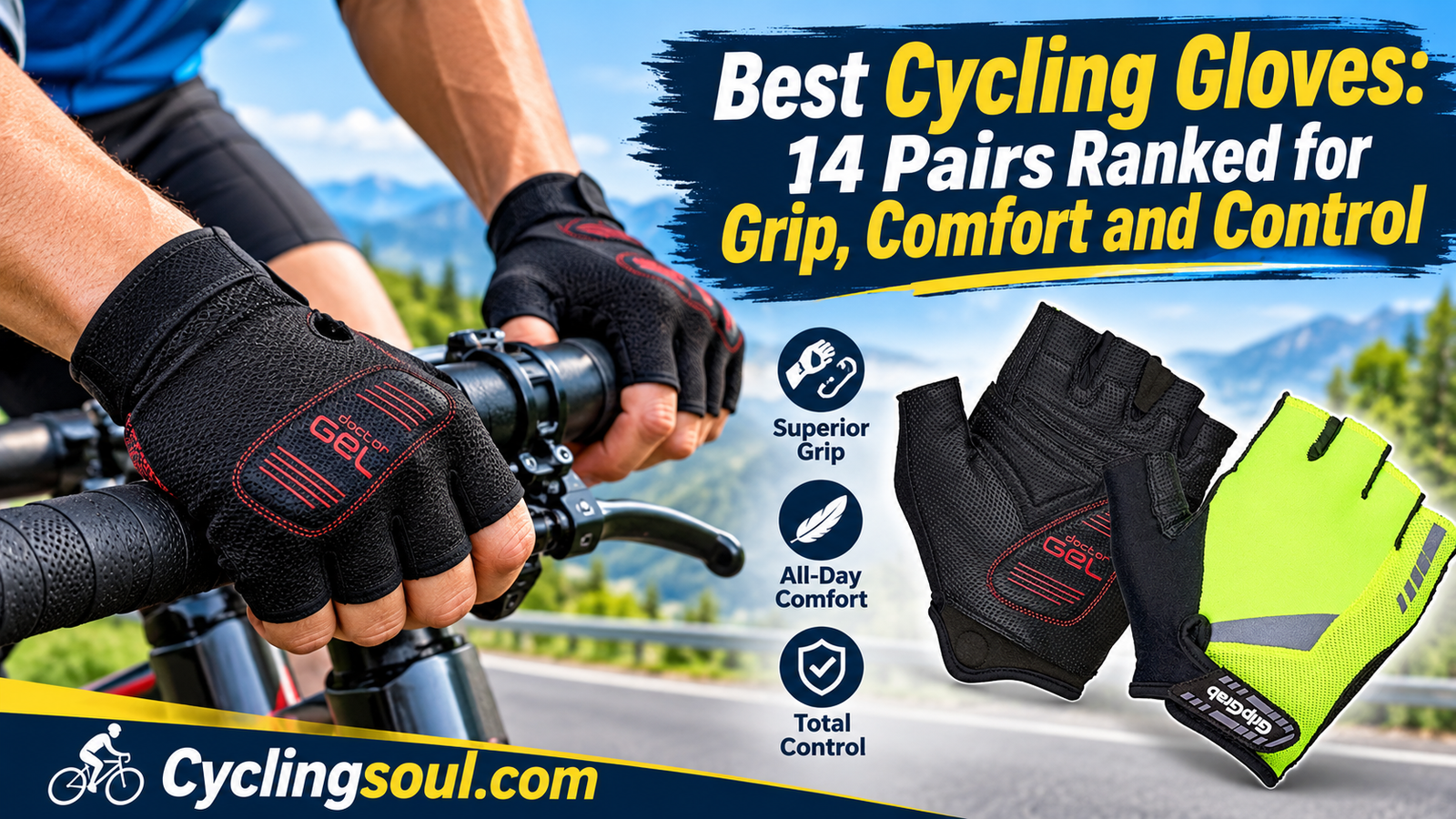
Best Cycling Gloves: 14 Pairs Ranked for Grip, Comfort and Control
From minimal summer gloves to cold-weather full-finger protection — how padding, fit and fabric actually affect your hands, and which pairs earn a place on your bars.
The Complete Guide
Cycling gloves are the most underrated piece of kit in the entire wardrobe. They’re small, inexpensive and easy to overlook — until the moment you really need them. On a long ride they’re the difference between arriving with comfortable hands and arriving with fingers you can’t feel. In a crash they’re the layer that takes the first, worst impact against tarmac. And on every single ride, they’re what sits between your control of the bike and everything the road throws at it.
Yet most riders buy gloves almost as an afterthought — usually the first pair they see, often sized wrong, almost always chosen for how they look rather than how they work. That’s a shame, because the right glove is genuinely transformative. Your hands stop aching halfway through a descent. Your grip stays confident when the bars get sweaty. Your fingers keep working when the temperature drops. And when you need to steady the bike on a loose surface or brace in a fall, you’ve got protection in exactly the right place.
The market is crowded, though. Gel padding, foam padding, gel-and-foam combinations, silicone grip, microsuede palms, mesh backs, reflective details, touchscreen fingertips, windproof membranes, fleece linings — the vocabulary is enormous and the claims all sound similar. What separates a glove that solves your problem from one that just adds a layer is a handful of design decisions: how much padding sits where, how the palm material grips when wet, how the fabric breathes, and how the whole thing fits your hand.
That’s exactly what this guide covers. We start with the fundamentals — padding, fit, fabric and finger length — then apply them to fourteen popular pairs spanning summer fingerless gloves, everyday value options, performance grip-focused designs and a proper winter glove. Whether you’re buying your first pair of gloves or replacing a worn-out favourite, the framework below will save you money and sore hands.
Why bother getting it right? Because comfortable hands change how much you ride. Cycling is one of the kindest forms of exercise available — see our guide to why cycling is good for you — and it’s remarkably adaptable to any starting point. If you’re new to it all, our guide on how to start cycling gets you rolling safely, and good gloves are one of the first things worth owning. Let’s get into it.
Quick Comparison: Our Top Picks
All fourteen gloves in this guide, side by side. The ranking reflects how well each pair delivers on grip, padding, comfort and durability for the rider it’s designed for — not how expensive it is. Every product links to its exact listing.
| # | Image | Product | Key Specs | Verdict | Check Price |
|---|---|---|---|---|---|
| 1Top Pick |  |
GripGrab ProGel 4mm DoctorGel Short Finger GlovesBest Overall |
|
Ergonomic padding that solves real hand problems. | Check Price on Amazon |
| 2 |  |
Castelli Arenberg Gel 2 Cycling GlovesBest for Long Rides |
|
Named after rough roads — built for hours in the saddle. | Check Price on Amazon |
| 3 |  |
Giro Bravo Gel GlovesBest All-Round Comfort |
|
The dependable, comfortable choice that suits almost everyone. | Check Price on Amazon |
| 4 |  |
DUEECO Cycling GlovesBest Impact Protection |
|
Serious palm protection without bulk or restriction. | Check Price on Amazon |
| 5 |  |
MOREOK 5MM Gel Cycling GlovesBest Budget |
|
Generous padding and phone-friendly at a tiny price. | Check Price on Amazon |
| 6 |  |
LuxoBike Cycling GlovesBest Value Comfort |
|
Soft palm, solid cushioning, excellent everyday value. | Check Price on Amazon |
| 7 |  |
POC Agile Short GlovesBest Minimalist |
|
Direct bar feel for riders who want to stay connected. | Check Price on Amazon |
| 8 |  |
INBIKE 5mm Padded Half Finger GlovesBest for Visibility |
|
Comfort plus extra presence when the light fades. | Check Price on Amazon |
| 9 |  |
Souke Sports Half Finger Cycling GlovesBest Grip |
|
Confident bar hold even when your hands are sweating. | Check Price on Amazon |
| 10 |  |
HTZPLOO Half-Finger Cycling GlovesBest Anti-Slip Value |
|
Budget-friendly grip that handles sweaty summer bars. | Check Price on Amazon |
| 11 |  |
GEZVOC Cycling GlovesBest for Sweat |
|
Wipe your brow without reaching for a jersey sleeve. | Check Price on Amazon |
| 12 |  |
ATERCEL Cycling GlovesBest Breathable Everyday |
|
Cool, light and easy to live with on warm rides. | Check Price on Amazon |
| 13 |  |
Tanluhu Cycling GlovesBest First Pair |
|
Everything a beginner needs, nothing they don’t. | Check Price on Amazon |
| 14 |  |
ROCKBROS Winter Cycling GlovesBest Winter Glove |
|
The cold-morning glove that keeps you riding all winter. | Check Price on Amazon |
Ready to protect your hands?
Compare fit notes and current prices across the range.
Check Cycling Gloves on AmazonHow to Choose Cycling Gloves
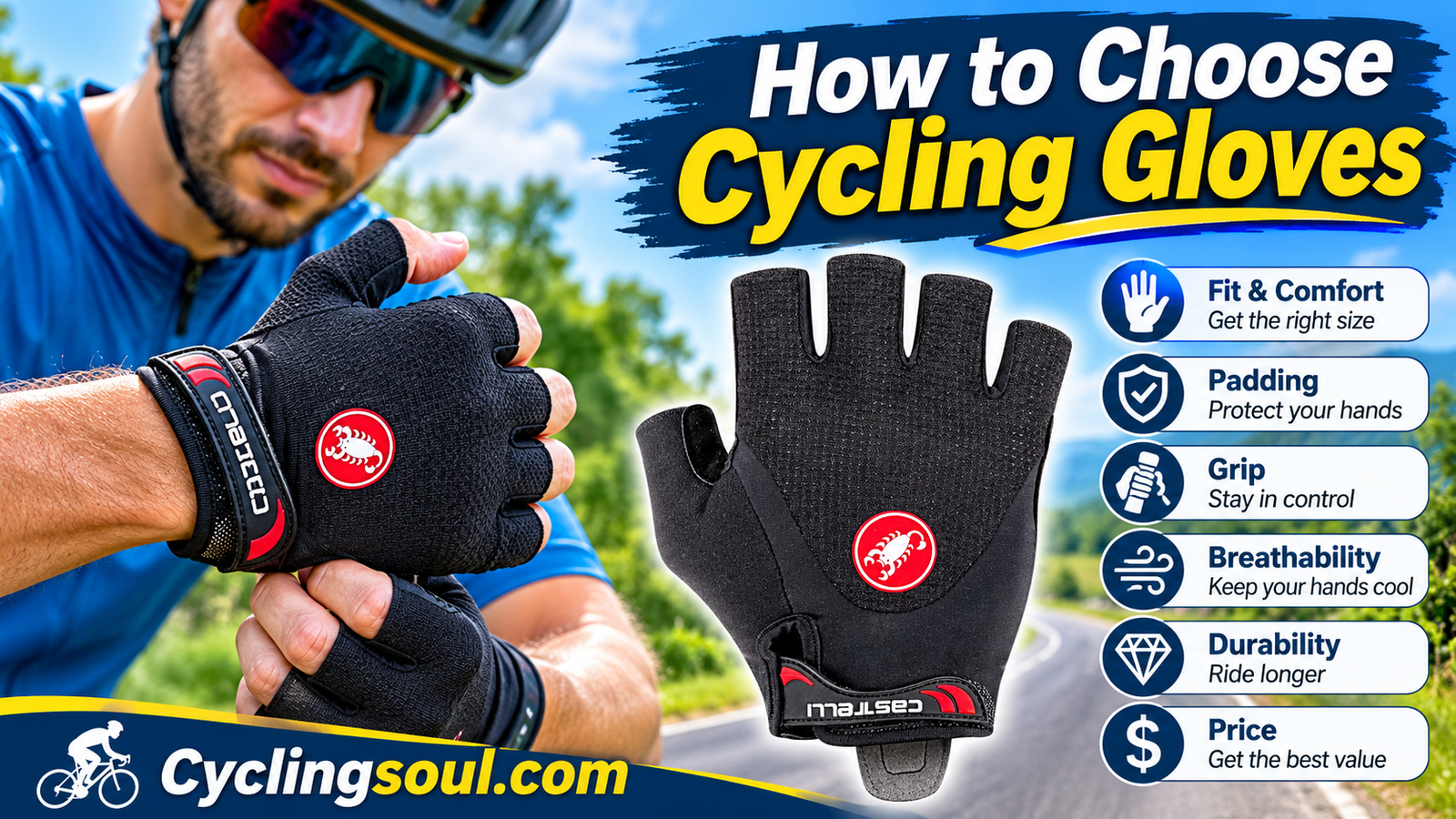
Choosing gloves is simpler than the marketing suggests, because there are only four decisions that matter: how much padding you need, where that padding sits, how the glove fits, and which finger length suits your riding. Get those right and everything else — colour, branding, extra features — becomes optional.
Start with the problem you’re solving
Gloves solve different problems for different riders, so the first question isn’t “which glove is best” but “what do I want these gloves to fix?” If your hands ache after long rides, padding and palm placement are your priority. If your grip slips on sweaty summer bars, the palm material and ventilation matter more than cushioning. If your fingers go numb in the cold, you need insulation and wind protection, not more gel. And if you simply want protection in a fall, impact-absorbing materials and durable palms are what to look for.
Being specific here saves money. A rider with cold fingers doesn’t need a heavily padded summer glove, and a rider chasing direct bar feel doesn’t need a thick gel palm. Matching the glove to the problem is the single most effective thing you can do.
The four checks that separate good gloves from great ones
- Padding that matches your needs. Enough cushioning for your ride length and bar position — no more. Excess bulk reduces grip and bar feel.
- A palm that grips when wet. Sweat and rain are the real test. Look for textured or silicone-treated palms, not smooth fabric.
- A fit that’s snug without restricting. No bunching in the palm, no tightness across the knuckles, no loose material at the fingertips.
- Construction that holds up. Reinforced palm zones, quality stitching at the fingers and a closure that doesn’t stretch out.
Where to spend and where to save
Spend on fit and palm quality. Those two things determine whether a glove helps or hinders, and they’re the hardest parts to get right. Save on features you won’t use — touchscreen tips are useless if you never touch a screen with gloves on, and extra padding is wasted weight if you ride short distances. A well-cut, well-palmed mid-price glove will outperform a poorly fitted premium one every time.
Gloves also work as part of a system. Your grip on the bars depends on your hands, your bar tape and your shoes’ connection to the pedals — and a properly fitted bike helps enormously. If you’re still shopping, our guide on how to choose a road bike covers the fit fundamentals. The rest of the wardrobe matters too: see our guide to what to wear cycling for how it all layers together.
A quick buying checklist
Padding matched to ride length · textured palm that grips wet · snug fit with no palm bunching · reinforced wear zones · closure that holds · finger length suited to your weather.
Compare gloves at every price
Filter by padding, finger length and palm type.
Shop Cycling Gloves on AmazonPadding Types and Placement
Padding is the headline feature in almost every glove listing, and the one most riders misunderstand. More padding is not automatically better — in the wrong place or the wrong thickness, it actively makes riding worse. Here’s how it actually works.
What padding does
Your hands carry a meaningful share of your upper body weight through the bars, and that weight travels through a specific set of structures: the ulnar nerve and the carpal tunnel, running along the outside and centre of the palm. Padding spreads that pressure over a larger area, dampens vibration from rough surfaces and reduces the constant micro-shock that accumulates over long rides. It’s why hands feel fine after an hour and wrecked after four.
The main padding materials
- Foam padding. Light, simple and effective at basic cushioning. Great for shorter rides and riders who don’t want to lose bar feel. It compresses over time and offers less vibration damping than gel.
- Gel padding. The standard for long-distance comfort. Gel conforms more precisely to the shape of your palm and dampens vibration better than foam, which is why endurance-focused gloves lean on it.
- Hybrid gel-and-foam constructions. Combine the conforming comfort of gel with the structure and lightness of foam — increasingly the sweet spot for all-round riding.
- Impact-absorbing materials. Specialised foams that stiffen under sudden impact to absorb shock, then remain soft and flexible in normal use. The DUEECO pair in this guide uses exactly this kind of XRD padding, and it’s the right choice for riders who value crash protection alongside comfort.
Placement matters more than thickness
A good glove puts cushioning under the heel of the hand and along the outer edge where the ulnar nerve runs — the two zones that take real pressure on drop bars and flat bars alike. What it avoids is padding in the middle of the palm, right where your fingers grip. Too much material there pushes your hand away from the bar, weakens your grip and forces your fingers to work harder. This is the most common flaw in cheap “extra thick” gloves.
Bar position changes what you need. Riders on drop bars spend long stretches on the hoods and in the drops, loading the outer palm; riders flat bars distribute pressure differently again. If you’re unsure, look for gloves with multi-zone padding that follows the natural contact points rather than one uniform slab.
Thickness, and when less is more
Padding thickness is a trade-off between cushioning and bar feel. Thick pads feel plush on a rough road but mute the feedback that tells you what the front wheel is doing. Minimal pads give you control and precision but punish you over long distances. Match thickness to your rides: short and punchy favours thin; long and steady favours more.
The quick palm test
Put the gloves on and grip your bars in your normal position. If you can feel the bar shape through the padding and your fingers close comfortably around the tape, the padding is right. If your grip feels stretched open or vague, the pad is too thick or badly placed.
Padding also interacts with everything else about your contact points. A bike that fits well spreads your weight more evenly, which is why riders chasing comfort should look at the whole picture — our guide on how long it takes to get used to a bike seat covers the rest of that equation.
Shop gloves by padding type
Compare gel, foam and impact-absorbing designs.
See Padded Gloves on AmazonFit and Sizing Guide
Fit is where most glove purchases go wrong. Gloves that are too big bunch in the palm and let the padding slide out of position; gloves that are too small pull across the knuckles and cut into your fingers when you grip. Either way, you lose exactly what the glove was supposed to give you.
How a glove should feel
Snug but not tight. The palm should sit flat against your skin with no excess material to fold up under your grip. The fingers should reach the end of the glove without being compressed — a small amount of fingertip length is fine, a lot means the glove is too big. Across the knuckles there should be no resistance when you close your hand around a bar. And the closure should hold the glove comfortably in place without a tight band around the wrist.
How to measure for cycling gloves
- Measure your palm circumference around the widest part of your hand, just below the knuckles, with your fingers relaxed and hand flat.
- Measure your hand length from the base of the palm at the wrist to the tip of your middle finger.
- Compare both numbers against the brand’s own sizing chart. Glove sizing varies noticeably between brands and is rarely the same as your street-glove size.
- Check the finger length in reviews and product photos. Short-finger gloves are measured differently from full-finger gloves, and hand shape matters more than chest-and-waist style sizing.
The four fit failure points
- Palm bunching. Fabric folds under the grip and creates pressure points — usually a sign the glove is too large.
- Knuckle tightness. The glove resists when you close your hand — too small, or cut too shallow for your hand shape.
- Padding migration. The gel or foam shifts during the ride, which means the glove isn’t anchored properly at the wrist.
- Fingertip dead space. Excess material at the tips catches on brake levers and reduces feel.
Fit changes with the season
Cold-weather gloves need room for a thin liner or simply for the fact that hands swell slightly in the cold; a winter glove that fits like a summer glove will feel constricting. Conversely, summer gloves should fit close because there’s nothing between your skin and the palm. If you ride year-round, expect to own at least two pairs rather than forcing one to do everything.
Good fit also keeps you riding more, which is where the real gains come from. Comfortable hands mean longer rides and more consistent weeks — the foundation of any improvement plan, whether you’re building fitness or following structured training. And if you’re putting together a full kit, gloves pair naturally with properly fitted cycling shoes and technical cycling socks, both of which change how the whole ride feels.
Between sizes?
For short-finger gloves, size for a close fit at the palm and accept slightly longer fingers. For winter gloves, size up slightly to allow for insulation and hand swelling in the cold.
Find your size across brands
Compare fit notes and size charts before you order.
Browse Cycling Gloves on AmazonFabric and Breathability
Gloves are a small garment doing a big job. They have to breathe in heat, block wind in cold, manage sweat constantly and still let you feel the bars — all through a handful of carefully chosen materials. Understanding the fabrics makes choosing much easier.
Palm materials: where grip lives
- Synthetic leather and microsuede. The standard for performance palms. They grip well when dry, feel smooth against the bar and can be treated or textured for wet-weather hold. Microsuede in particular gives a soft, confident grip.
- Silicone-treated palms and grip prints. Silicone patterns dramatically improve hold when your hands are sweaty or it’s raining. If you ride hard in summer, this is the single most useful palm feature.
- Perforated palms. Small holes that let heat and sweat escape. Excellent in warmth, slightly less weather-resistant in the wet.
Back-of-hand materials
The back of the glove controls temperature and comfort. Mesh and open knits maximise airflow and are the right choice for warm riding. Stretchy knits and Lycra-style fabrics give a close, aerodynamic fit that feels like a second skin. Windproof and membrane-backed fabrics block cold air and are essential for winter gloves. Fleece linings add insulation for genuinely cold conditions.
Moisture management
Sweaty hands are a grip problem as much as a comfort problem. A glove that wicks sweat away from the skin keeps your hand drier and the palm more secure. Towel-cloth or absorbent thumb panels — like the design on the GEZVOC pair below — exist for exactly this, giving you somewhere to wipe your brow or glasses mid-ride without fumbling for a sleeve.
Details worth paying for
- Reinforced palm zones where the bar wear concentrates.
- Soft, wide closures that hold without digging into the wrist.
- Seam placement away from the palm — seams in the grip zone create pressure points.
- Reflective details for riders out in low light; pair them with proper lighting for real safety.
- Odour-resistant treatments that help between washes, though they never replace proper washing.
Breathability is the trade-off that matters most in a single glove. The more open and ventilated a glove is, the less weather protection it offers; the more protective, the warmer it runs. This is why most experienced riders end up owning at least two pairs — a summer glove and a winter glove — rather than searching for one that compromises on both. The same logic runs through the whole wardrobe; our guide to the best cycling jerseys covers how upper-body layers work alongside.
The sweat test
Wear the gloves for a hard, warm ride and check the palm afterwards. If the inside is soaked and the palm feels slippery, the glove lacks both ventilation and moisture management — and your grip will pay for it.
Shop breathable, grippy gloves
Look for mesh backs and textured palm materials.
Check Fabric Options on AmazonFull-Finger vs. Fingerless Gloves
It’s the first decision every rider makes, and it’s mostly about weather, discipline and what you value most. Here’s how the two styles actually compare.
| Feature | Fingerless (Short Finger) | Full Finger |
|---|---|---|
| Bar feel | Excellent — bare fingertips on levers and shifters. | Good, but slightly muted through the material. |
| Temperature range | Best for warm and mild conditions. | Cool, cold and changeable weather. |
| Protection | Palm and heel of hand only. | Palm plus full finger and knuckle coverage. |
| Grip in the wet | Fingertip grip depends on dry conditions. | Continuous grip material across the whole hand. |
| Everyday tasks | Easier for keys, zips and small items. | More fiddly without touchscreen tips. |
| Best for | Summer riding, road, commuting in warmth. | Winter, gravel, mountain biking, rough conditions. |
When fingerless is the right call
Short-finger gloves dominate summer riding for good reason. They keep your palms protected and cushioned where the pressure is while leaving fingertips free for shifters, brake levers, computers and phones. If you ride mostly in warm conditions and value tactile control, fingerless is the answer. The pairs from GripGrab, POC, Souke and HTZPLOO below all follow this philosophy with different balances of padding and grip.
When full finger wins
Cold hands are the obvious case — you simply lose dexterity and comfort when the temperature drops, and a proper full-finger glove solves it. But full-finger gloves also earn their place in warm weather on gravel, trails and anywhere the surface is rough or loose. Finger skin is the first thing to get shredded in a fall onto grit, and covering it is cheap insurance. Mountain bikers rarely ride without full-finger gloves for exactly this reason.
The middle ground
Many riders own both: fingerless for warm road days, full-finger for cold mornings and rough surfaces. That two-pair approach costs about the same as one premium glove and covers far more conditions. If you ride in low light as well, add visibility — reflective glove details help, but proper lights matter more. See our guide to the best bike lights for what actually keeps you seen.
And for warm-weather riding in particular, the wider kit question matters. Sunglasses protect eyes from glare, wind and debris while your hands stay busy on the bars — our pick of the best cycling sunglasses covers that side of the equation.
Compare fingerless and full-finger gloves
See both styles in one search before you decide.
Compare Cycling Glove StylesTouchscreen Compatibility
Almost every modern glove listing mentions touchscreen compatibility, and almost nobody explains what it actually means in practice. Here’s the honest version.
How touchscreen gloves work
Capacitive touchscreens respond to the electrical conductivity of your skin. Ordinary glove fabric is an insulator, so tapping a screen does nothing. Touchscreen-compatible gloves use conductive material — usually at the tip of the index finger and thumb — that transfers your body’s capacitance to the screen, letting it register a tap.
The variation is enormous. Some gloves register every tap accurately through the whole fingertip; others require precise pressure on a small conductive patch, work only when the screen is clean and dry, and stop functioning entirely when the material wears. Treat touchscreen capability as a convenience feature, not a reason to buy one glove over another.
What actually works well
- Large conductive areas covering the whole fingertip rather than a small dot.
- Thin fingertip material — the more fabric between the conductive thread and the screen, the worse the response.
- Both index finger and thumb treated, so you can swipe as well as tap.
- Short-finger designs that sidestep the problem entirely by leaving fingertips bare.
Practical tips for using a phone in gloves
Keep the screen clean — a greasy or wet screen defeats even the best conductive material. Press with the flat of the fingertip rather than the very tip. Calibrate expectations for navigation: pinch-to-zoom and fine scrolling are where gloves struggle most, which is why many riders set up their route before setting off. If you rely heavily on a head unit or phone on the bike, a handlebar mount means fewer mid-ride taps altogether.
And the reason you need to interact with food and navigation mid-ride is usually that you’re out for a while — which means fuelling matters as much as gadgets. Our guide to the best energy gels for cycling covers what to carry and when to use it.
A reality check on touchscreen claims
Touchscreen performance degrades as conductive material wears and as gloves get damp. If reliable phone use is critical, fingerless gloves or a voice-activated setup will always beat conductive fingertips.
Shop touchscreen cycling gloves
Compare conductive fingertip designs across styles.
Check Touchscreen Gloves on AmazonBest Summer and Fingerless Gloves
Warm-weather gloves have one job: protect the palm without turning your hands into ovens. These four do it with different balances of padding, grip and ventilation.
| # | Image | Product | Key Specs | Check Price |
|---|---|---|---|---|
| 1 | |
GripGrab ProGel DoctorGelBest Overall |
|
Check Price |
| 2 | |
INBIKE 5mm Padded Half FingerBest for Visibility |
|
Check Price |
| 3 | |
POC Agile Short GlovesBest Minimalist |
|
Check Price |
| 4 | |
Tanluhu Cycling GlovesBest First Pair |
|
Check Price |
GripGrab ProGel 4mm DoctorGel Padded Short Finger Summer Cycling Gloves
Padding designed with anatomy in mind — and you feel it from the first ride.
Most gloves treat padding as a comfort feature. GripGrab treats it as an ergonomic one. The DoctorGel construction in these short-finger gloves is shaped around the pressure points that actually cause problems — the ulnar nerve and the heel of the hand — and the 4mm cushioning is deliberately moderate, keeping your grip close to the bar while absorbing the vibration that wears hands down over long days.
What you notice is how quickly the gloves disappear. The palm feels confident rather than spongy, the fingers leave your fingertips free for levers and computers, and the whole glove stays put without any of the bunching or migration that ruins cheaper designs. For riders who’ve struggled with hand discomfort on longer rides, this is the pair that changes things.
Key Features
- DoctorGel padding positioned to relieve pressure on key nerve paths
- Moderate 4mm cushioning that protects without killing bar feel
- Short-finger design keeping fingertips free for levers and devices
- Comfort-focused palm construction that stays secure in place
Pros
- Genuinely effective pressure relief on long rides
- Maintains confident grip and bar feedback
- Thoughtful, well-executed construction
Cons
- Short-finger only — no cold-weather coverage
- Comfort-focused design, not ultra-minimal
Who it’s best for: Riders who spend hours on the bars and want real, ergonomic relief rather than just a thicker pad.
INBIKE 5mm Padded Half Finger Cycling Gloves (Reflective)
Comfort and cushioning, with a little extra presence in fading light.
Plenty of riders set off in sunshine and finish in dusk, especially on longer weekend days. The INBIKE half-finger gloves address that reality with reflective details alongside a properly padded 5mm palm — so you get genuine cushioning for the ride and a bit more visibility when the light starts to go.
The padding is generous enough for longer outings while still leaving your fingertips free, and the half-finger cut keeps things cool in warm conditions. It’s a practical, well-thought-out combination for riders whose days start early or finish late.
Key Features
- 5mm padded palm for cushioning on longer rides
- Reflective details to improve low-light presence
- Half-finger design for warm-weather comfort
- Practical construction suited to regular riding
Pros
- Comfortable padding for mid-to-long rides
- Reflective touches add confidence at dusk
- Good all-round value
Cons
- Reflective details supplement — not replace — lights
- Thicker padding suits comfort over minimal feel
Who it’s best for: Riders who ride in changing light and want extra visibility built into a comfortable glove.
POC Agile Short Gloves (Minimal Padding, Short Finger)
For riders who want protection without losing the feeling of the bars.
Some riders hate thick padding. They want to feel exactly what the front wheel is doing, they want their fingers close to the tape, and they’d rather ride with light protection than a cushioned barrier. The POC Agile is built for that preference: minimal padding, a short-finger cut and a clean, uncluttered construction that prioritises direct contact.
That doesn’t mean it’s basic. The materials are well chosen, the fit is precise, and there’s still enough palm protection to make a difference in a slide. It’s a confident, understated glove for riders who value feel and simplicity over plushness.
Key Features
- Minimal padding that preserves bar feel and control
- Short-finger design for direct lever and shifter feel
- Clean, simple construction with no unnecessary bulk
- Light protection for palm and heel of hand
Pros
- Superb direct bar feedback
- Light and unobtrusive on hot days
- Understated design that works with any kit
Cons
- Less cushioning on very long, rough rides
- Minimal padding suits experienced riders best
Who it’s best for: Riders who prioritise feel and precision over maximum cushioning.
Tanluhu Cycling Gloves (Breathable Mesh and Padding)
A sensible, comfortable first pair that covers all the basics properly.
If you’ve never worn cycling gloves before, there’s no need to start with the most technical option on the market. The Tanluhu gloves do the essential job well: a breathable mesh back that keeps hands cool, palm padding that takes the sting out of the bars and a straightforward design that’s easy to live with.
They’re a particularly good choice for newer riders, commuters and anyone building out a kit for the first time. Comfort is immediate, the build is practical, and they’ll teach you exactly what you want from your next pair — which is the most valuable thing a first glove can do.
Key Features
- Breathable mesh back for cool, comfortable hands
- Palm padding to cushion bar pressure
- Simple, practical construction that’s easy to care for
- Versatile design suited to road and general riding
Pros
- Comfortable straight out of the package
- Cool and breathable in warm weather
- Accessible way to try cycling gloves
Cons
- Less technical than performance options
- Padding is moderate — not for very long rough rides
Who it’s best for: Newer riders, commuters and anyone buying their first pair of cycling gloves.
Best Value and Everyday Gloves
Not every glove needs to be a statement. These four deliver comfort, grip and durability at prices that make owning two or three pairs realistic — which, as we’ll see later, is exactly what most riders should do.
| # | Image | Product | Key Specs | Check Price |
|---|---|---|---|---|
| 1 | |
MOREOK 5MM Gel GlovesBest Budget |
|
Check Price |
| 2 | |
LuxoBike Cycling GlovesBest Value Comfort |
|
Check Price |
| 3 | |
Souke Sports Half FingerBest Grip |
|
Check Price |
| 4 | |
ATERCEL Cycling GlovesBest Breathable |
|
Check Price |
MOREOK 5MM Gel Cycling Gloves (Half Finger, Touchscreen)
Generous gel cushioning and phone-friendly fingertips for very little money.
It’s remarkable what a small budget gets you these days. The MOREOK half-finger gloves come with 5mm of gel padding across the palm — the kind of cushioning that makes a genuine difference on a two-hour ride — plus touchscreen-compatible fingertips so you can handle your phone without pulling gloves off mid-climb.
The half-finger cut keeps things cool and light, and the overall build is straightforward and comfortable. For riders buying gloves for a second bike, a travel bag or simply as a sensible spare, these are hard to argue with.
Key Features
- 5mm gel padding for substantial palm cushioning
- Touchscreen-compatible fingertips for phone use on the go
- Half-finger design for warm-weather comfort
- Light, comfortable construction for everyday riding
Pros
- Excellent padding for the price
- Useful touchscreen capability
- Great for building a multi-pair rotation
Cons
- Touchscreen response varies with wear
- Less refined fit than premium options
Who it’s best for: Budget-conscious riders who want real gel cushioning and phone-friendly gloves.
LuxoBike Cycling Gloves (SBR Gel Pad, Microsuede Palm)
A soft, grippy palm and genuine cushioning at a very sensible price.
Microsuede palms are one of those small upgrades you appreciate immediately. They feel soft against the bar, grip confidently and stay comfortable through long rides — and pairing that with SBR gel cushioning is exactly the combination that makes the LuxoBike gloves such good value.
The fit is secure without feeling restrictive, and the whole glove has an easy, comfortable character that makes it ideal for riders who want something pleasant to wear rather than something technically imposing. It’s a glove that simply works, day after day.
Key Features
- SBR gel padding for effective pressure relief
- Microsuede palm for soft, confident grip
- Secure, comfortable fit that holds position
- Durable construction suited to regular use
Pros
- Soft, high-quality palm feel
- Genuine comfort on longer rides
- Strong quality-to-price ratio
Cons
- Comfort-focused rather than minimal
- Basic feature set without extras
Who it’s best for: Riders who want a soft, comfortable everyday glove without spending premium money.
Souke Sports Half Finger Cycling Gloves (5mm Foam Padding, Anti-Slip Gel Palm)
Confident bar hold even when your hands are pouring with sweat.
Grip is the one thing you can never have too much of. The Souke Sports gloves lead with an anti-slip gel palm that keeps your hands locked in place through hot climbs, humid days and the kind of effort that leaves your palms slick. Combined with 5mm of foam padding, you get both security and cushioning.
The half-finger cut keeps the glove light and cool, and the overall construction feels solid for regular riding. If you’ve ever had a hand slip on a sweaty descent, these are designed to end that problem.
Key Features
- Anti-slip gel palm for confident hold in hot, sweaty conditions
- 5mm foam padding for effective bar cushioning
- Half-finger design for lightweight, cool comfort
- Solid construction suited to frequent riding
Pros
- Excellent grip when hands are wet
- Comfortable padding for mid-length rides
- Cool and light in warm weather
Cons
- Designed for warm conditions only
- Pad is comfort-focused, not minimal
Who it’s best for: Riders in hot climates and anyone whose grip suffers from sweaty hands.
ATERCEL Cycling Gloves (Half Finger)
Cool, light and refreshingly easy to live with on warm days.
Some gloves try to do everything; the ATERCEL gloves know exactly what they are. They’re light, breathable half-finger gloves built for comfortable everyday riding in warmth — nothing fussy, nothing over-engineered, just a pleasant glove that keeps your hands cool and your palms protected.
That simplicity makes them excellent for commuting, casual rides and anyone who dislikes bulky kit. They pack small, wash easily and feel comfortable from the first ride, which is more than enough for a huge number of riders.
Key Features
- Breathable construction that keeps hands cool in warmth
- Half-finger design for light, unrestricted feel
- Comfortable everyday fit that’s easy to wear
- Practical construction that washes and dries easily
Pros
- Excellent ventilation on hot rides
- Light and unobtrusive
- Easy to care for and quick to dry
Cons
- Light build suits fair-weather riding
- Basic, no-frills feature set
Who it’s best for: Commuters, casual riders and anyone who wants a light, cool glove for warm weather.
Best Performance and Grip-Focused Gloves
These five are for riders who notice the details — the feel of the palm material, the precision of the fit, the way padding protects without muting feedback. Whether that’s long-distance comfort, impact protection or wet-weather grip, there’s a specialist here.
| # | Image | Product | Key Specs | Check Price |
|---|---|---|---|---|
| 1 | |
Castelli Arenberg Gel 2Best for Long Rides |
|
Check Price |
| 2 | |
Giro Bravo Gel GlovesBest All-Round |
|
Check Price |
| 3 | |
DUEECO Cycling GlovesBest Impact Protection |
|
Check Price |
| 4 | |
GEZVOC Cycling GlovesBest for Sweat |
|
Check Price |
| 5 | |
HTZPLOO Half-Finger GlovesBest Anti-Slip Value |
|
Check Price |
Castelli Arenberg Gel 2 Cycling Gloves
Named after rough roads — and built for hours spent on them.
The Arenberg name is borrowed from one of the most brutal cobbled sectors in professional racing, and it sets expectations perfectly. These are gloves designed around the reality of long days on imperfect surfaces, with gel palm padding that dampens vibration rather than simply sitting between you and the bar.
What stands out is the refinement. The fit is precise and performance-oriented, the materials feel considered rather than merely adequate, and the palm strikes that difficult balance between cushioning and feedback. For riders who measure their weekends in hours rather than kilometres, this is the kind of glove that earns its keep.
Key Features
- Gel palm padding tuned for vibration damping on rough surfaces
- Performance-informed fit that stays composed over long rides
- Quality construction built for sustained use
- Balanced cushioning that preserves bar feel
Pros
- Excellent comfort over long distances
- Precise, confident fit
- Refined materials and finishing
Cons
- Performance fit demands accurate sizing
- Priced above everyday options
Who it’s best for: Endurance riders and anyone tackling rough roads who wants real vibration protection.
Giro Bravo Gel Gloves
The dependable, comfortable choice that suits almost everyone.
Every category has a pair that simply works for most people, and in cycling gloves that’s the Giro Bravo Gel. It takes a balanced approach — gel padding positioned where pressure builds, a breathable back for comfort in varied conditions and a secure closure that holds without pinching — and executes all of it well.
There’s nothing flashy here, and that’s the point. It’s comfortable from the first ride, easy to size and reliable enough that many riders buy the same pair again when theirs wear out. If you don’t have a specific problem to solve and just want a genuinely good glove, start here.
Key Features
- Gel padding zones placed at natural pressure points
- Breathable back for comfort across varied conditions
- Secure closure that holds comfortably at the wrist
- Balanced design suited to road and general riding
Pros
- Genuinely comfortable for most riders
- Reliable, consistent quality
- Easy to choose and live with
Cons
- Not a specialist for extreme conditions
- Balanced design, not ultra-minimal
Who it’s best for: The majority of riders who want a comfortable, dependable glove without overthinking it.
DUEECO Cycling Gloves (XRD Impact-Absorbing Padding, Italian Mesh Back)
Serious palm protection that stays flexible until the moment it matters.
Most padding is designed to absorb the constant, low-level pressure of riding. XRD is different — it’s an impact-absorbing material that remains soft and flexible in normal use but stiffens momentarily under sudden impact, absorbing shock before it reaches your hand. That makes these gloves as much protective equipment as comfort equipment.
Pair that with an Italian mesh back that breathes properly and you have a glove that protects without turning your hands into sweatboxes. For gravel riders, commuters in traffic and anyone who simply wants insurance in a fall, the combination is compelling.
Key Features
- XRD impact-absorbing padding that responds to sudden shock
- Italian mesh back for excellent ventilation
- Protective palm construction for slide protection
- Flexible, comfortable feel in normal riding
Pros
- Genuine impact protection, not just cushioning
- Breathable enough for warm riding
- Comfortable and flexible on the bars
Cons
- Protective build is slightly more structured
- Impact features matter most for rough-terrain riders
Who it’s best for: Gravel riders, commuters and safety-conscious riders who want real impact absorption.
GEZVOC Cycling Gloves (Silicone Gel Grip, Towel Cloth Thumb)
Wipe your brow mid-climb without fumbling for a jersey sleeve.
It’s a tiny detail with a big effect: a soft towel-cloth panel on the thumb that lets you wipe sweat from your forehead, nose or glasses without breaking position or losing grip on the bars. Combined with a silicone gel palm that holds firm when your hands are slick, the GEZVOC gloves are built around exactly what hot riding demands.
The palm comfort is there too, and the overall build is straightforward and practical. For riders in warm climates, on hilly routes or simply anyone who runs hot, the sweat-management details make these a genuinely useful glove.
Key Features
- Silicone gel grip that holds firmly in sweaty conditions
- Towel-cloth thumb for wiping sweat and clearing eyewear
- Comfortable palm construction for regular riding
- Practical design suited to warm-weather efforts
Pros
- Excellent grip when hands are wet
- Towel thumb is genuinely useful on climbs
- Comfortable for everyday riding
Cons
- Warm-weather focused
- Simple feature set beyond the grip details
Who it’s best for: Riders who run hot, ride hills and want confident grip in sweaty conditions.
HTZPLOO Half-Finger Cycling Gloves (Anti-Slip Palm Padding)
Budget-friendly grip and cushioning that handles sweaty summer bars.
The HTZPLOO gloves hit the sweet spot that matters for most riders: anti-slip palm padding that keeps your hands secure, enough cushioning for comfortable riding and a light half-finger build that stays cool in the heat. They do all of it at a price that makes buying a spare pair entirely reasonable.
Nothing here is over-engineered. The grip is the headline, the comfort is solid and the build is light and breathable. For riders who want reliable summer gloves without a premium price tag, these deliver exactly what’s promised.
Key Features
- Anti-slip palm padding for confident grip in the heat
- Half-finger design for cool, light comfort
- Breathable construction suited to warm riding
- Practical, easy-care build for regular use
Pros
- Reliable grip in sweaty conditions
- Light and cool for summer riding
- Great value for a rotation pair
Cons
- Warm-weather use only
- Comfort-focused padding, not minimal
Who it’s best for: Riders wanting dependable summer grip and comfort at a sensible price.
Gloves like these come into their own when the rides get serious. If you’re building toward harder efforts and longer days, a structured approach makes the difference — see our guide on how to train for cycling.
Compare performance gloves
Find the grip and padding that match how you ride.
Shop Performance Gloves on AmazonBest Winter and Full-Finger Gloves
Cold hands end more rides than tired legs do. Once your fingers lose dexterity you lose braking control, shifting precision and the will to keep going — which is why a proper winter glove is the single most valuable upgrade for cold-weather riding.
ROCKBROS Winter Cycling Gloves (Fleece-Lined, Windproof, Full Finger)
The cold-morning glove that keeps you riding all the way through winter.
Winter gloves have to solve three problems at once: block wind, trap warmth and still let you operate brake levers and shifters accurately. The ROCKBROS winter gloves tackle it with a windproof outer shell and a fleece lining that holds heat where you need it, all in a full-finger design that covers everything the cold attacks.
What matters is that dexterity survives the insulation. You still get confident lever feel and enough grip to hold the bars securely in cold, greasy conditions — which is exactly what makes the difference between a miserable winter ride and an enjoyable one. If you’ve been skipping cold mornings because of your hands, this changes the calculus.
Key Features
- Fleece lining that traps warmth through genuinely cold rides
- Windproof construction that blocks the chill at speed
- Full-finger coverage for complete hand protection
- Construction that preserves lever feel and grip control
Pros
- Warmth that lasts through cold rides
- Wind protection makes a real difference at speed
- Full coverage for fingers and knuckles
Cons
- Bulkier than summer gloves by design
- Less breathable in mild conditions
Who it’s best for: Year-round riders and anyone whose cold hands have been limiting winter riding.
Winter riding is as much about visibility as warmth — the days are short and the light is poor, so gloves with reflective details earn their place alongside proper lighting. And cold-weather training tends to be more structured, which is where knowing your numbers helps; our explainer on what FTP is in cycling covers the metric most training plans are built around.
Shop cold-weather gloves
Compare fleece-lined, windproof and insulated designs.
Shop Winter Gloves on AmazonHow to Prevent Hand Numbness While Cycling
That tingling, dead-finger feeling on long rides is one of the most common complaints in cycling — and one of the most fixable. Numbness happens when sustained pressure compresses the nerves and blood vessels running through the palm, usually the ulnar nerve on the outside of the hand and the median nerve through the carpal tunnel. Here’s how to stop it.
Fix the bike first
Numbness is often a fit problem rather than a glove problem. If you’re reaching too far for the bars, too much weight lands on your hands. If your saddle is tilted forward, you slide and brace with your palms. If your handlebars are too low for your flexibility, you lock your arms and dump pressure straight into the heel of each hand. Adjusting reach, saddle angle and bar height frequently solves the issue before you spend anything.
Change how you hold the bars
- Move your hands regularly. Shift between hoods, tops and drops every few minutes. Changing position changes the pressure point.
- Keep a light grip. Most riders hold harder than necessary, especially on rough ground or descents. Relax the fingers; the bar isn’t going anywhere.
- Bend your elbows. Straight, locked arms transmit every bump directly into your palms. A slight bend lets your arms work as suspension.
- Rotate your wrists slightly. A natural, neutral wrist angle relieves the carpal tunnel; extreme angles compress it.
Let the gear help
Gloves with correctly placed padding spread pressure and damp vibration, which directly reduces nerve compression. So does good bar tape — thicker, denser tape cushions the contact point far more effectively than thin, worn wrap. Replace tape when it goes hard or smooth, and consider denser options if you ride rough surfaces regularly.
Hand position and weight distribution are also affected by how you sit. Riders still adapting to a new saddle often brace through their hands without realising it, which is why comfort at both contact points is connected. If that’s you, our guide on getting used to a bike seat and our tips on preventing saddle sores cover the rest.
Build up gradually
Numbness often appears only on rides longer than you normally do. Increasing distance progressively gives your hands and nerves time to adapt — the same principle behind all endurance training. And how you clip in matters more than riders expect: a clean, relaxed pedal stroke means less upper-body tension, which means lighter hands. See our guide on how to clip into pedals if that’s still new to you.
When to take it seriously
Occasional tingling that fades when you change position is normal. Numbness that persists after riding, weakness in the hand, or pain that wakes you at night is worth discussing with a medical professional — no glove replaces proper advice.
Find gloves that relieve pressure
Compare ergonomic padding and palm placement.
Shop Comfort Gloves on AmazonHow to Wash and Care for Cycling Gloves
Gloves work hard and get dirty fast. They absorb sweat, road spray and everything else your hands touch, which makes regular washing as much a hygiene issue as a longevity one. Fortunately, looking after them properly takes almost no time at all.
After every ride
- Turn them inside out. The inside collects the most sweat and salt — exactly where bacteria and odour build up.
- Rinse if you can’t wash straight away. A quick rinse removes most of the residue that degrades palm materials and elastic.
- Let them air before storing. Don’t seal damp gloves in a bag or pocket where odour has nowhere to go.
The washing routine
- Cold or lukewarm water, gentle cycle. Heat degrades elastic, gel and grip coatings.
- Mild detergent, no fabric softener. Softener coats technical fibres, ruins wicking and can make palm materials slippery.
- Use a mesh laundry bag. It protects closures and stops Velcro from snagging other garments.
- Wash with similar technical fabrics. Towels and denim produce lint and abrasion that shorten a glove’s life.
Drying: the part that matters most
Always air dry. Lay them flat or hang by the cuff in shade, away from direct heat and radiators. A tumble dryer is the fastest way to shrink, stiffen and crack palm materials — damage that can’t be reversed. If you ride frequently, two or three pairs rotated between washes always outlast one pair washed and hurriedly dried every night.
What never to do
- Don’t iron — it destroys elastic and grip prints.
- Don’t bleach or use harsh stain removers.
- Don’t dry clean.
- Don’t leave gloves baking in direct sunlight; UV degrades stretch fabrics and grip coatings.
Odour that won’t shift?
Soak the gloves in cold water with a specialist sports-fabric soak, then wash as normal. Hot water sets odour into fibres instead of removing it — resist the urge to “boil” the smell out.
The same principles apply across your wardrobe, and good habits genuinely extend kit life. Clean, well-cared-for kit also just rides better — and staying comfortable is what keeps you riding consistently, which is where the real health benefits come from. See our look at cycling as cardio for what regular riding does for your fitness.
Look after your kit properly
Find gentle sports detergents and mesh wash bags.
Shop Kit Care Products on AmazonFAQs
Do cycling gloves really make a difference?
Yes — and noticeably so. They spread pressure across the palm, damp vibration from rough surfaces, keep your grip secure when hands are sweaty and protect your skin in a fall. Riders who switch usually report more comfortable hands within a single ride.
Should cycling gloves be tight or loose?
Snug. The palm should sit flat with no bunching, the fingers shouldn’t be compressed and the glove shouldn’t shift when you grip. Loose gloves let padding migrate out of position and reduce control; tight gloves restrict circulation and make your fingers colder.
Are fingerless or full-finger gloves better?
Depends on conditions. Fingerless gloves suit warm weather and offer the best lever and device feel. Full-finger gloves win in cold, wet and rough conditions, and give better crash protection. Most riders eventually own a pair of each.
How thick should cycling glove padding be?
Match thickness to ride length and bar position. Short, punchy rides favour thin padding for bar feel; long rides favour more cushioning under the heel of the hand and outer palm. Padding in the middle of the palm weakens grip, so placement matters more than thickness.
Why do my hands go numb when cycling?
Usually sustained pressure on the nerves running through the palm, often made worse by locked elbows, a heavy grip or a poor bike fit. Change hand positions frequently, keep a light grip and ensure your reach and saddle angle aren’t dumping weight onto your hands.
Do I really need gloves for short rides?
It’s your call, but the value of gloves is highest when you don’t expect it. Even on a short commute, a fall or sudden braking puts your hands on the road first. Gloves also protect against blisters and improve grip in sweaty conditions.
Can I wash cycling gloves in a washing machine?
Yes — turn them inside out, use a cold gentle cycle with mild detergent and a mesh bag, then air dry. Never use fabric softener or a tumble dryer, both of which damage elastic, gel and grip coatings.
Do touchscreen cycling gloves actually work?
They work, with caveats. Gloves with large conductive areas over the whole fingertip perform best, while small conductive patches are unreliable, especially on wet or dirty screens. Performance also degrades as the material wears. Fingerless gloves sidestep the issue entirely.
How many pairs of cycling gloves should I own?
Two is a sensible minimum: one pair for warm weather and one for cold, ideally with a spare for washing rotation. Gloves are inexpensive compared with most cycling kit, and having a dry pair available is a genuine comfort upgrade.
Why do my gloves smell even after washing?
Because sweat and bacteria settle deep in the padding and fabric. Wash inside out after every sweaty ride, avoid fabric softener and air dry fully. Persistent odour usually means a specialist sports-fabric soak is needed before the next wash.
Should I wear gloves indoors on a turbo trainer?
Many riders do, because indoor riding produces more sweat with less airflow and no wind to dry your hands. Any comfortable glove works — just wash it promptly afterwards.
What else helps with comfort on the bike?
Gloves are one contact point of three. Correctly fitted shoes and quality socks change how your feet feel, and a saddle that suits your body changes everything above it. Our guides to cycling shoes and cycling socks cover those in detail.
Still deciding?
Browse gloves and compare options by padding and grip.
Browse Cycling Gloves on AmazonFinal Verdict: Which Cycling Gloves Should You Buy?
If you want one pair that covers most riding, the GripGrab ProGel DoctorGel is the easiest recommendation here — ergonomic padding that genuinely relieves pressure, a confident palm and a fit that disappears on the bars. For long days and rough roads, the Castelli Arenberg Gel 2 is purpose-built for exactly that, while the Giro Bravo Gel is the dependable all-rounder that suits almost everyone.
On a budget, the MOREOK 5MM Gel gives real cushioning and touchscreen tips for very little, and the Souke Sports pair is the one to pick if sweaty hands are your problem. Cold-weather riders should go straight to the ROCKBROS winter gloves, and anyone who values impact protection should look at the DUEECO design.
Whatever you choose, remember the fundamentals: padding matched to your ride length, a palm that grips when wet, a snug fit with no bunching, and finger length suited to your weather. Wash cold, air dry, and rotate at least two pairs. Do that and your hands stay comfortable, your grip stays confident and you ride more — which is the whole point.
Find your next pair of gloves
Compare prices across every option in this guide.
Check Cycling Gloves on AmazonYou May Also Like
More guides to help you ride further, faster and more comfortably.
Best Cycling Shorts
The strongest padded shorts for every budget, discipline and ride length.
Kit GuideBest Women’s Cycling Shorts
Women’s-specific fit, pad shape and comfort — explained properly.
ComparisonCycling vs Running
Calories, joint impact, fitness gains and convenience — which suits you?
TrainingHow Often Should You Cycle to Lose Weight?
Realistic weekly frequency and how to build a routine that sticks.
FitnessCycling for Weight Loss
A practical plan for using time in the saddle to reach your goals.
StrengthDoes Cycling Build Muscle?
Where cycling adds strength, where it doesn’t, and how to complement it.
StrengthDoes Cycling Build Glutes?
What hours in the saddle actually do for your backside.
NutritionHow Many Calories Does Cycling Burn?
Realistic numbers by ride type, intensity and duration.
FitnessDoes Cycling Burn Belly Fat?
What actually happens to body fat when you ride regularly.
Affiliate disclosure: some links in this article are affiliate links, meaning we may earn a commission if you make a purchase — at no extra cost to you. Product availability and details can change, so always confirm current specifications on the retailer’s page before ordering.