
Cycling sunglasses sit in that unusual category of equipment where the cheap option is not necessarily a bargain and the expensive option is not necessarily a status symbol. What you are buying is a piece of safety equipment that happens to look good: it keeps wind, grit, insects and UV out of your eyes while letting you read surface changes, potholes and trail obstacles early enough to react.
The difference between a proper cycling frame and a pair of everyday sunglasses is bigger than most riders expect. Cycling glasses are shaped around a head position that is tipped forward and moving at speed. They wrap further around the face to block wind from the sides, they use lens and frame materials that survive an impact rather than shattering, they ventilate deliberately so your body heat does not fog the lens on a climb, and they are built to sit comfortably under a helmet for hours rather than minutes.
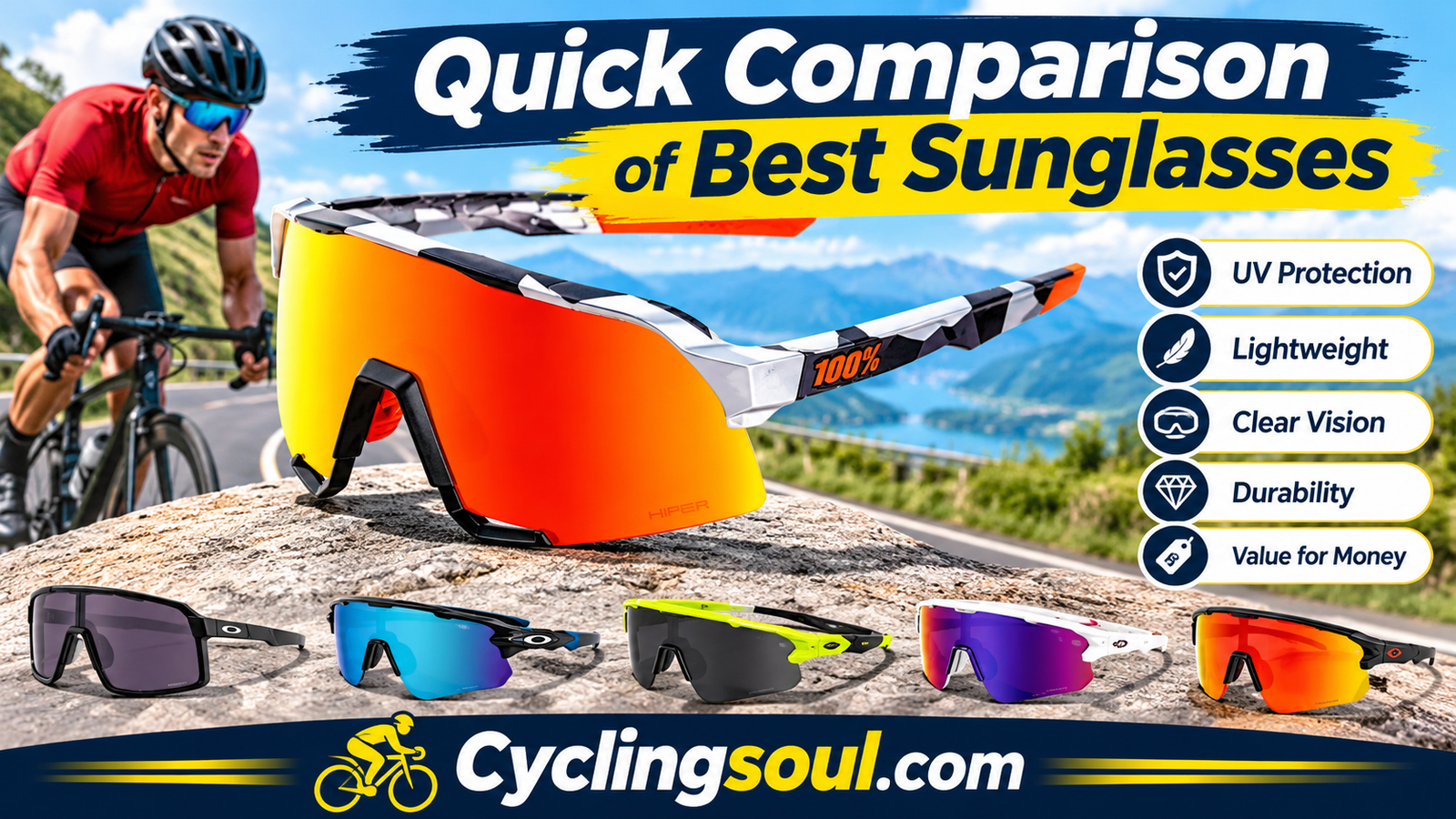
A well-chosen pair disappears on your face — that is the whole point.
Across this guide you will find fifteen pairs covering the whole market: value polarised options, lightweight all-day frames, race-focused shield glasses and trail-ready designs from specialists. Each one has its own review below with the features worth knowing, honest pros and cons, and a clear verdict on who should buy it. Around those reviews sits a complete buying guide covering lens types, tints, frame materials, fit, UV protection, fog management and care.
If you are building out your wider kit at the same time, our guides to the best cycling helmets and what to wear cycling are natural companion reads — eyewear, helmet and headwear all have to work together.
The Short Version
Choose your lens technology first, then your tint, then your fit. Polarised lenses cut glare from wet roads and car panels but can hide surface detail. Photochromic lenses adapt across changing light and are the best single-lens answer for mixed rides. Match coverage and ventilation to your discipline, and never skip UV protection.
01Quick Comparison: Our Top Picks
All fifteen pairs appear below with the details that separate them. Where a specification is not published in the product listing, we describe the characteristic in general terms rather than guessing at a number.
| # | Image | Product | Key Specs | Verdict | Check Price |
|---|---|---|---|---|---|
| Top Pick 1 |
 |
Oakley Radar EV PathBest Overall for Road Riding |
|
The benchmark race frame most riders should try first. | Check Price on Amazon |
| 2 | |
Oakley OO9406 SutroBest Bold-Look Shield |
|
Big lens, big coverage, unmistakably modern. | Check Price on Amazon |
| 3 |  |
Oakley EncoderBest for Multi-Sport Training |
|
A do-everything frame for riders who train across sports. | Check Price on Amazon |
| 4 |  |
100% SpeedcraftBest Race Shield |
|
Pro-level coverage that reads the road beautifully. | Check Price on Amazon |
| 5 |  |
100% S2Best Everyday Sport Frame |
|
The sweet spot between race coverage and daily wear. | Check Price on Amazon |
| 6 |  |
100% S3Best Progressive Shield |
|
Refined shape with coverage that stays out of your way. | Check Price on Amazon |
| 7 |  |
Oakley Radar EV Path Alt LensBest for Changing Conditions |
|
Familiar frame, different lens for different light. | Check Price on Amazon |
| 8 |  |
Tifosi Vogel SL ShieldBest Mid-Range Shield |
|
Serious coverage without the flagship price tag. | Check Price on Amazon |
| 9 |  |
Tifosi Rail RaceBest for Gravel and Racing |
|
Fast-road comfort with gravel-ready coverage. | Check Price on Amazon |
| 10 |  |
Smith Attack MAG MTBBest for Mountain Biking |
|
Built for rough ground where glasses matter most. | Check Price on Amazon |
| 11 |  |
Julbo RushBest for Mixed Terrain |
|
Confident protection for rides that change character. | Check Price on Amazon |
| 12 |  |
Rockbros Polarized Cycling SunglassesBest Value Polarised |
|
Glare-cutting polarisation without the premium cost. | Check Price on Amazon |
| 13 |  |
RIVBOS RB833 PolarizedBest Starter Pair |
|
An easy first pair for new riders and backups alike. | Check Price on Amazon |
| 14 |  |
KAPVOE K63 PhotochromicBest Photochromic Value |
|
One lens that handles dawn starts and bright returns. | Check Price on Amazon |
| 15 | 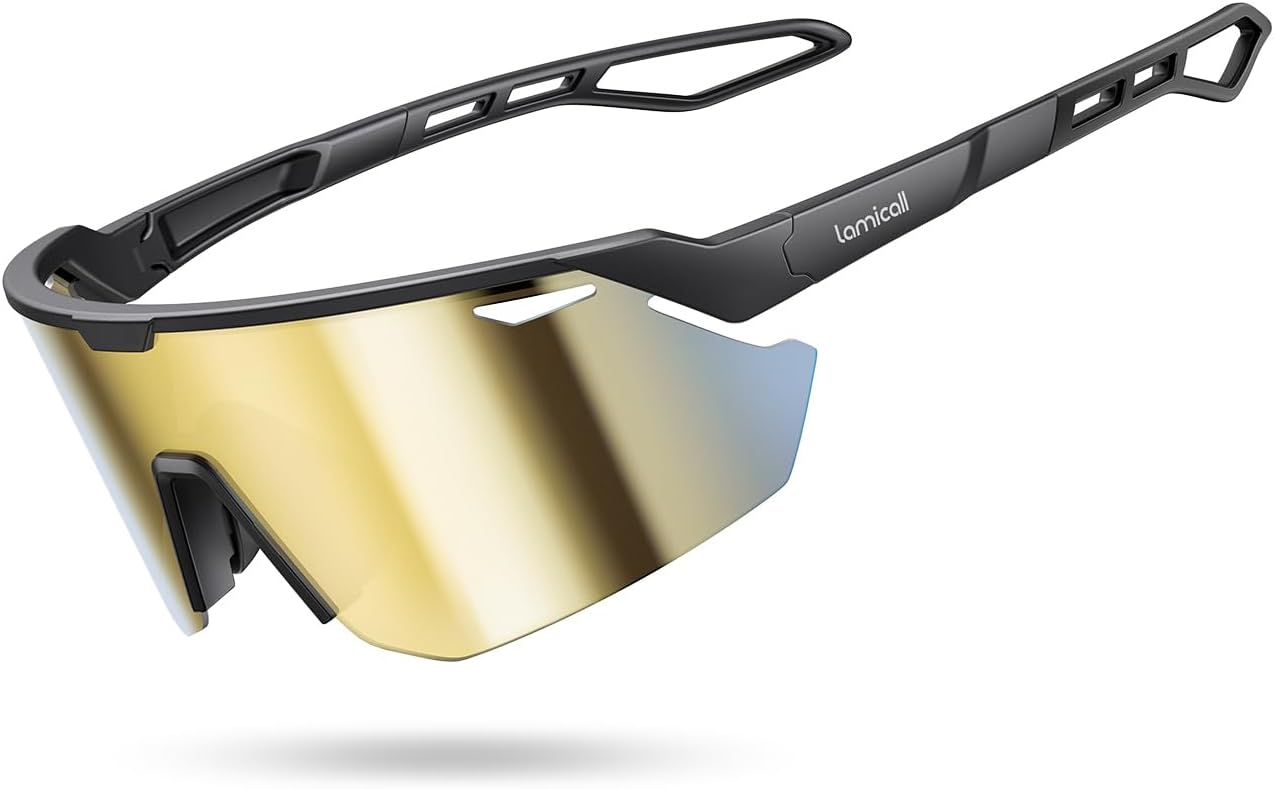 |
Lamicall 24g PolarizedBest Lightweight Value |
|
So light you genuinely forget you are wearing them. | Check Price on Amazon |
Compare Cycling Sunglasses Side by Side
Filter by lens type, fit and riding discipline.
Check Price on Amazon02Why Cycling Sunglasses Differ From Regular Sunglasses
Plenty of riders start out in a pair of everyday sunglasses and never quite get round to changing. It works — until it does not. The first time a stone flicked up by a car hits a lens at speed, or a gust of wind dries your eyes on a long descent, or a lens fogs solid on a cold climb, the difference between a lifestyle frame and a cycling-specific one becomes obvious.
Impact Resistance Matters More Than You Think
The single most important difference is what happens when something hits the lens. Cycling eyewear is designed around lens and frame materials chosen for their behaviour under impact — they flex and resist rather than splintering into fragments near your eye. Everyday fashion frames make no such promise, and cheap novelty glasses can be worse than wearing nothing at all, because they give a false sense of security while offering little real protection.
Wraparound Coverage Blocks Wind, Grit and Insects
At riding speed, airflow does not come straight at you — it curls around the sides of your face. A flat lens lets that flow hit your eyes directly from oblique angles, which is why riders in regular sunglasses often report streaming eyes on descents. A wraparound shape follows the curve of the face and closes off those gaps. It also matters for debris: road grit and trail dust arrive from angles you cannot anticipate.
Ventilation Prevents the Most Common Complaint
Heat and moisture from your face rise straight into the lens when you are working hard. Cycling frames address this with deliberate airflow paths — gaps at the brow, vented lens edges and frame shapes that stand the lens slightly off the face. It is a small design detail that makes the difference between a pair you wear all ride and a pair you push up onto your helmet at the first climb.
Fit Is Built Around a Head in Motion
A cycling position tips the head forward and puts the frame under load from helmet straps, sweat and vibration. Sport frames use temple shapes and nose pads that grip without pinching, and they sit at a height that keeps the lens in your line of sight when you are looking up the road from a drops position. Getting this right is worth as much as the lens technology itself — see our section on fit further down for the details.
Put the glasses on, drop into your normal riding position and look up the road without tilting your head. If the top edge of the frame cuts across your field of view, the frame is wrong for cycling — no lens technology will fix it.
Cycling eyewear also has to work with the rest of your kit rather than against it. Helmet straps, cap brims and headwear all interact with the temples and nose bridge, which is why it is worth trying glasses on with your helmet rather than in isolation. Our guide to the best cycling helmets covers helmet fit in depth, and how to start cycling walks through the wider essentials if you are setting up from scratch.
03Lens Types: Polarised vs Photochromic vs Mirrored
Most confusion about cycling sunglasses comes from lens technology. The marketing language overlaps, the options multiply, and it is genuinely unclear what any of it does until you have tried them side by side. Here is the practical version.
Polarised Lenses
Polarisation filters out light that has bounced off a flat surface and become horizontally oriented — the blinding white glare you get from wet tarmac, car bonnets, water and shiny metal. On a bright day with wet roads or low sun, the effect is dramatic and genuinely reduces eye fatigue.
There is a trade-off, and it is the reason some cyclists avoid polarised lenses. Glare carries information: the sheen on a wet patch, the shine on a pothole edge, the reflection off ice. Remove the glare and you remove some of those cues. Polarised lenses can also make digital displays harder to read, which matters if you use a cycling computer or watch.
Photochromic Lenses
Photochromic lenses change tint in response to light intensity — darker in bright conditions, lighter when the light drops. For riders who set off at dawn and come home in full sun, or who ride routes that switch between exposed ridges and tree cover, a single photochromic lens handles conditions that would otherwise require two pairs.
The honest limitations: transitions are not instantaneous, they work less effectively behind a windscreen or in very cold conditions, and a photochromic lens rarely reaches the same peak darkness as a dedicated dark lens. But for versatility per pound spent, they are hard to beat.
Mirrored Lenses
A mirror coating reflects a portion of light away from the lens before it reaches your eye. It is excellent in consistently bright conditions — high altitude, open roads, midsummer — and it reduces the light load without necessarily making the lens darker to look through. Mirrored finishes also reduce how much of your eyes are visible from outside, which some riders prefer.
Mirrored coatings are a surface treatment and can be scratched or degraded if the lens is mistreated, so care matters more with them than with plain tints. We cover that in the care section below.
| Lens Type | Best For | Worth Knowing | Check Price |
|---|---|---|---|
| Polarised | Wet roads, bright glare, long road rides | Can reduce surface detail and screen readability | Check Price on Amazon |
| Photochromic | Mixed light, dawn starts, woodland routes | Transitions take time and are less effective in cold | Check Price on Amazon |
| Mirrored | Consistently bright, high-glare conditions | Coating needs careful handling to avoid scratches | Check Price on Amazon |
| Standard tinted | Everyday riding in predictable light | Fixed tint means no adaptability | Check Price on Amazon |
For most riders, the practical answer is to own two lens options rather than chasing one that does everything. A photochromic or polarised main pair plus a clear or light-tint spare covers essentially every riding condition you will meet. That two-lens approach pairs well with a similar philosophy in the rest of your kit — see our guides to what to wear cycling and the best cycling jerseys for layering thinking that works the same way.
04Lens Colours and When to Use Them
Lens tint is not a style choice — it is a light-management choice, and picking the wrong one can leave you squinting in bright sun or struggling to read the trail in shade. The good news is that the rules are simple enough to learn once and apply forever.
Clear Lenses
Clear lenses do not filter light at all. Their job is physical protection: wind, grit, insects and rain at night or in very low light, when any tint would leave you straining to see. If you ride in the dark, a clear lens is not optional — and it pairs naturally with good lighting, covered in our best bike lights guide.
Yellow and Rose Lenses
Yellow and rose tints filter out blue light, which is the wavelength that causes haze and flat, low-contrast vision. The result is enhanced contrast and depth perception — overcast days, forest trails, dawn and dusk, and mixed shade. Rose is generally the softer option and flatters a wider range of conditions; yellow is the sharper choice for genuinely dull light.
Grey and Brown Lenses
Grey is the neutral all-rounder: it reduces overall brightness without shifting colour, which makes it the safest choice for bright, consistent conditions. Brown adds a warm shift that boosts contrast while still handling strong light, which is why so many road riders prefer it — surface texture and road markings stand out more clearly.
Copper, Bronze and Gradient Options
Copper and bronze tints sit between brown and rose, offering strong contrast enhancement with moderate light reduction. Gradient lenses, darker at the top and lighter at the bottom, are designed for driving-style use where you want sky protection and a clearer view of the dashboard or, in cycling terms, of the road surface directly ahead.
| Lens Colour | Conditions | What It Does | Check Price |
|---|---|---|---|
| Clear | Night, very low light | Physical protection without any light reduction | Check Price on Amazon |
| Yellow / Rose | Overcast, woodland, dawn and dusk | Boosts contrast and depth perception | Check Price on Amazon |
| Grey | Bright, consistent sunshine | Reduces brightness without distorting colour | Check Price on Amazon |
| Brown / Copper | Bright to variable sun | Enhances surface contrast while cutting glare | Check Price on Amazon |
If you are squinting, the lens is too light. If you are straining to read the surface, it is too dark or too high-contrast for the conditions. When in doubt, brown is the most forgiving all-round tint for daytime riding.
Lens choice is one of several decisions that depend on how and where you ride, and it connects to the wider question of route and terrain. Riders choosing a new bike often find their eyewear needs change too — our guide to how to choose a road bike covers that side, while the discipline section below maps lens choices to riding style directly.
Match the Tint to the Light
Shop interchangeable-lens sets for every condition.
Check Price on Amazon05Frame Materials and Weight
Frame material determines how glasses feel on a long ride, how they behave when dropped, and how they respond to temperature swings. It is also where marketing names get confusing, so it is worth knowing what the common materials actually do.
Grilamid TR-90
Grilamid TR-90 is a nylon-based thermoplastic that has become the default for performance eyewear, and for good reason. It is remarkably light, highly flexible, resistant to stress cracking and returns to its shape after being bent. Frames made from it flex around your head rather than gripping it rigidly, which is exactly what you want over several hours of riding.
Nylon and Polyamide Frames
Nylon-family frames share many of TR-90’s characteristics — low weight, toughness and flexibility — and appear across a wide range of sport eyewear. The practical differences between them are subtle, and both are excellent choices for cycling. What matters more is the overall frame geometry and how the material is used in the temples and bridge.
Polycarbonate Lenses
Polycarbonate is a lens material rather than a frame material, but it belongs here because it is central to impact resistance. It is the standard for sport eyewear precisely because it is tough, light and naturally blocks a large proportion of ultraviolet light even before coatings are applied.
Metal and Mixed-Material Frames
Metal frames appear in lifestyle-leaning cycling glasses and can look excellent, but they generally carry more weight and less flex than thermoplastic alternatives. For racing and long days in the saddle, light flexible frames win comfortably. For commuting and café rides where looks matter as much as performance, a metal-accented frame is a reasonable choice.
Why Weight Matters More Than It Sounds
A few grams sounds trivial until it sits on the bridge of your nose for four hours. Lightweight frames reduce pressure on the nose and behind the ears, and they move less when you are out of the saddle or riding rough ground. Some frames in this roundup are engineered specifically around low weight, and you notice the difference at the end of a long day rather than the start.
| Material | Character | Best Suited To | Check Price |
|---|---|---|---|
| Grilamid TR-90 | Very light, flexible, shape-retaining | Performance and long-distance riding | Check Price on Amazon |
| Nylon / polyamide | Tough, low weight, comfortable flex | All-round cycling use | Check Price on Amazon |
| Polycarbonate lenses | High impact resistance, low weight | Every sport eyewear application | Check Price on Amazon |
| Metal accents | Heavier, more rigid, refined look | Casual and commuting use | Check Price on Amazon |
Weight is one of those factors that also shows up elsewhere in cycling kit. Once you have felt the difference a lightweight pair of glasses makes, you start noticing it in other contact points too — see our guides to the best cycling shoes, cycling gloves and cycling socks for the same thinking applied to your feet and hands.
06Fit, Comfort and Helmet Compatibility
If there is one section worth reading carefully, it is this one. A brilliant lens in a badly fitting frame will be left at home, while a modest lens in a frame that disappears on your face will be worn every single ride. Fit is the highest-value decision in this entire category.
Nose Pads: Where Most Fit Problems Live
The nose bridge carries almost all of the frame’s weight, so it is where discomfort shows up first. Look for adjustable or well-shaped nose pads that distribute pressure across a broad area rather than two small contact points. Adjustable pads are worth seeking out if you have a narrower or wider bridge, because they let you tune both height and grip.
Height matters as much as comfort: the position of the nose pads determines where the top of the lens sits in your field of view. Set too low, the frame edge cuts across your sightline when your head is tipped forward in a riding position. Set correctly, the frame disappears.
Temple Grips and Retention
Temples need to hold the frame steady through vibration, sweat and out-of-the-saddle efforts without squeezing your head. Look for temple tips with a subtle grip surface and a shape that follows the side of the head rather than pressing into it. On mountain bike and gravel frames, more aggressive retention is genuinely useful; on road frames, a gentler grip is usually more comfortable.
Helmet Compatibility
Helmet straps run down the side of your face and interact directly with the temples. In an ideal setup, the strap sits outside the temple without pressing it into your head, and the temple does not lift the strap away from your skin. This is why trying glasses on with your helmet matters — a frame that fits perfectly bareheaded can become uncomfortable once straps are involved.
Helmet fit is a deep topic in its own right. Our guide to the best cycling helmets covers retention systems and strap geometry in detail, and it is worth reading alongside this section if you are buying both.
Face Shape and Lens Height
- Narrow faces do better with smaller lenses and frames that do not extend past the temples.
- Round faces often suit angular shield shapes that add definition.
- Wide faces need frames with genuine wrap coverage rather than narrow lifestyle shapes.
- Low nose bridges benefit from adjustable pads that raise the frame to the correct height.
- Anyone in a drops position should prioritise lens height over style, so the top edge stays out of sight.
Glasses on, helmet on and straps done up. Look up, down and side to side. Then drop into your riding position and look up the road. If anything presses, slips or blocks your view, adjust the pads before you buy — most fit problems are solvable, but only if you test first.
Comfort problems rarely exist in isolation. Riders who sort out eyewear fit often find the same approach helps with contact points elsewhere — the saddle being the classic example. See getting used to a bike seat and preventing saddle sores if that is your current battle.
07UV Protection and Lens Coverage
Everything else in this guide is about how well you ride. This section is about how well your eyes age. Ultraviolet exposure is cumulative, and cycling delivers a great deal of it — long hours outdoors, often in bright conditions, with light arriving from multiple angles including reflections off the road surface.
What UV400 Means
A UV400 rating means the lens blocks ultraviolet light up to a wavelength of 400 nanometres, which covers the entire UVA and UVB range that reaches your eyes. It is the standard you should look for, and it is widely available across every price point in this roundup. There is no reason to buy cycling eyewear without it.
Coverage Matters as Much as the Rating
A lens can block one hundred percent of UV and still leave your eyes exposed if it does not cover them properly. Light arriving from the sides, from above the frame, or from below through the gap at the cheeks all bypass the lens entirely. This is why wraparound shapes and generous lens height matter for eye health as well as for wind protection.
Reflections and the Second Exposure
Light does not only come from the sky. Water, pale road surfaces, snow and sand all reflect UV upward, meaning your eyes receive it from below as well as above. Larger lenses and closer-fitting frames reduce that reflected exposure, which is why high-coverage shield styles are popular with riders in exposed, high-glare environments.
Don’t Forget the Skin Around Your Eyes
UV exposure contributes to skin ageing and damage in the delicate area around the eyes, and cycling positions put that area directly in the sun’s path for hours. Coverage that shades the whole orbital area rather than just the eye itself is genuinely protective, and it is one reason larger lenses have become the norm in performance cycling.
Price has very little to do with UV protection. Affordable eyewear can block UV every bit as effectively as premium frames. What you pay for at the top end is optics, fit, durability and lens technology — not basic safety.
Eye protection is part of a wider sun and exposure strategy that also includes skin and hydration. Long hours in the saddle benefit from sensible fuelling too — see our guide to the best energy gels for cycling — and from understanding what those hours are doing for your body, covered in is cycling good for you.
08Anti-Fog, Ventilation, Interchangeable Lenses and Prescription Options
These are the features that separate a pair you simply own from a pair you rely on. None of them are glamorous, and all of them change the riding experience significantly.
Anti-Fog Treatments
Anti-fog coatings work by reducing the surface tension that causes moisture to form tiny droplets on the lens. Instead of scattering light and turning the lens opaque, moisture spreads into a thin transparent film. Some coatings are applied to the inner lens surface, and their durability varies — they can wear with repeated cleaning, which is one reason gentle cleaning technique matters.
Ventilation Design
Good ventilation is structural rather than chemical. Vents at the brow line, gaps at the frame edges and a lens that stands slightly away from the face all encourage airflow across the inner surface. The best designs move enough air to clear fog on a hard climb while still blocking wind on a descent — that balance is where the engineering really shows.
Interchangeable Lens Systems
Frames with swappable lenses effectively give you several pairs in one. Swap to a clear or light lens for evening rides, a dark or mirrored lens for bright days, and a contrast-enhancing tint for overcast conditions. The swap mechanism varies from tool-free to fiddly, so it is worth checking how easy it is before buying if you plan to change lenses often.
The value here is real: rather than owning three pairs of glasses, you own one frame and three lenses. For riders whose conditions vary widely across a single week, that is the most cost-effective route to full coverage.
Prescription and Insert Options
Riders who need vision correction have several routes, and the right one depends on your prescription strength and how you ride.
- Prescription lenses cut to fit the frame directly — the cleanest solution but usually the most expensive.
- Rx inserts that clip behind the main lens, letting you use standard sport lenses while wearing your correction underneath.
- Contact lenses combined with non-prescription eyewear, which many riders find simplest of all.
- Oversized fits that accommodate glasses underneath, useful for commuting but less secure at speed.
Prescription inserts are particularly popular because they keep all the benefits of a proper sport lens — impact resistance, wrap coverage, tint options — while solving vision correction separately. If you go this route, check compatibility before buying, since not every frame accepts an insert.
| Feature | Why It Helps | Look For | Check Price |
|---|---|---|---|
| Anti-fog coating | Keeps vision clear on climbs and in cold | Inner-surface treatment, gentle cleaning | Check Price on Amazon |
| Ventilation | Passive airflow that clears moisture | Brow vents and frame-edge gaps | Check Price on Amazon |
| Interchangeable lenses | One frame covers every light condition | Easy swap mechanism and lens range | Check Price on Amazon |
| Prescription insert | Vision correction without losing sport benefits | Frame compatibility and fit behind lens | Check Price on Amazon |
Eye health is one of several long-horizon reasons to ride consistently. If you want the wider picture on what regular riding does for you, our reads on cycling as cardio, whether cycling is good for your knees and what muscles cycling works all cover the physiology behind the habit.
09Best Value Cycling Sunglasses
You do not need to spend a great deal to get genuine eye protection and a comfortable fit. These five pairs cover the value end of the market convincingly, and each brings something specific rather than simply being inexpensive.
| Pair | Lens | Standout | Check Price |
|---|---|---|---|
| RIVBOS RB833 | Polarised | Accessible first pair with full wraparound cover | Check Price on Amazon |
| Rockbros Polarized | Polarised | Glare-cutting lenses at a budget price | Check Price on Amazon |
| Lamicall 24g | Polarised | Ultra-light build for long days in the saddle | Check Price on Amazon |
| BEACOOL HD Polarized | Polarised | Clear optics at a very approachable price | Check Price on Amazon |
| KAPVOE K63 | Photochromic | Adaptive lens at value pricing | Check Price on Amazon |
RIVBOS RB833 Polarized Cycling Sunglasses
The RB833 is the pair we point new riders towards when they ask what to buy first. It has a proper sport shape with genuine wraparound coverage, a polarised lens that deals with glare effectively, and a price that makes it easy to own without agonising over the decision. It is also a sensible backup pair for riders who already own something more expensive.
Key Features
- Polarised lens designed to cut reflected glare from road surfaces and vehicles.
- Wraparound sport shape blocking wind and debris from the sides.
- Lightweight frame construction that stays comfortable over longer rides.
- Accessible price point making it a natural first purchase or spare.
Pros
- Genuine wraparound coverage at entry-level cost
- Polarisation is a real benefit on wet and bright roads
- Comfortable enough for long days
- Easy to replace without regret
Cons
- Optical clarity is good rather than exceptional
- Fixed lens means no adaptability to changing light
- Finish will not match premium frames
Rockbros Polarized Cycling Sunglasses
Rockbros has built a reputation for delivering genuine functionality at very approachable prices, and their polarised cycling sunglasses follow that pattern. The appeal is straightforward: you get the glare-cutting benefits of polarisation and a proper sport fit without paying a premium for the privilege.
Key Features
- Polarised lens reducing reflected glare on bright days and wet surfaces.
- Sport wrap profile for wind and debris protection at speed.
- Light, comfortable frame suited to everyday riding.
- Strong value positioning across the range.
Pros
- Polarisation at a genuinely low price
- Comfortable sport fit for most face shapes
- Good coverage of the eye area
- Low risk if lost or damaged on a trip
Cons
- Polarisation can soften surface detail on some terrain
- Frame finish is utilitarian
- Less refined optics than specialist brands
Rockbros Polarized Sunglasses
Budget polarised protection for everyday riding.
Check Price on AmazonLamicall 24g Polarized Cycling Sunglasses

Weight is the Lamicall’s headline, and at 24 grams it is light enough that you genuinely stop noticing the glasses after a few minutes. That matters more than it sounds on long rides, where pressure on the nose and ears becomes the thing that ends your tolerance for a pair of sunglasses before anything else does.
Key Features
- 24g ultra-lightweight construction minimising pressure on nose and ears.
- Polarised lens for glare control in bright conditions.
- Sport cycling shape with wraparound coverage.
- Low-profile fit that sits close to the face.
Pros
- Weight is a genuine comfort advantage
- Polarised lens handles bright, reflective conditions
- Stays comfortable on long days
- Excellent value for the comfort on offer
Cons
- Ultra-light frames can feel delicate if mistreated
- Fixed lens tint offers no adaptability
- Fit will be too slim for wider faces
Lamicall 24g Polarized
Ultra-light comfort for the longest days in the saddle.
Check Price on AmazonBEACOOL HD Polarized Cycling Sunglasses

Optical clarity is where budget eyewear usually gives itself away, and the BEACOOL HD Polarized is interesting precisely because it prioritises that area. The HD designation points to a focus on clear, undistorted vision — which is exactly what matters when you are reading road surface at speed.
Key Features
- HD polarised lens focused on clarity as well as glare control.
- Wraparound sport frame protecting against wind and debris.
- Lightweight build for comfort on extended rides.
- Very approachable price for the optics on offer.
Pros
- Optical clarity is a real step above typical budget frames
- Polarisation for glare-heavy conditions
- Comfortable sport fit
- Easy recommendation as a first pair
Cons
- Single lens type means limited adaptability
- Finish and detailing are basic
- Not designed as a specialist performance frame
KAPVOE K63 Photochromic Cycling Sunglasses
Photochromic technology at value pricing is genuinely useful, and the K63 delivers exactly that. If your rides regularly start in dim light and finish in bright sun — or the reverse — an adaptive lens removes the need to decide which tint to carry, which is a meaningful simplification.
Key Features
- Photochromic lens that adjusts its tint to the light around you.
- Sport cycling shape with wraparound coverage.
- Single-lens versatility across dawn, day and dusk riding.
- Value pricing for adaptive lens technology.
Pros
- Adapts across changing light without swapping lenses
- Excellent for dawn starts and late returns
- Comfortable sport fit
- Best value entry into photochromic lenses
Cons
- Transitions are not instantaneous
- Less effective in very cold conditions
- Will not reach the darkness of a dedicated bright-sun lens
Shop Value Cycling Sunglasses
Compare affordable polarised and photochromic options.
Check Price on Amazon10Performance and Race Cycling Sunglasses
At the performance end, you are paying for optical precision, refined fit, superior ventilation and lens technology developed around how riders actually see the road. These are the frames that define the category.
| Pair | Style | Standout | Check Price |
|---|---|---|---|
| Oakley Radar EV Path | Extended-view shield | The frame everything else is measured against | Check Price on Amazon |
| Oakley OO9406 Sutro | Large rectangular shield | Maximum coverage with a bold silhouette | Check Price on Amazon |
| Oakley Encoder | Lightweight sport frame | Versatile across riding and training | Check Price on Amazon |
| 100% Speedcraft | Race shield | Pro-level coverage for fast road riding | Check Price on Amazon |
| 100% S3 | Progressive shield | Refined shape with generous coverage | Check Price on Amazon |
Oakley Radar EV Path
The Radar EV Path is the frame most riders should try before anything else, because it establishes what good looks like. The extended lens geometry is designed to keep your upward field of view clear when your head is tipped forward in a riding position — a detail that solves one of the most common complaints about sport eyewear.
Key Features
- Extended-view lens geometry keeping the upper field clear in a riding position.
- High-wrap sport frame for wind and debris protection at speed.
- Refined retention and grip that holds through hard efforts.
- Proven performance platform refined over successive generations.
Pros
- Field of view is the best in class for road riding
- Optics are exceptionally clear and distortion-free
- Fit is refined across a wide range of face shapes
- Build quality that survives daily use
Cons
- Premium positioning compared with value alternatives
- Distinctive look will not suit every taste
- Investment level means losing one stings
Oakley OO9406 Sutro
The Sutro took the performance shield mainstream, and it did so with a large rectangular lens that provides enormous coverage. Beyond the look, that size delivers real benefits: less wind reaching your eyes, less UV arriving from oblique angles, and a field of view that feels expansive rather than restricted.
Key Features
- Large rectangular shield lens for maximum eye-area coverage.
- Wide field of view with minimal frame intrusion.
- Sport-optimised fit designed around the riding position.
- Strong visual identity that has become a category standard.
Pros
- Coverage is outstanding across the whole eye area
- Excellent optical clarity on a large lens
- Feels secure at speed and over rough ground
- Versatile across road, gravel and commuting
Cons
- Large shape overwhelms smaller faces
- Bold styling divides opinion
- Premium pricing
Oakley Encoder
The Encoder is built for riders who do more than one sport, and that versatility is the point. It is a lightweight frame with full wrap coverage that works equally well on a road ride, a run or a training session, which makes it a strong single-pair solution for multi-sport athletes.
Key Features
- Lightweight sport construction that stays comfortable across long sessions.
- Full-wrap coverage protecting from wind, sun and debris.
- Multi-sport versatility across cycling and other training.
- Refined retention designed to stay put through hard efforts.
Pros
- Light enough for all-day comfort
- Coverage works at cycling speeds
- One pair covers several sports
- Excellent optics as expected from the brand
Cons
- Less specialisation than a pure race shield
- Premium pricing for a versatile frame
- Style is understated rather than bold
100% Speedcraft
The Speedcraft is a race frame in the fullest sense: large, high-coverage and designed for riders who need to see the road clearly while tucked and moving fast. The aggressive wrap blocks wind effectively on descents, and the lens geometry is built around reading surface detail rather than simply cutting brightness.
Key Features
- Large performance shield lens for expansive coverage and visibility.
- Aggressive wrap shape blocking wind and debris at speed.
- Race-focused fit that stays stable through hard efforts.
- Competition-proven design used at the highest levels of the sport.
Pros
- Coverage and field of view are exceptional
- Optics tuned for reading road and trail detail
- Stays planted during sprints and descents
- Looks every bit as fast as it rides
Cons
- Large format is not for every face shape
- Race-biased fit can feel intense for casual use
- Premium pricing
100% S3
The S3 takes the shield concept and refines it into something more balanced. The silhouette is less aggressive than pure race shields while still delivering generous coverage, which makes it an excellent everyday performance frame for riders who want capability without the full race aesthetic.
Key Features
- Progressive shield shape blending coverage with a balanced look.
- Wide coverage area protecting the full eye region.
- Performance sport fit built for the riding position.
- Refined detailing across frame and lens integration.
Pros
- More wearable than aggressive race shields
- Coverage is still genuinely generous
- Comfortable across long rides
- Works well on road and gravel alike
Cons
- Less extreme coverage than the largest shields
- Premium pricing
- Look is subtle rather than striking
100% S2
The S2 is the everyday workhorse of the range. It offers a balanced lens shape that suits a wide variety of faces, sport performance construction that holds up to regular use, and a comfort level that makes it easy to reach for on any ride rather than only on special ones.
Key Features
- Balanced lens shape suiting a broad range of face shapes.
- Sport performance build for durability and secure fit.
- Comfortable all-day design with thoughtful pressure distribution.
- Versatile styling that works across riding disciplines.
Pros
- Flattering, versatile shape for most riders
- Comfortable enough to forget about
- Performance without the aggressive race look
- Excellent optics for the price bracket
Cons
- Less coverage than the largest shields
- Not the lightest frame available
- Premium pricing
11Trail, Gravel and All-Day Cycling Sunglasses
Off-road riding changes the eyewear equation. You need more protection from branches and trail debris, more retention against vibration and rough ground, and better performance in the low, shifting light of woodland. These four pairs are built around those demands.
Smith Attack MAG MTB
Mountain biking is where eyewear earns its keep most visibly — literally. Trail debris, low branches and roost from the rider ahead all arrive at speed, and the Attack MAG MTB is designed around exactly those conditions. The MTB-specific design language shows in the coverage, the retention and the way the frame handles vibration.
Key Features
- MTB-specific design built around off-road demands.
- Secure trail-ready fit that holds through rough terrain.
- High-coverage lens protecting against debris and branches.
- Optics designed for variable woodland light and shifting contrast.
Pros
- Purpose-built for trail riding rather than adapted from road
- Excellent retention over rough ground
- Coverage handles debris from multiple angles
- Optics tuned for woodland contrast
Cons
- Over-specified for pure road riding
- Premium pricing
- Bulkier than minimal road frames
Julbo Rush
Julbo comes from a mountain heritage, and it shows in the Rush. This is a frame for rides that change character — starting on tarmac, climbing into exposed terrain, dropping through woodland. The coverage, ventilation and confident fit are all geared toward that kind of varied day rather than a single discipline.
Key Features
- All-terrain sport design suited to mixed rides.
- Strong coverage protecting from sun, wind and debris.
- Ventilated frame shape managing heat and moisture.
- Confident retention across varied surfaces.
Pros
- Excellent across mixed terrain and conditions
- Ventilation handles hard climbs well
- Coverage extends across the whole eye area
- Mountain-bred design philosophy
Cons
- More frame than pure road riders need
- Premium pricing
- Styling leans toward the technical end
Tifosi Rail Race
The Rail Race sits in the sweet spot between road speed and gravel toughness. The lens shape is race-oriented for speed and clarity, while the frame and retention are secure enough for the vibration and unpredictability of unpaved surfaces. It is a genuinely versatile option at a mid-range price.
Key Features
- Race-oriented lens shape for clarity at speed.
- Secure sport fit handling vibration and rough surfaces.
- Designed for fast riding across road and gravel.
- Mid-range positioning balancing capability and cost.
Pros
- Bridges road speed and gravel toughness well
- Secure fit on rough ground
- Strong value for the capability
- Comfortable over long days
Cons
- Not as specialised as pure race or pure trail frames
- Mid-range optics rather than flagship
- Styling is function-first
Tifosi Vogel SL Shield
Shield-style coverage without flagship pricing is a genuinely appealing proposition, and the Vogel SL delivers it. The single-lens design gives you the wide field of view and generous protection that shield formats are known for, in a lightweight frame with sensible ventilation.
Key Features
- Shield-style lens for wide, unobstructed vision.
- Lightweight sport frame that stays comfortable over distance.
- Good ventilation design managing heat and lens fogging.
- Mid-range pricing for shield-format coverage.
Pros
- Shield coverage at a sensible price
- Light and comfortable for long rides
- Ventilation performs well on climbs
- Clean, modern look
Cons
- Optics are good rather than exceptional
- Shield format suits larger faces better
- Fixed lens limits adaptability
Shop Trail and Gravel Eyewear
Find frames built for rough ground and mixed light.
Check Price on Amazon12Road vs Mountain Bike vs Gravel Sunglasses
Marketing categories blur together in practice, but the three main disciplines do place genuinely different demands on eyewear. Understanding what each one prioritises makes the choice far simpler.
Road Cycling Sunglasses
Road riding means sustained speed, long exposure and a head position tipped forward. Frames prioritise aerodynamic shape, upward field of view so the frame does not cut across your sightline in the drops, and wind management at speed. Lens clarity and contrast matter enormously because you are reading surface detail at pace.
Mountain Bike Sunglasses
Trail riding demands more retention, more coverage and better performance in variable light. Frames tend to be more robust, with grip that holds through vibration and bumps, and lenses that handle the shifting contrast of woodland riding. Impact resistance matters more here than anywhere else, because trail debris is a constant.
Gravel Sunglasses
Gravel sits between the two and borrows from both: road-style clarity and comfort for long hours, with trail-style security and coverage for unpaved surfaces. Photochromic and high-contrast lenses shine here because gravel routes tend to mix exposed open sections with tree cover.
How to Choose the Right Lens Tint for Different Weather
Beyond discipline, weather is the variable that changes most from ride to ride. The practical approach is to think in terms of light level and contrast rather than “sunny” or “cloudy”. Bright, consistent sun calls for grey or brown reduction. Flat, overcast conditions call for contrast enhancement. Low light calls for clear or very light tints. Variable conditions are where photochromic lenses earn their keep.
- Bright sun: grey or dark brown, mirrored where glare is intense.
- Overcast or flat light: rose, yellow or copper for contrast.
- Woodland and mixed shade: photochromic or high-contrast tints.
- Dawn and dusk: light photochromic or yellow.
- Night: clear, purely for physical protection.
- Wet roads: polarised to cut reflected glare, with the caveat about surface detail.
| Discipline | Priority | Lens Approach | Check Price |
|---|---|---|---|
| Road | Clarity, upward view, wind management | Grey or brown; polarised for glare | Check Price on Amazon |
| Mountain bike | Retention, impact resistance, coverage | High contrast or photochromic | Check Price on Amazon |
| Gravel | Versatility, comfort, mixed-light performance | Photochromic or interchangeable set | Check Price on Amazon |
Discipline shapes a great deal more than eyewear — it drives bike choice, tyre choice and kit preferences too. If you are still deciding what kind of riding suits you, our guide to how to choose a road bike is a good place to start, and how to clip into pedals covers the other upgrade most new riders weigh up around the same time.
13How to Clean, Care For and De-Fog Cycling Sunglasses
Most damaged lenses damage themselves. The overwhelming cause of scratches on cycling eyewear is improper cleaning — wiping a dusty lens with a jersey sleeve, using household glass cleaner, or dropping the glasses into a bag loose. A two-minute care routine keeps a pair performing like new for years.
The Correct Cleaning Method
- Rinse first. Hold the lens under lukewarm running water to float off grit before anything touches it.
- Use the right soap. A small drop of mild dish soap on your fingertips, worked gently over both surfaces.
- Rinse thoroughly so no residue remains on the lens.
- Pat dry with a clean microfibre cloth rather than rubbing aggressively.
- Store in the case whenever the glasses are not on your face.
The key principle is this: never wipe a dry, dusty lens. Grit trapped between cloth and lens acts like sandpaper, and every wipe deepens the scratches. Rinsing first is the single habit that prevents the vast majority of lens damage.
What to Avoid
Household glass cleaners, ammonia-based products, paper towels, tissues and clothing all damage lens coatings over time. Mirrored and anti-reflective coatings are particularly vulnerable because they are surface treatments rather than bulk material. Warm water and mild soap is genuinely all you need.
How to Stop Cycling Sunglasses From Fogging Up
Fogging is the most common complaint in cycling eyewear, and it is almost always solvable. The cause is warm, moist air from your face condensing on a cooler lens surface. Everything about preventing it is either about airflow or about keeping that air off the lens.
- Keep moving air. A slight increase in speed usually clears fog instantly, which is why it appears on climbs and clears on descents.
- Use the frame’s vents. Brow vents and frame-edge gaps only work if they are not blocked by a cap, headband or helmet padding.
- Fit matters. A frame pressed flat against your face traps warm air; one that stands slightly off allows circulation.
- Anti-fog treatments help but degrade with aggressive cleaning, so be gentle on the inner lens surface.
- Avoid touching the inner lens with fingers, as skin oils are difficult to remove and attract condensation.
- On cold days, ventilate early — letting airflow start before you work hard prevents the initial fogging.
If a lens fogs mid-climb, lifting the frame slightly away from your face for a few seconds is enough to break the temperature difference and clear it. It is not elegant, but it works immediately and costs nothing.
Storage and Long-Term Care
Frames and lenses both suffer from heat and pressure. Do not leave glasses on a hot dashboard, do not store them lens-down on a hard surface, and do not hang them from a jersey pocket where they can be sat on. A hard case costs little and prevents almost every storage-related failure.
Care routines like this are the unglamorous side of cycling that pays off repeatedly. The same applies to your kit generally — see our guides to cycling shorts, cycling bibs and women’s cycling shorts for how to keep technical fabrics performing, and cycling jerseys for the same approach to upper-body layers.
14Cycling Sunglasses FAQs
1. Are polarised lenses good for cycling?
They are excellent for cutting glare from wet roads, car panels and water, and they noticeably reduce eye fatigue in bright conditions. The trade-off is that glare carries information — the sheen on a wet patch or pothole edge — which polarisation removes, and digital screens can be harder to read. Many riders keep a polarised pair for bright road days and a non-polarised pair for everything else.
2. Do cycling sunglasses really differ from regular sunglasses?
Yes, meaningfully. Cycling frames use impact-resistant materials, wrap around the face to block wind and debris, ventilate to prevent fogging, and are shaped around a head position tipped forward at speed. Regular sunglasses offer none of that, and in some cases can shatter on impact.
3. What lens colour should I use for overcast days?
Contrast-enhancing tints — rose, yellow or copper — are the right choice for flat, overcast light. They filter the blue light that causes haze and make surface detail and depth easier to read, which is exactly what you need when overall brightness is low.
4. Are photochromic lenses worth it for cycling?
For riders whose conditions change across a ride or a week, absolutely. One adaptive lens covers dawn starts, midday sun and late returns without carrying spares. The limitations are that transitions are not instant, they are less effective in cold weather, and they do not reach the darkness of a dedicated bright-sun lens.
5. What does UV400 mean?
It means the lens blocks ultraviolet light up to 400 nanometres, covering the full UVA and UVB range. It is the standard you should require of any cycling eyewear, and it is available across all price points. Coverage matters too — a UV-rated lens still leaves you exposed if light reaches your eyes from the sides or below.
6. How do I stop my cycling glasses from fogging?
Keep airflow moving across the lens. Make sure brow vents and frame gaps are not blocked by caps or helmet padding, ensure the frame sits slightly off your face rather than pressed flat, and be gentle on anti-fog coatings. Increasing speed briefly also clears fog immediately in most cases.
7. Can I wear cycling sunglasses with a helmet?
Yes, and you should test the combination before buying. The ideal setup has the helmet strap sitting outside the temple without pressing it into your head, and the temple not lifting the strap away from your skin. Frames that fit perfectly bareheaded can feel wrong once straps are involved.
8. What if I need prescription lenses?
You have several options: prescription lenses cut to the frame, clip-in inserts that sit behind the main lens, contact lenses paired with standard eyewear, or oversized frames worn over regular glasses. Inserts are popular because they preserve all the benefits of a proper sport lens while handling vision correction separately.
9. Are expensive cycling sunglasses worth the money?
Price has almost nothing to do with basic eye protection — affordable eyewear can block UV and resist impact perfectly well. What you pay for at the top end is optical clarity, refined fit, ventilation, lens technology and durability. For daily riders, those refinements are genuinely noticeable; for occasional use, a value pair is entirely sensible.
10. Should mountain bike sunglasses be different from road ones?
Generally yes. Trail riding demands more retention against vibration, more coverage against debris and branches, and lenses that handle shifting woodland contrast. Road frames prioritise aerodynamic shape, upward field of view and clarity at speed. Many frames work across both, but dedicated designs do each job better.
11. How should I clean my cycling sunglasses?
Rinse under lukewarm water first to float off grit, wash gently with a drop of mild soap, rinse again and pat dry with a clean microfibre cloth. Never wipe a dry, dusty lens and never use household glass cleaner or paper towels — they damage coatings and cause the scratches that ruin lenses.
12. Do I need a clear lens for night riding?
Yes, if you ride in the dark. Any tint reduces the light reaching your eyes at exactly the moment you need maximum visibility. A clear lens provides physical protection from wind, grit and insects without any light reduction, and it pairs naturally with good bike lights.
15Conclusion: Choose the Lens First, Then the Fit
The best cycling sunglasses are the ones you forget you are wearing — and that comes down to matching lens technology to your conditions and fit to your face. For most road riders, the Oakley Radar EV Path remains the benchmark: exceptional field of view, refined fit and optics that make reading the road effortless. The Oakley Sutro offers maximum coverage in a bold shape, the Encoder does everything across multiple sports, and the 100% Speedcraft and S3 deliver race-grade coverage at the top end.
For off-road and mixed terrain, the Smith Attack MAG MTB, Julbo Rush and Tifosi Rail Race bring the retention and coverage that trail riding demands, while the Tifosi Vogel SL delivers shield-style protection at a mid-range price. At the value end, the RIVBOS RB833, Rockbros Polarized, Lamicall 24g, BEACOOL HD Polarized and KAPVOE K63 Photochromic prove that genuine protection and comfort do not require a premium outlay.
Whatever you choose, get the fit right with your helmet on, match your lens tint to the light you actually ride in, and clean the lenses properly. Those three habits matter more than which pair you buy.
Find Your Cycling Sunglasses Today
Check current colours, lens options and pricing.
Check Price on Amazon