

Best Energy Gels for Cycling: The Complete Rider’s Guide to Fueling Every Ride
Sixteen gels tested, compared and ranked — from caffeine-loaded race rockets to honey-sweetened real-food pouches. Here’s what actually works when the road tilts upward and your legs start asking awkward questions.
Which Energy Gel Should You Actually Buy?
There is no single “best” energy gel for cycling — there is a best gel for your ride, your gut, and your goals. That said, after working through every major brand on the market, a clear pattern emerges: the GU Energy Original remains the most versatile everyday option, SiS Beta Fuel and Maurten Gel 160 lead the high-carbohydrate revolution, SiS GO Isotonic is the easiest on the stomach when you forget to drink, and GU Roctane is purpose-built for the days that hurt the most. Everything else on this list earns its place for a specific reason, and this guide explains exactly what that reason is.
Energy gels are the single most concentrated, most convenient fuel source ever invented for riders. They weigh almost nothing, they disappear into a jersey pocket, and they deliver a fast, predictable hit of carbohydrate exactly when your glycogen stores start sounding the alarm. But walk into any bike shop or scroll any online store and you’re confronted with an absurd wall of pouches: isotonic, hydrogel, dual-source, chia-based, maple-based, caffeinated, caffeinated-more, drinkable, chewable. The marketing gets loud. The science gets buried.
This guide cuts through it. We break down what actually matters in a gel (carbohydrate type, ratio, osmolality, caffeine dose, sodium, texture), then review sixteen of the most popular products on the market in depth — including GU Energy Original, GU Roctane, SiS GO Isotonic, SiS Beta Fuel, Maurten Gel 100, Maurten Gel 160, CLIF SHOT, Honey Stinger, Huma Chia, Spring Energy Awesome Sauce, Torq, High5, High5 Aqua, Precision Fuel & Hydration PF 30, Untapped Maple and Skratch Labs Energy Chews. You’ll get comparison tables, honest pros and cons, and a practical fueling protocol you can use on your very next ride.
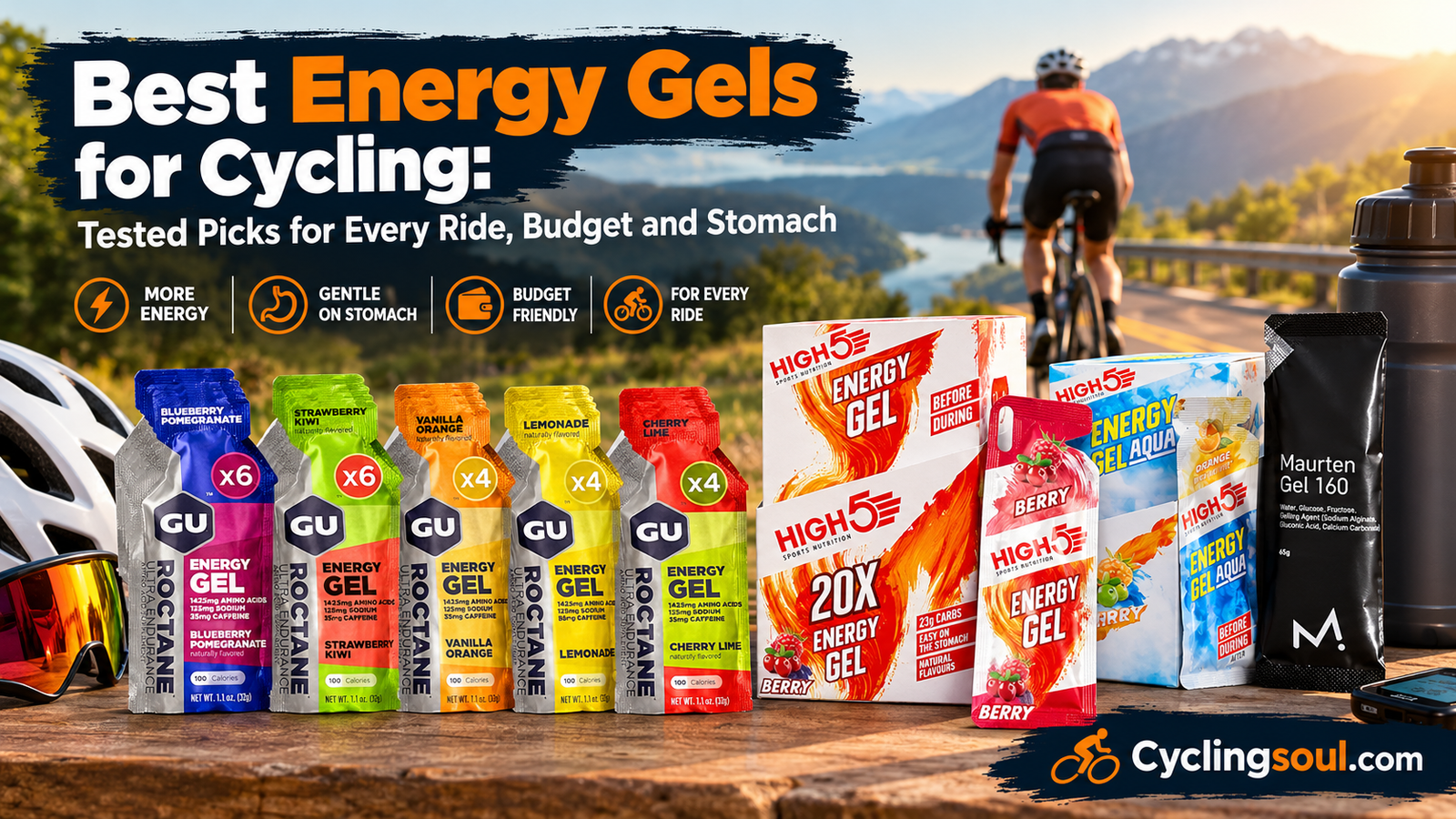
Before we get into the pouches, one framing point. Gels are not magic. They are a delivery system for sugar — engineered sugar, in most cases, but sugar nonetheless. Their genius lies in form factor: a 30-gram packet that your body can absorb in twenty minutes while you’re producing threshold power. Understanding why that works — and why it sometimes spectacularly doesn’t — is the difference between floating through hour four and doubled over at the roadside.
While you’re here, it’s worth understanding the engine you’re fueling. If you’ve ever wondered what muscles cycling actually works, the answer directly shapes how you eat: your glutes, quads and calves are glycogen-hungry machines, and every gel you swallow is essentially prepaid energy for those tissues. And if you track numbers, FTP in cycling gives you the intensity ceiling that determines how fast you burn through those stores in the first place.
Browse Every Energy Gel on Amazon
Compare prices, flavors and multipack deals before you commit to a box.
Why On-Bike Fueling Decides How Your Ride Ends
Every cyclist eventually meets the same wall. It arrives somewhere between ninety minutes and three hours into a hard ride, depending on fitness, breakfast and ambition. Your legs don’t exactly stop working — they just stop listening. Cadence drifts, power collapses, the hill that felt manageable twenty minutes ago now feels personal. Riders call it the bonk. Physiologists call it glycogen depletion. Either way, it’s entirely predictable and almost entirely avoidable.
Your muscles are batteries with a strict charging policy
When you ride, your working muscles draw on two primary fuel tanks: glycogen stored inside the muscle itself, and glucose circulating in your blood. A well-fed rider carries roughly 400 to 500 grams of muscle glycogen — enough for somewhere around 90 minutes to two hours of moderate-to-hard endurance effort, depending on intensity and individual physiology. Once that glycogen drops below a critical threshold, power output falls off a cliff. You cannot will your way past depleted glycogen any more than you can will your phone to keep working at one percent battery.
This is where carbohydrate intake during exercise becomes transformation rather than supplementation. Research consistently shows that consuming carbohydrate during rides longer than about 60–90 minutes preserves power output, sustains cognitive function (your ability to hold a line, judge a corner, make tactical decisions), and dramatically reduces perceived effort in the final hours. The difference between a fueled rider and an unfueled rider at hour four of a century ride isn’t marginal — it’s the difference between finishing strong and limping home in survival mode.
The rule of thumb: aim for roughly 30–60 grams of carbohydrate per hour for moderate rides, 60–90 grams per hour for hard or long endurance work, and up to 90–120 grams per hour for ultra-endurance events — the higher figures require gut training and usually a dual-source (glucose plus fructose) formula.
Why gels specifically — not bars, not chews, not drink mix alone
Bars are wonderful at low intensity, but chewing a dense oat-and-caramel bar while you’re breathing through your eyeballs on a steep climb is an invitation to choke or cramp. Drink mix is arguably the most efficient fuel of all, but it commits you to a fixed concentration in your bottles, and it becomes cloying after four hours. Chews sit somewhere in between and are genuinely excellent for riders who hate the texture of gels.
Gels win because of concentration and portability. A single pouch delivers 20–45 grams of carbohydrate in a pocketable, tear-open, thirty-second format that requires almost no chewing and very little thinking. You can carry six of them in a jersey pocket and barely notice the weight. You can adjust your intake in real time — take one early if the pace spikes, skip one if you’re spinning easy. That flexibility is exactly what a long, unpredictable day in the saddle demands.
What happens when fueling goes wrong
Underfueling is the obvious failure mode, but overfueling badly is nearly as common. Riders dump three gels in thirty minutes because they’re nervous, wash them down with concentrated energy drink, and then wonder why their stomach is staging a coup. The gut is trainable but it has limits: absorption capacity for carbohydrate tops out somewhere between 60 and 90 grams per hour for most people unless you specifically train the gut to handle dual-source formulas at higher rates. Exceed your personal absorption ceiling and the unabsorbed carbohydrate sits in your gastrointestinal tract, drawing in water and producing exactly the bloating, cramping and nausea that give gels a bad reputation.
The good news is that the stomach responds to training much like the legs do. Gradual exposure to higher carbohydrate intakes during easy and moderate rides reliably increases tolerance over a period of weeks. We cover the full protocol in the practical fueling section further down, but the principle is simple: practice your race-day nutrition in training, relentlessly, until it’s boring.
Fueling connects to everything else you do on the bike
Nutrition doesn’t exist in a vacuum. The intensity you sustain dictates your burn rate; the duration of your ride dictates your total requirement; your body composition goals shape how aggressively you should (or shouldn’t) restrict intake around training. Riders exploring cycling for weight loss often under-fuel their hard sessions, which destroys workout quality and backfires spectacularly. Understanding how many calories cycling burns helps you frame gels not as “extra” food but as strategic fuel that makes the work possible.
And if you’re cross-training or comparing sports, the fueling lesson from cycling versus running is instructive: cyclists can generally tolerate more intake during exercise because of the stable, non-impact posture, which is precisely why the gel category has been driven so hard by bike culture. Cyclists are the ideal users of concentrated carbohydrate — we can keep eating while we keep working.
Stock Your Jersey Pockets
Grab a mixed box of energy gels and test them on training rides before race day.
How to Choose an Energy Gel: The Only Criteria That Matter
Ignore the packaging for a moment. Strip away the branding, the athlete endorsements, the claims about rocket fuel and quantum absorption. Every energy gel on earth can be evaluated against a short, unglamorous checklist — and once you know that checklist, you can walk into any shop and sort the entire shelf in under two minutes.
1. Carbohydrate content per pouch
This is the headline number. Most classic gels deliver somewhere between 20 and 25 grams of carbohydrate per packet. Modern high-carbohydrate gels push 30 to 45 grams. The right number for you depends on your hourly target: if you’re aiming for 60 grams per hour and your gels contain 20 grams each, you need three per hour — that’s a lot of wrapper management. If your gels contain 30 grams, two an hour does the job. Fewer packets means less fuss, less chance of forgetting, and less litter stuffed in your pockets.
2. Carbohydrate source and ratio
This is the technical detail that separates modern gels from their predecessors. Early gels were almost pure maltodextrin — a chain of glucose molecules, absorbed via a single intestinal transporter (SGLT1) that saturates at roughly 60 grams per hour. Add fructose, which is absorbed via a different transporter (GLUT5), and total absorption capacity rises, potentially to 90–120 grams per hour. The best endurance formulas now use a deliberate glucose-to-fructose ratio — commonly 2:1 or 1:0.8 — precisely to exploit this dual-transport mechanism. If you plan to take more than 60 grams per hour, a dual-source gel isn’t a luxury, it’s a requirement.
3. Osmolality and gastric comfort
Osmolality describes how concentrated a solution is relative to body fluids. A hyperosmolar gel (most traditional gels, taken without water) draws fluid into the gut and can cause sloshing, cramping and the dreaded “gel stomach.” Three solutions exist: drink water alongside the gel (which most brands recommend), choose an isotonic formulation like SiS GO Isotonic that’s diluted enough to be absorbed smoothly, or choose a hydrogel like Maurten that encapsulates the carbohydrate and releases it in the acidic environment of the stomach. Any of these can work brilliantly — they just need to match your habits and your event’s aid-station layout.
4. Caffeine: dose, timing and tolerance
Caffeine is the legal performance enhancer hiding in plain sight — reliably improving endurance performance, perceived exertion and concentration at doses of roughly 3 milligrams per kilogram of body weight. Gels typically carry 20, 25, 40, 50, 70 or 100 milligrams. The strategy that works best for most riders is to save caffeine for the second half of a long event rather than front-loading it, and to know exactly how your body responds on a normal Tuesday ride before you gamble on a mountain sportive. If you’re sensitive, sleep quality after an evening turbo session is a real consideration.
5. Sodium and electrolytes
Every gel contains some sodium, but the amounts vary wildly — from under 20 milligrams to over 200. On hot days or for salty sweaters, higher sodium helps maintain blood volume and fluid balance. On cool days, it matters far less. The pragmatic approach: match sodium intake to conditions and to what your drink mix already provides, and remember that electrolyte needs are individual enough that generic advice is only a starting point.
6. Taste, texture and “flavor fatigue”
This sounds trivial until hour five of a ride, when a gel that tasted delightful at kilometer 20 becomes physically repulsive at kilometer 160. Flavor fatigue is real, physiological, and one of the main reasons riders abandon their nutrition plan mid-event. Solutions: rotate flavors, choose gels with mild or savory profiles for long days, keep one intensely caffeinated “rescue” flavor for emergencies, and never try anything new on event day.
7. Format: gel, drinkable gel, chew or whole-food pouch
Traditional gels have a thick, syrupy consistency. “Aqua” or drinkable gels (High5 Aqua, for example) are thinner and can be swallowed without water. Chews like the Skratch Labs Energy Chews suit riders who gag on gels entirely. Whole-food pouches like Huma and Spring Energy use recognizable ingredients — fruit puree, chia, rice, maple — for riders who want to minimize processed ingredients. None of these is objectively superior. What matters is which one you will actually consume, reliably, under stress.
Quick decision checklist
- Rides under 60 minutes: water and a normal meal are usually enough; gels optional.
- 60–90 minutes, hard effort: one gel, optionally caffeinated, taken around the 45-minute mark.
- 2–4 hours: 30–60 grams of carbohydrate per hour from gels, drink mix or a blend; practice this in training.
- 4+ hours or ultra-endurance: 60–90+ grams per hour with a dual-source formula, a gut-training plan and a flavor-rotation strategy.
- Upset stomach history: isotonic or hydrogel formats first, always taken with a few sips of water.
One final note on gear: nutrition and equipment work together. A comfortable setup means you actually want to ride long enough to need fuel — so make sure the basics are dialed too. A properly fitted pair of cycling shoes keeps your feet happy deep into a ride, quality cycling kit keeps you comfortable in changing weather, and well-made cycling bibs stop saddle discomfort from ending your ride before your fuel stores do.
Compare Gel Multipacks & Starter Boxes
Variety packs are the cheapest way to find the gel your stomach actually likes.
All 16 Energy Gels Compared at a Glance
Here’s the complete field in one table. Swipe horizontally on mobile to see every column. Numbers are approximate and can vary slightly by flavor and region — use this as a decision map, not a lab report, and always check the packet for the final word.
| Product | Carbs / Pouch | Carb Source | Caffeine | Water Needed? | Best For | Score |
|---|---|---|---|---|---|---|
| GU Energy Original | ~22 g | Maltodextrin + fructose | 0 / 20 / 40 mg | Yes, recommended | Everyday training & racing | 9.4 |
| GU Roctane | ~23 g + aminos | Maltodextrin + fructose | 0 / 35 / 70 mg | Yes | Ultra-endurance & events | 9.3 |
| SiS GO Isotonic | ~22 g | Maltodextrin | 0 / 75 mg versions | No | Easy digestion, hot days | 9.2 |
| SiS Beta Fuel | ~40 g | Maltodextrin + fructose | 0 / 100 mg versions | Optional | High-carb racing | 9.5 |
| Maurten Gel 100 | ~25 g | Fructose + glucose (hydrogel) | 0 / 100 mg version | Optional | Sensitive stomachs | 9.3 |
| Maurten Gel 160 | ~40 g | Fructose + glucose (hydrogel) | Uncaffeinated | Optional | Maximum fuel per pocket | 9.2 |
| CLIF SHOT | ~22 g | Maltodextrin + cane sugar | 0 / 25 / 50 / 100 mg | Recommended | Flavor variety, training | 8.8 |
| Honey Stinger | ~24 g | Organic honey + tapioca | 0 / 32 mg versions | Recommended | Natural-ingredient fans | 8.7 |
| Huma Chia | ~24 g | Fruit puree + chia | 0 / 25 mg versions | Recommended | Real-food fueling | 8.6 |
| Spring Awesome Sauce | ~30 g+ | Rice, fruit & maple | Varies by pouch | Recommended | Real-food long days | 8.5 |
| Torq Energy Gel | ~30 g | 2:1 maltodextrin : fructose | 0 / caffeinated | Yes | Structured hourly fuelling | 8.8 |
| High5 Energy Gel | ~23 g | Maltodextrin-led | 0 / caffeinated | Yes | Budget-friendly training | 8.6 |
| High5 Energy Gel Aqua | ~20 g | Maltodextrin-led | 0 / caffeinated | No | Drinkable, no-water use | 8.5 |
| Precision PF 30 | ~30 g | 1:0.8 maltodextrin : fructose | 0 / 100 mg version | Recommended | Minimalist high-carb plan | 9.1 |
| Untapped Maple | ~25 g | Pure maple syrup | 0 / caffeinated | Recommended | Single-ingredient simplicity | 8.4 |
| Skratch Energy Chews | ~20 g / serving | Glucose + fructose | 0 / caffeinated | No | Gel-haters & steady nibbling | 8.7 |
How to read this table
Notice how the field splits into three families. The classic gels (GU Original, CLIF SHOT, Honey Stinger, High5, Huma, Untapped) cluster around 20–25 grams of carbohydrate and expect you to drink water alongside. The high-carbohydrate gels (SiS Beta Fuel, Maurten 160, Precision PF 30, Torq) push 30–40 grams per pouch and are designed for riders deliberately chasing higher hourly intakes with fewer packets. And the convenience formats (SiS GO Isotonic, High5 Aqua, Skratch Chews) solve a specific problem — no water available, or a dislike of thick gels — at the cost of slightly lower carbohydrate density.
Scores reflect the balance of formula, taste, stomach comfort, practicality and value — not just carbohydrate content. A gel that delivers 40 grams is useless if you can’t stomach it at hour four; a 22-gram gel that you happily consume every 30 minutes will outperform it every single time.
| Hourly Carbohydrate Target | Gels Needed (22 g each) | Gels Needed (30 g each) | Gels Needed (40 g each) |
|---|---|---|---|
| 30 g / hour (easy endurance) | ~1.5 | 1 | ~0.75 |
| 60 g / hour (steady hard) | ~2.75 | 2 | 1.5 |
| 90 g / hour (racing, gut trained) | ~4 | 3 | ~2.25 |
That second table is the one most riders skip, and it’s the most useful thing in this entire guide. Do the arithmetic before you buy. If you’re targeting 90 grams an hour with 22-gram gels, you’ll be tearing open four packets every sixty minutes — possible, but miserable. Buying 30- or 40-gram gels for high-intensity work is a genuine quality-of-life upgrade.
Shop High-Carbohydrate Gels
Fewer packets per hour means less fumbling, less litter and steadier energy.
GU Energy Original Sports Nutrition Energy Gel — The Everyday Workhorse

GU Energy Original Sports Nutrition Energy Gel
GU basically invented the modern energy gel, and decades of refinement show. The Original delivers roughly 22 grams of carbohydrate from a dual maltodextrin-and-fructose blend, a modest sodium hit for electrolyte support, and a small payload of branched-chain amino acids intended to reduce muscle damage perception during hard efforts. It comes in a staggering range of flavors — sweet, fruity, chocolatey, salted-caramel, even chocolate-mint — with caffeine options at roughly 20 and 40 milligrams depending on flavor.
What makes it the best all-round gel isn’t any single spec. It’s the combination: predictable absorption, wide flavor rotation (your best weapon against flavor fatigue), universal availability, and a price per packet that doesn’t make you wince when you’re consuming three an hour. It is the gel most riders should start with before experimenting with exotic formulas.
On the bike
Take GU Original with a few good swigs of water and it settles quickly — most riders feel the carbohydrate lift within 10 to 15 minutes. The texture is thick enough to feel substantial but not so gluey that it’s unpleasant; if you’ve ever had a gel that felt like swallowing wallpaper paste, you’ll appreciate the restraint here. Flavors skew sweet, which is worth knowing in advance: the chocolate and peanut butter varieties divide opinion fiercely, while salted caramel and tri-berry are almost universally popular.
For riders building a fueling plan, GU Original is ideal for the 30–60 gram per hour range. Two packets an hour plus a carbohydrate drink gets you comfortably past 60 grams; add a third if you’re racing and gut-trained. The caffeine versions are best saved for the second half of a long ride, when the perceptual lift genuinely matters.
What We Like
- Massive flavor range fights flavor fatigue
- Dual-source carbohydrate for smoother absorption
- Multiple caffeine strengths to build a real strategy
- Excellent value per packet in bulk boxes
- Available almost everywhere, worldwide
Worth Knowing
- Definitely wants water alongside it
- Sweet flavors can become cloying on very long days
- Not the highest carbohydrate-per-pouch option
Who should buy it: literally anyone new to gels, and most experienced riders too. If you only own one box of gels in your kit cupboard, make it this one. It covers training rides, sportives, races and the emergency “I forgot to eat breakfast” scenario with equal competence.
Get the GU Energy Original Box
The most versatile gel in cycling — perfect for training and race day alike.
GU Roctane Ultra Endurance Energy Gel — Built for the Longest Days

GU Roctane Ultra Endurance Energy Gel
Roctane is GU’s answer to a simple question: what does a rider need at hour eight that they don’t need at hour two? The carbohydrate backbone is familiar — a maltodextrin and fructose blend in a similar ballpark to the Original — but the supporting cast is dramatically more ambitious. We’re talking a substantially heavier amino acid payload (including leucine, valine and taurine), electrolyte levels tuned for long sweaty days, and a flavor profile engineered to stay palatable when everything else has become sickly.
The caffeine versions sit at higher doses than the Original range, and the intent is clear: this is a gel for events where you need sustained output deep into the pain cave — double centuries, gravel epics, ultra-distance races, all-day mountain missions.
On the bike
Roctane tastes richer and slightly more “serious” than the Original — less candy-shop, more workmanlike. The texture is comparably thick and, again, wants a few mouthfuls of water to help it on its way. Where riders notice the difference is late in a long event: the higher amino acid and electrolyte content seems to take the edge off that hollow, shredded feeling you get after six hours of continuous output. Whether that’s partly psychological is almost beside the point — the effect on morale is real.
Practically speaking, Roctane is expensive enough that most riders reserve it for key events and use the Original for everyday training. That’s a sensible strategy, though there’s an argument for training with Roctane occasionally simply to confirm your gut likes it before you rely on it at an event.
What We Like
- Designed specifically for multi-hour efforts
- High amino acid and electrolyte support
- Strong caffeine options for late-race surges
- Flavor stays tolerable deep into long days
Worth Knowing
- Noticeably pricier than standard gels
- Overkill for rides under two hours
- Thick texture still requires water
Who should buy it: ultra-distance riders, bikepackers, gravel racers and anyone doing events where the clock runs past four hours. If your rides are typically two-hour weeknight loops, the standard GU does the same job for less money.
Shop GU Roctane Ultra Endurance
Premium fuel for events where hour eight matters just as much as hour one.
Science in Sport: GO Isotonic and Beta Fuel — Two Philosophies, One Brand

Science in Sport (SiS) GO Isotonic Energy Gel
The GO Isotonic gel solved a problem that had plagued gels since the beginning: the water requirement. By diluting the carbohydrate solution to an isotonic concentration — meaning it’s roughly matched to the osmolality of your body fluids — SiS created a gel that can be swallowed straight from the pouch without a chaser and absorbed without dragging a flood of water into your gut.
Each pouch carries around 22 grams of carbohydrate, almost entirely from maltodextrin, in a lighter, slightly more liquid consistency than traditional gels. For riders with sensitive stomachs, or anyone riding routes without reliable water stops, this is a genuinely liberating product.
On the bike
The first thing you notice is how fast it goes down. No sticky coating on your tongue, no desperate reach for a bidon. Flavors are relatively subtle — apple, lemon-lime, tropical — and intentionally restrained to minimize flavor fatigue. The trade-off for that lightness is a lower carbohydrate payload per pouch, which matters if you’re chasing high hourly intakes. Riders targeting 60-plus grams an hour will need three or more of these per hour, or a combination with drink mix.
Some versions carry caffeine (commonly around 75 milligrams), which is a strong dose worth planning around. As always, test caffeinated variants in training before deploying them on an event morning.

SiS Beta Fuel Energy Gel
Beta Fuel represents the modern high-carbohydrate school of thought. Roughly 40 grams of carbohydrate per pouch in a dual-source maltodextrin-to-fructose ratio, engineered to let trained riders absorb far more carbohydrate per hour than older single-transport formulas allowed. It’s the gel equivalent of upgrading from a single-lane road to a dual carriageway.
The practical benefit is brutal in its simplicity: with 40 grams per pouch, two gels an hour plus a carbohydrate drink pushes you past 90 grams an hour with only two wrappers to manage. For racing — grand fondos, time trials, criteriums with long openers, gravel events — that’s a decisive logistical advantage.
On the bike
Beta Fuel is thicker and noticeably more concentrated than GO Isotonic. Some riders tolerate it beautifully straight from the pouch; others prefer a few sips of water to help it settle. The 100-milligram caffeine version is a serious tool — roughly equivalent to a strong double espresso — and genuinely changes how the second half of a hard event feels. Use it deliberately, not casually.
The one caveat: if your gut is untrained, jumping straight to 40-gram gels at high hourly intakes is asking for trouble. Build up over several weeks of training rides before trusting it on an event day.
What We Like
- ~40 g carbohydrate means fewer packets per hour
- Dual-source formula supports high absorption rates
- Excellent caffeinated option for racing
- GO Isotonic version needs no water at all
Worth Knowing
- Isotonic version is lower in carbohydrate per pouch
- Beta Fuel is concentrated — respect your gut limits
- Flavor range is narrower than some rivals
Who should buy them: SiS GO Isotonic for riders with fussy stomachs, hot-weather riding and self-supported routes; Beta Fuel for competitive riders deliberately targeting 90+ grams of carbohydrate per hour.
Shop Science in Sport Gels
From isotonic simplicity to high-carb race fuel — find your match.
Maurten Gel 100 and Gel 160 — Hydrogel, Explained Honestly

Maurten Gel 100
Maurten built its reputation on hydrogel technology, and Gel 100 is the purest expression of the idea. The carbohydrate — fructose and glucose in a carefully chosen ratio — is encapsulated in a hydrogel matrix using sodium alginate (derived from seaweed) and pectin. In the acidic environment of your stomach, that hydrogel forms and releases the carbohydrate gradually, which Maurten argues reduces osmotic shock and gastrointestinal distress.
What’s undeniable is the ingredient list: remarkably short, with no added flavors, colors or preservatives. The taste is famously neutral — faintly sweet, slightly mineral — which makes it extraordinarily easy to keep consuming hour after hour when sweet gels have become unbearable.
On the bike
Gel 100 has a curious texture — smoother and less sticky-sweet than conventional gels, with a slightly gelled mouthfeel that divides first-time users. Within a ride or two, most people stop noticing it. The absence of flavor is the superpower: at hour five of an event, when every fruit-flavored gel tastes like liquid regret, neutral is magnificent. A caffeinated version exists for those who want the ergogenic boost without the flavor load.
Water alongside it is still recommended, though many riders find it gentler than classic gels even without. For anyone who has abandoned gels entirely because of stomach issues, Gel 100 deserves a second attempt.

Maurten Gel 160
Gel 160 takes the hydrogel concept and doubles down on density: roughly 40 grams of carbohydrate per pouch and around 160 calories, in a format still compact enough to vanish into a jersey pocket. It’s designed for riders who need high hourly intakes and don’t want to carry — or open — a mountain of packets.
Like its smaller sibling, it’s unflavored and minimalist. That means it pairs beautifully with caffeinated gels from other brands or with plain water, without creating the flavor clashes that ruin multi-product fueling plans.
On the bike
The 160 is noticeably thicker than the 100, and some riders prefer to take it in two halves — half now, half in twenty minutes — rather than all at once. That’s a perfectly good strategy and one we’d recommend during intense efforts when blood flow to the gut is reduced. Combined with Maurten’s drink mix, it forms one of the most complete fueling systems available; combined with a standard bottle of water and a caffeinated Gel 100 late in the day, it’s equally effective.
What We Like
- Neutral flavor eliminates flavor fatigue
- Very short, transparent ingredient list
- Hydrogel format is gentler for many sensitive stomachs
- Gel 160 packs ~40 g of carbs into one small pouch
Worth Knowing
- Premium pricing
- Unusual texture takes getting used to
- Limited flavor variety by design
Who should buy them: riders who have struggled with traditional gels, minimalists who hate artificial ingredients, and high-intake athletes who want maximum carbohydrate per pocket.
Shop Maurten Hydrogel Gels
Neutral taste, minimal ingredients, serious carbohydrate delivery.
CLIF SHOT and Honey Stinger — Familiar Flavors, Honest Ingredients

CLIF SHOT Energy Gel
CLIF brought its snack-bar sensibility to the gel category and produced something refreshingly unpretentious. SHOT gels run slightly thinner than GU’s classic syrup, which many riders prefer — they go down quickly with a small sip of water and leave less residue in your mouth. The carbohydrate comes from a maltodextrin and cane sugar blend totaling around 22 grams per pouch.
The standout feature is the caffeine ladder: options at roughly 25, 50 and 100 milligrams let you build a genuinely graduated strategy — mild lift early, big hit late. The “litter leash” tab keeps the torn-off top attached to the pouch, a tiny detail that anyone who has fished gel wrappers out of a hedgerow will appreciate enormously.
On the bike
CLIF SHOT flavors lean into dessert territory — chocolate, vanilla, mocha, strawberry, citrus — and the coffee-flavored versions are legitimately delicious if you’re a caffeine hound. The thinner consistency means less chewing and less jaw fatigue on long days, and it mixes well in a pocket alongside bars and chews for riders who like to rotate formats.
It’s a classic gel in the sense that it wants water alongside it, and the sweet flavors can become intense in heat. Still, for the price, the flavor variety and the caffeine flexibility, it’s one of the best-value options for daily training.

Honey Stinger Organic Energy Gel
Honey Stinger built its gel around an ingredient humans have been eating for millennia: honey. Combined with organic tapioca syrup and a pinch of sea salt, the result is a gel that tastes genuinely food-like rather than pharmaceutical — think toast topping rather than lab experiment. Around 24 grams of carbohydrate per pouch, with caffeine options in certain flavors.
Honey brings a natural glucose-fructose blend along for the ride, which means the carbohydrate profile is dual-source without any engineered ratio claims. For riders who prioritize organic ingredients and recognizable labels, this is the sweet spot.
On the bike
Of every gel in this guide, Honey Stinger is the one that disappears fastest at feed zones — it tastes so familiar that riders who normally avoid gels will happily take one. The texture is smooth and slightly runny in warm weather, which actually works in its favor: it’s easy to consume even when you’re breathing hard. The flip side is that sweetness can stack up over many hours, so rotation with a plainer gel is smart for ultra-distance days.
What We Like
- Organic, recognizable ingredients
- Genuinely enjoyable flavor — great for gel-haters
- CLIF’s caffeine ladder allows precise dosing
- Litter leash keeps wrappers under control
Worth Knowing
- Both skew sweet on very long rides
- Not the highest carbohydrate per pouch
- Honey-based texture softens in extreme heat
Who should buy them: riders who want a treat-like gel they’ll actually look forward to (CLIF for flavor variety and caffeine control, Honey Stinger for organic credentials and everyday deliciousness).
Shop CLIF SHOT & Honey Stinger
The gels you’ll actually want to eat when the miles get long.
Huma Chia and Spring Energy Awesome Sauce — Real-Food Fuels

Huma Chia Energy Gel
Huma’s pitch is refreshingly straightforward: if you can’t pronounce the ingredients, maybe they don’t belong in your fuel. These gels are built on fruit puree — apple, strawberry, mango, blueberry — blended with chia seeds and a touch of sea salt. Around 24 grams of carbohydrate per pouch, delivered as a naturally dual-source blend of fruit-derived sugars.
The chia adds a subtle texture and a small amount of fiber and omega-3 fats, though the amounts are modest enough that this still behaves like a fast fuel rather than real food. For riders who felt alienated by maltodextrin-heavy formulations, Huma feels like eating rather than dosing.
On the bike
These taste like fruit compote, which is both their strength and their limitation. In cool conditions and moderate intensities, they’re delightful. In serious heat at threshold, some riders find the fruit acidity slightly harder to stomach than neutral engineered gels — which is exactly why testing in training matters. The “Plus” versions with extra sodium and electrolytes are a smart upgrade for salty sweaters.

Spring Energy Awesome Sauce
Spring Energy takes real-food fueling further than almost anyone, formulating pouches from recognizable kitchen ingredients — rice, fruit, maple, honey — engineered to deliver a solid carbohydrate payload with a texture closer to a thin porridge than a syrup. Awesome Sauce is one of their flagship pouches: savory-sweet, substantial, and designed for the kind of long, low-to-moderate intensity days where appetite suppression becomes a bigger enemy than glycogen depletion.
The broader Spring range includes pouches of varying carbohydrate densities and caffeine levels, which makes it possible to build an entire fueling plan from one brand — useful when you want simplicity more than optimization.
On the bike
Awesome Sauce feels like actual food at a point in the ride when actual food is impossible to chew, and that’s its magic trick. It’s especially effective for ultra-distance riding, bikepacking and events where you’re burning through interest in sweet gels fast. The trade-off is that the carbohydrate concentration isn’t as high as Beta Fuel or Maurten 160, so intake rates per hour require a bit more arithmetic.
What We Like
- Recognizable, whole-food ingredients
- Flavors stay interesting on ultra-distance days
- Great option for riders who distrust engineered fuels
- Wide range covers different carb and caffeine needs
Worth Knowing
- Lower carbohydrate density than high-carb gels
- Texture is divisive on first use
- Can sit heavier at very high intensities
Who should buy them: clean-ingredient devotees, riders with aversions to artificial flavors, and ultra-distance athletes who need something that still feels like food at hour ten.
Shop Real-Food Energy Gels
Fruit, chia, rice and maple — fuel made from ingredients you recognize.
Torq and High5 — Europe’s Systematic Approach to Fuelling

Torq Energy Gel
Torq didn’t just make a gel — they made a fuelling system. Their approach is built around “Torq units,” a standardized unit of carbohydrate that lets you construct an exact hourly intake from gels, bars and drink mix in any combination. Each gel delivers around 30 grams of carbohydrate in a 2:1 maltodextrin-to-fructose ratio, a formulation well supported by absorption research.
Flavors are natural and relatively subtle, sweetened and thickened with ingredients like rice starch and fruit concentrates. The system-thinking makes Torq particularly appealing to data-driven riders who want their nutrition plan to be measurable and repeatable.
On the bike
Two Torq gels an hour hits 60 grams of carbohydrate almost exactly — no calculator required, no guesswork. That simplicity is wonderful during events when your brain is running on fumes. The texture is medium-thick and the flavors (forest fruits, vanilla, banoffee) are pleasant without being overpowering. Caffeinated versions slot neatly into the same unit system.

High5 Energy Gel
High5 is the workhorse of European sportive feed zones for good reason: it’s clean-tasting, reliable, well-priced and formulated without unnecessary extras. Around 23 grams of carbohydrate per pouch from a maltodextrin-led blend, natural flavors and colors, and a texture that most riders describe as smooth and easy.
It won’t win a spec-sheet battle against high-carb specialist gels, but that’s not the point. For everyday training and for riders consuming gels by the box, cost per packet matters enormously, and High5 delivers here convincingly.
On the bike
Reliable is the word. High5 gels go down easily, settle predictably, and taste like what they claim to be. Nothing exotic, nothing clever — just a competent gel at a fair price, which is exactly what most training rides need.

High5 Energy Gel Aqua
For riders who can’t face thick gels, the Aqua version is a genuinely different experience: a light, drinkable consistency closer to a sports drink in gel packaging. It can be swallowed without water and leaves almost no aftertaste, which makes it popular with riders returning from stomach troubles and with anyone who races in heat.
The trade-off is straightforward: less carbohydrate per pouch than a standard gel, so you’ll need slightly more packets to hit the same hourly intake.
What We Like
- Torq’s unit system removes nutrition guesswork
- 2:1 carb ratio supports efficient absorption
- High5 offers outstanding value per packet
- Aqua format solves the thick-gel problem entirely
Worth Knowing
- Aqua version carries less carbohydrate per pouch
- Flavor selection is more limited than US rivals
- Availability varies by region
Who should buy them: Torq for riders who love structure, data and repeatable hourly targets; High5 for budget-conscious training fuel; High5 Aqua for anyone who has sworn off thick gels.
Shop Torq & High5 Gels
Systematic fuelling and friendly prices — without compromising on quality.
Precision Fuel PF 30, Untapped Maple and Skratch Chews — The Specialists

Precision Fuel & Hydration PF 30 Gel
Precision Fuel & Hydration comes from the endurance-coaching world, and it shows. The PF 30 Gel delivers approximately 30 grams of carbohydrate per pouch in a 1:0.8 maltodextrin-to-fructose ratio — one of the most absorption-efficient dual-source ratios currently used in sports nutrition. The formula is deliberately minimal: no colors, no preservatives, no gimmicks.
The product name tells you exactly what it does — 30 grams of carbohydrate, in a ratio designed for high intake rates. Two an hour gets you to 60 grams; three gets you to 90. It’s nutrition as arithmetic, and for riders who plan their fueling like their training, that clarity is addictive.
On the bike
The texture is smooth and relatively neutral, sitting somewhere between a classic gel and a hydrogel. It wants a sip of water but is far from the stickiest gel on this list. The 100-milligram caffeinated version is a legitimate race tool — plan its arrival for when you need it most rather than sipping it casually from the gun.

Untapped Maple Syrup Gel
Untapped looked at the energy gel category and asked what would happen if you just… didn’t add anything. The answer is a pouch of pure maple syrup with a pinch of salt. That’s genuinely it. Around 25 grams of carbohydrate per pouch, delivered as the natural glucose-sucrose-fructose blend found in maple, plus trace minerals like manganese and zinc.
It tastes exactly like maple syrup, which is either the best or worst news of your day depending on your feelings about maple syrup. For riders who want the shortest possible ingredient list and don’t mind a distinctive flavor, it’s a delightful option.
On the bike
Maple syrup absorbs quickly and gives a clean, fast lift. On hot days the viscosity drops and it goes down easily; in winter it’s almost comforting. The intensity of the flavor means it’s best rotated with something plainer on very long rides — eight consecutive maple gels is a commitment even for enthusiasts. Caffeinated versions exist for those who want the ergogenic boost with the maple finish.

Skratch Labs Energy Chews (Gel Alternative)
Not a gel at all — and that’s precisely the point. Skratch Labs Energy Chews are fruit-flavored gummies made with real fruit, offering a dual-source carbohydrate blend in a format that riders who dislike gel texture find infinitely more pleasant. You chew them in small batches over several minutes, which naturally paces your intake and avoids the sudden sugar bolus that upsets some stomachs.
Each pack contains multiple servings, making them easy to split into half-hourly portions. They’re also brilliant for junior riders and for anyone who wants to graze rather than gulp.
On the bike
Chews require chewing, which is a genuine drawback at threshold but irrelevant on endurance-paced rides. The advantage is control: you can eat two chews now and two in twenty minutes, building up intake gradually. Combined with Skratch’s drink mix, they form a complete fueling system that tastes more like a picnic than a science experiment.
What We Like
- PF 30’s 1:0.8 ratio supports very high carb intakes
- Untapped’s ingredient list is unbeatably short
- Chews solve the texture problem completely
- Gradual intake suits sensitive digestive systems
Worth Knowing
- Chews are impractical at very high intensities
- Maple flavor is polarizing on long rides
- Specialist brands cost more per gram of carbohydrate
Who should buy them: PF 30 for riders running a precise high-carb protocol; Untapped for minimalists and maple devotees; Skratch Chews for anyone who has tried gels and simply cannot get on with them.
Shop the Specialist Gels
Minimal formulas, smart ratios and chewable alternatives for every palate.
How to Actually Fuel With Gels: Timing, Water and Gut Training
Buying the right gel is half the job. Using it properly is the other half — and it’s the half most riders get wrong. Here’s a practical protocol you can adapt to any of the products reviewed above.
Start fueled, don’t try to catch up
A gel strategy begins the night before and the morning of your ride, not at the first feed zone. Eat a carbohydrate-rich dinner, then a familiar breakfast two to three hours before you roll out. If you start a long ride already behind on fuel, no amount of gel consumption will save you — you cannot out-eat a deficit once you’re on the bike and riding hard. Starting topped up means your gels maintain your stores rather than fighting a losing battle to replace them.
The first gel should arrive before you feel empty
Most riders wait too long. By the time hunger or heaviness arrives, you’re already dipping into your reserves and digestion has become harder because intensity has crept up. A good default: take your first gel roughly 30 to 45 minutes into a ride that will last longer than 90 minutes, then continue at regular intervals of 30 to 45 minutes. Set a bike computer reminder if you’re forgetful — this single habit fixes more fueling problems than any product upgrade.
Match your gel to your hourly target
- Endurance rides (2–4 hours): 30–60 g carbohydrate per hour. One classic gel every 30–40 minutes plus a carbohydrate drink works well.
- Hard racing (2+ hours): 60–90 g per hour. Use dual-source gels (Beta Fuel, PF 30, Torq, Maurten 160) and take them on a strict schedule.
- Ultra-distance (6+ hours): 60–90+ g per hour with gut training, flavor rotation and a mix of formats — gels early, real-food pouches in the middle, caffeinated gels late.
Water is part of the system
Most gels want 150–250 milliliters of water to help dilute and absorb comfortably. Isotonic and hydrogel gels relax this requirement but still benefit from regular sipping. The failure mode to avoid: gels without water, combined with concentrated drink mix, in heat. That combination produces the osmotic chaos that ruins rides. If you’re drinking carb-loaded mix, either reduce gel frequency or stick with water in one bottle.
Caffeine is a tool, not a snack
Save caffeine for the second half. A 25–50 milligram dose around the midpoint of a long ride lifts alertness and mood without the jittery overshoot; 100 milligrams is best reserved for the final hour or the decisive moment of an event. Track your total daily intake, including coffee at breakfast — caffeine stacks fast and disrupts sleep quality for days afterwards if you’re careless.
Train your gut like you train your legs
Gastrointestinal tolerance is trainable. The protocol is unglamorous but effective: during easy and moderate rides, practice your target hourly carbohydrate intake, starting at the low end and increasing by about 10 grams per hour every week or two. Keep a simple note of what you consumed, when, and how your stomach felt. Within a month, most riders can comfortably process 20–30 percent more carbohydrate per hour than when they started — and that margin is worth minutes over a long event.
Build a “fueling dress rehearsal” into your training calendar: one ride every week or two where you execute your exact event-day nutrition plan, down to the flavors and timings. Race day should be boringly familiar.
Sample fueling plans
| Ride Type | Duration | Plan | Approx. Intake |
|---|---|---|---|
| Weekend endurance | 2.5–3 h | Gel at 40 min, 1 h 20, 2 h; water throughout | ~45–55 g / h |
| Gran fondo / sportive | 4–6 h | Classic gel every 35 min + carb drink; caffeinated gel at halfway and final hour | ~60–75 g / h |
| Ultra / bikepacking | 8 h+ | High-carb gels early, real-food pouch mid-ride, caffeinated gel late; flavor rotation | ~70–90 g / h |
Recovery starts at the roadside
The ride doesn’t end when you unclip. Within about 30 to 60 minutes of finishing, consume a mix of carbohydrate and protein — a recovery drink, a proper meal, or simply real food you actually enjoy. If you’re riding again the next day, this window matters more than any supplement. Riders building strength alongside endurance should pay attention here too: the muscle-building response discussed in guides to cycling and muscle growth depends on fuel availability just as much as on training stimulus.
Beginners: keep it embarrassingly simple
If you’re new to cycling nutrition, don’t build a spreadsheet. Buy one box of classic gels, eat one every 40 minutes on rides over 90 minutes, drink water regularly, and see how you feel. Complexity can come later. New riders have enough to think about — our guide on how to start cycling covers the rest of the fundamentals while you get comfortable on the bike.
And for riders cross-training in the gym or on foot, the same fueling principles apply — though the mechanics differ, which is why comparing cycling versus running is useful for understanding why cyclists can generally consume more mid-workout fuel than runners can tolerate.
Build Your Fueling Kit Today
Gels, chews and real-food pouches — everything you need to never bonk again.
Energy Gel FAQs — Everything Riders Ask Before They Buy
How many energy gels should I take per hour?
For most endurance rides, aim for 30 to 60 grams of carbohydrate per hour. With a typical 22-gram gel, that works out to roughly one and a half to two and a half gels per hour — practically, many riders take one gel every 30 to 40 minutes alongside a carbohydrate drink. Hard racing and ultra-distance riding can push intake to 60–90 grams per hour, but only with dual-source formulas and a trained gut. Start low, build gradually, and never copy someone else’s plan without testing it yourself.
Do I need to drink water with an energy gel?
With classic, hyperosmolar gels — yes, generally. Around 150–250 milliliters of water per gel helps dilute the carbohydrate solution and reduces the risk of bloating, cramping and nausea. Isotonic gels (like SiS GO Isotonic) and hydrogel products (like Maurten) are formulated to be more comfortable without water, though regular sipping is still smart. Whatever you do, avoid stacking concentrated gels with sugary drink mix and no plain water — that’s the fastest route to a ruined stomach.
When should I take my first gel on a ride?
Earlier than feels necessary. For rides lasting beyond 90 minutes, take your first gel around 30 to 45 minutes in, then continue at regular intervals of 30 to 45 minutes. Waiting until you feel hungry or flat means you’re already behind, and digestion becomes harder once intensity rises and blood flow leaves the gut. Set a repeating timer on your bike computer until the rhythm becomes automatic.
Why do energy gels upset my stomach?
Usually one of four culprits: too much carbohydrate taken too quickly, insufficient water alongside hyperosmolar gels, an unusually high intake at high intensity (when gut blood flow is reduced), or simply an untrained digestive system. The fixes are practical — spread intake into smaller, more frequent doses, hydrate alongside, try an isotonic or hydrogel formula, and train your gut gradually over several weeks of riding. If problems persist, try real-food gels or chews, which are gentler for some riders.
Are energy gels only for racing, or should I use them in training?
Use them in training — always. Nutrition is a skill, and like every skill it requires practice under realistic conditions. Rehearse your event-day fueling on long or hard training rides until the timing, flavors and amounts are boringly familiar. On short, easy rides, gels are unnecessary; eat a normal meal instead. But any session over 90 minutes, or any interval session where you want quality output, is a legitimate gelling opportunity.
What’s the difference between caffeinated and non-caffeinated gels?
Caffeine reduces perceived exertion and improves focus and endurance performance at effective doses — roughly 3 milligrams per kilogram of body weight for a meaningful effect. Gels carry anywhere from 20 to 100 milligrams, and the caffeinated versions are best deployed strategically: a moderate dose mid-ride, a stronger dose late when fatigue bites. Non-caffeinated gels should form the backbone of your plan, with caffeine as the finishing tool. Test everything in training — caffeine tolerance is highly individual.
Can beginners use energy gels?
Absolutely, and they can make a huge difference to a new rider’s enjoyment. If you’re heading out for more than 90 minutes, one gel every 40 minutes plus water will keep your energy stable and your mood intact. Start with a widely available classic gel in a mild flavor, avoid caffeine at first, and don’t overthink the science. Comfort and consistency matter far more than optimization when you’re building your riding habit.
How do I avoid flavor fatigue on long rides?
Rotate flavors and formats. Carry two or three different gels rather than twelve identical ones, and mix in a savory or neutral option (Maurten, for example) to break up sweetness. Real-food pouches and chews also help, since they engage taste and chewing differently. Many ultra riders keep one intensely caffeinated “emergency” gel for the final hours — partly for the caffeine, partly because novelty is a genuine morale boost when everything else has become tedious.
Do energy gels go bad in heat, or expire?
Gels are very shelf-stable, but they do have best-before dates and their texture can change with temperature extremes. Heat makes them thinner and easier to consume; cold makes them thick and sluggish — many riders keep gels in a back pocket in winter specifically to keep them soft enough to squeeze. A gel past its best-before date will usually still be safe, but flavor and consistency degrade. Store them somewhere cool and dry and they’ll be reliable for a long time.
Can I mix energy gels with energy drink mix in my bottles?
You can, but you need to do the arithmetic. If your bottles contain 60 grams of carbohydrate per hour and you add three 22-gram gels on top, you may exceed your absorption capacity and invite stomach trouble. The sensible approach is to treat gels and drink mix as parts of one total intake budget: if you’re drinking carbs, use fewer gels; if your bottles are plain water, gels can carry the full load. Riders using drink mix alone should still keep one or two gels in a pocket for emergency top-ups or missed bottle stops.
Are natural or real-food gels better than maltodextrin-based ones?
“Better” depends on what you’re optimizing for. Real-food gels (Huma, Spring Energy, Untapped, Honey Stinger) offer recognizable ingredients and flavors many riders find more pleasant over ultra-distance efforts. Engineered gels (SiS Beta Fuel, Precision PF 30, Maurten) offer precisely controlled carbohydrate ratios and densities that make hitting high hourly intakes easier. Neither camp is universally superior — pick based on your gut, your taste and your goals, and test relentlessly in training.
Can I use cycling energy gels for running, triathlon or other sports?
Yes — a gel is essentially portable carbohydrate and works for any endurance activity. Runners often prefer thinner, drinkable gels or chews since chewing and breathing hard simultaneously is harder on foot, and triathletes typically use gels on the bike leg and drink mix or cola on the run. The absorption science is identical across sports; only the practical logistics of carrying and consuming fuel change.
Start With a Variety Pack
The cheapest experiment you’ll ever run — find the gel your stomach loves.
The Best Energy Gel Is the One You’ll Actually Use
After comparing sixteen products across formula, taste, stomach comfort, practicality and value, the honest conclusion is this: the gel market has never been better, and the differences between the top options are smaller than the difference between fueling well and fueling badly.
If you want one recommendation, the GU Energy Original is the safest starting point — versatile, widely available, great value and available in enough flavors to keep you interested for years. If you’re racing and want maximum carbohydrate with minimum fuss, SiS Beta Fuel or Maurten Gel 160 are the modern answer. If your stomach has been the problem, SiS GO Isotonic or Maurten Gel 100 deserve your trust. If you want something that tastes like food, Huma, Honey Stinger and Untapped will make long days genuinely more enjoyable. And if you want structure and precision, Torq and Precision PF 30 turn nutrition into simple arithmetic.
Whichever you choose, remember the three habits that matter more than any brand: eat before you’re hungry, drink alongside your fuel, and rehearse everything in training until it’s automatic. Do those three things and almost any gel on this list will serve you brilliantly.
The reward for getting this right is enormous. Stable energy transforms how cycling feels — the hills get friendlier, the group rides get less intimidating, and the final hour of a long day becomes something you look forward to instead of endure. Fuel properly, and the bike becomes a much bigger world.
Find Your Perfect Energy Gel on Amazon
Compare today’s prices on every gel in this guide — then get out and ride further.