
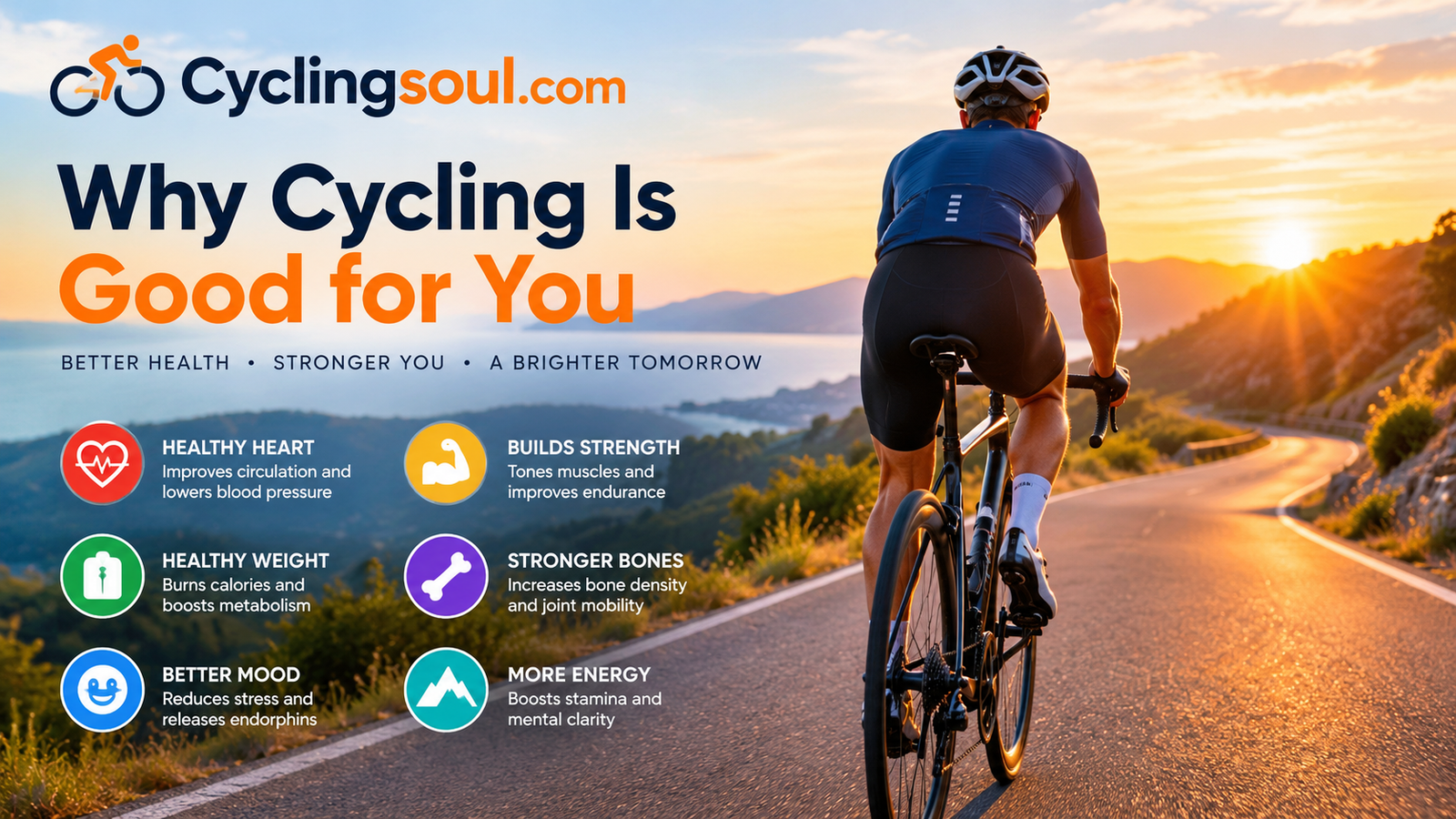
Is Cycling Good for You? What Riding a Bike Really Does for Your Body and Mind
A clear, honest look at the heart, weight, joint, mood and longevity benefits, plus the real risks and how to ride smart.
Ask ten people whether cycling is good for you and you will probably hear ten versions of “of course.” It feels obvious. You pedal, your heart rate climbs, you sweat a little, and you get somewhere. But “feels obvious” is not the same as “well understood,” and plenty of riders could not tell you what is actually happening inside their body, how much riding is enough, or whether the aches they sometimes feel are normal.
This guide goes through it properly. We will look at what cycling does for your heart and lungs, your weight, your muscles, your joints, your mood, your sleep and your long-term health. We will also be straight about the downsides, because there are a few, and most of them are easy to manage once you know about them. By the end you should know whether cycling suits your goals, how much of it to do, and what to buy (or skip) to make it comfortable.

Is Cycling Good for You? The Short Answer
Yes. Regular cycling improves cardiovascular fitness, supports healthy weight, builds lower-body endurance, protects joints better than most impact sports, lifts mood, and is linked in large studies to a lower risk of heart disease, type 2 diabetes and early death. The main risks are road safety, overuse aches from a poor bike setup, and the fact that cycling alone does little for upper-body or bone strength.
That is the headline, and it holds up well. Public health guidelines in most countries recommend around 150 minutes of moderate aerobic activity a week, and cycling is one of the easiest ways to hit that number. A relaxed ride on flat ground counts as moderate. A hilly ride or a quick commute pushes you into vigorous territory. You get to choose the dose, and you can adjust it as your fitness changes.
What makes cycling stand out is not that it is magic. It is that it is sustainable. Exercise only works if you keep doing it, and cycling has a lot going for it on that front. It is low impact, so you can ride the day after a hard session. It scales from a gentle spin to a lung-burning interval workout. It can replace a car trip, so exercise slides into your day instead of competing with it. And it is genuinely fun, which matters more than most fitness advice admits.
The benefits at a glance
| Area of health | What cycling does | How quickly you notice |
|---|---|---|
| Heart and lungs | Strengthens the heart, improves oxygen use, can lower resting heart rate and blood pressure | Within a few weeks |
| Weight and body fat | Burns calories, improves insulin sensitivity, supports fat loss with sensible eating | Gradual, over months |
| Muscles | Builds endurance in quads, glutes, hamstrings and calves | Within a few weeks |
| Joints | Moves joints through a full range without pounding them | Often immediate relief |
| Mood and stress | Raises mood, reduces stress and anxiety symptoms | Same day |
| Long-term health | Lower risk of heart disease, type 2 diabetes and some cancers | Years of consistency |
If you are brand new, our guide on how to start cycling walks through the first few weeks step by step. For now, let us dig into each benefit and see what the evidence says.
Who benefits most?
Almost everyone, but a few groups gain especially large returns. People who have been mostly sedentary see the biggest jump in health from even small amounts of riding. Office workers who sit for most of the day get a valuable counterweight to long hours at a desk. Older adults gain mobility and independence, and people managing weight or blood sugar gain a sustainable form of activity that does not punish their joints. Even experienced athletes use easy cycling as active recovery between harder sessions.
Starting out? Browse beginner-friendly cycling essentials.
Shop cycling essentialsCycling and Your Heart: A True Cardio Workout
Your heart is a muscle, and like any muscle it adapts to the work you give it. When you pedal at a steady, comfortable effort, your heart pumps more blood with each beat, your breathing deepens, and your body gets better at delivering oxygen to working muscles. Over weeks and months this shows up as a lower resting heart rate, easier breathing on hills, and the ability to ride longer without feeling wrecked.
Cycling is a textbook example of aerobic exercise. If you are wondering whether it really counts as proper cardio, we cover that in detail in is cycling good cardio. The short version is yes, and it can be as gentle or as demanding as you like.
Blood pressure and cholesterol
Regular moderate exercise is one of the most reliable non-drug ways to nudge blood pressure down. Cycling helps by improving how flexible and responsive your blood vessels are. It also tends to raise HDL, the “good” cholesterol, and can help lower triglycerides, particularly when paired with a reasonable diet. None of this requires heroic effort. Most of the benefit comes from simply being active regularly rather than from occasional extreme rides.
What the large studies show
One of the most cited findings comes from large population studies of commuters. People who cycled to work were found to have a meaningfully lower risk of heart disease and of dying from any cause compared with those who commuted by car or public transport. Researchers always add a caveat: people who cycle may differ from those who do not in ways that are hard to measure, so the studies show association rather than proof. Still, the pattern shows up again and again across countries, ages and fitness levels, which is why health agencies promote cycling so enthusiastically.
Training zones in plain English
You do not need a lab to ride in a useful heart-rate range. A simple rule: if you can speak in full sentences but could not comfortably sing, you are in the moderate zone that builds your base. If you can only manage a few words at a time, you are in the vigorous zone, which delivers more fitness per minute but needs more recovery. Mixing the two is ideal. Riders who want to measure effort more precisely often look into power-based training, and our explainer on how to train for cycling covers how to structure it without overcomplicating things.
Lungs, breathing and stamina
Your lungs do not get bigger from cycling, but the muscles that drive breathing get stronger and your body gets far better at extracting oxygen from each breath. That is why the same hill that left you gasping in your first week feels like a mild effort a couple of months later. People with mild asthma often find that steady, gradual riding helps their stamina, although cold air and sudden hard efforts can trigger symptoms, so a proper warm-up and having any prescribed inhaler on hand is sensible.
Heart rate recovery as a progress marker
A simple way to see your fitness improving is to notice how quickly your heart rate settles after a hard climb. As your cardiovascular system adapts, you will drop back to a comfortable rate faster. Many riders find this more motivating than any number on a scale, because it reflects something real that changes week by week.
A quick safety note: if you have a known heart condition, chest pain, unexplained breathlessness or have been inactive for a long time, talk to a doctor before ramping up your riding. Starting gently is always fine; starting hard without a check-up is where problems arise.
Track your effort with a heart rate monitor chest strap or watch.
See heart rate monitorsWeight, Calories and Body Fat
Cycling burns calories, and it does so at a rate that surprises many beginners. The exact number depends on your body weight, speed, terrain and wind, but a steady hour of moderate riding commonly burns somewhere in the range of 400 to 700 calories for an average adult, and more if you push the pace or climb. Our breakdown of how many calories cycling burns includes tables for different weights and speeds if you want specifics.
Can cycling help you lose weight?
It can, with a catch that applies to every form of exercise: weight change comes down to energy balance over time. Cycling gives you a large, low-stress way to increase the “calories out” side. But a long ride makes you hungry, and it is very easy to eat back more than you burned. Riders who lose weight successfully tend to ride consistently, keep rides enjoyable enough to repeat, and pay modest attention to food rather than treating every ride as permission for a feast. For a full plan, see cycling for weight loss.
What about belly fat?
You cannot choose where fat leaves your body, so “spot reduction” is a myth. What cycling does is create a calorie deficit and improve insulin sensitivity, which together encourage your body to draw on fat stores, including the visceral fat around the abdomen that carries the greatest health risk. We unpack this in does cycling burn belly fat.
Why intensity and duration both matter
Long, easy rides use a higher proportion of fat as fuel, while shorter, harder efforts burn more total calories per minute and keep your metabolism slightly elevated afterwards. Neither is “better.” The practical approach is a mix: most rides easy and conversational, one or two sessions a week with harder intervals or hills. That combination builds fitness, burns calories and keeps you from burning out mentally.
Fuel, but not too much
For rides under an hour, water and a normal meal beforehand are usually enough. Longer rides call for carbohydrates on the bike. Riders heading out for two hours or more often use gels, chews or simple snacks to avoid the dreaded energy crash. The trick is to match fuel to effort instead of snacking out of boredom.
Realistic expectations
If you ride three times a week for about forty-five minutes at a comfortable pace, you are doing a lot for your health even if the scale barely moves at first. Early on, your body may hold a little extra water as muscles adapt, and you may build some lean tissue, which can mask fat loss. Judge progress by how your clothes fit, how your rides feel, your energy and your measurements rather than daily weigh-ins. Most people see steady change after six to eight weeks of consistent riding combined with reasonable eating.
Keep your energy steady on longer rides with the right on-bike fuel.
Browse cycling nutritionMuscles and Strength: What Cycling Builds (and What It Does Not)
Pedaling is a repeated push-and-pull through the hips, knees and ankles, and the muscles doing that work get stronger and more fatigue-resistant. The quadriceps on the front of the thigh do most of the downward push. The glutes and hamstrings help drive the stroke and stabilize the pelvis, and the calves assist at the bottom. Meanwhile your core muscles work quietly to keep you steady on the saddle. For a complete map, see what muscles cycling works.
Does cycling build muscle or just endurance?
Mostly endurance. Riding at a steady pace trains the slow-twitch fibers that resist fatigue, and you will usually see firmer, more defined legs rather than bulk. Hard hill efforts and big-gear low-cadence work add more strength demand, but for serious muscle growth you need resistance training. We look at this in does cycling build muscle, and the lower-body question many people ask is answered in does cycling build glutes. Short answer on glutes: climbing seated and standing both load them well, and they respond best to hills and heavier gears.
The gaps cycling leaves
- Upper body: your arms, shoulders and back do postural work but are not trained like they would be in swimming or rowing.
- Bone density: cycling is non-weight-bearing, so it does not stimulate bone growth the way walking, running or lifting does.
- Hip flexors and chest: long hours in a folded position can leave these tight if you never stretch.
The fix is simple. Add two short strength sessions a week (squats, lunges, deadlifts, rows, planks, push-ups) and a few minutes of stretching after rides. You do not need a gym. Bodyweight and a pair of resistance bands go a long way.
Why cadence and gearing matter
Many beginners push a heavy gear at a slow cadence because it feels powerful. It also loads the knees and tires the legs quickly. A smoother cadence, often somewhere around 80 to 95 revolutions per minute for most riders, spreads the effort between muscles and your cardiovascular system, which is easier on your joints and lets you ride longer. If you are unsure, shift to an easier gear until the pedals feel light and your breathing is steady, then gradually add resistance on hills.
Strength pros of cycling
- Builds leg endurance steadily
- Low risk of strain compared with heavy lifting
- Works glutes, quads, hamstrings and calves together
- Core engages to stabilize the body
Strength limits to know
- Little upper-body development
- Does not load bones like impact exercise
- Can tighten hips if you never stretch
- Muscle gains plateau without added resistance work
Round out your riding with resistance bands and a foam roller for recovery.
Shop strength & recoveryJoints and Knees: Gentle on the Body, With a Condition
One of the biggest reasons people turn to cycling is that it spares the joints. When you run, each footstrike sends a shock equal to several times your body weight up through ankles, knees and hips. On a bike, the saddle carries your weight, and the motion is smooth and circular. That makes cycling a favorite for people who are carrying extra weight, recovering from injury, or managing arthritis and want to stay active.
Movement also helps joints in a more subtle way. Cartilage has no direct blood supply and relies on motion to circulate nutrient-rich fluid. Gentle, repetitive movement like pedaling helps with that, which is why many people with stiff or achy joints feel better after a spin rather than worse. We go deeper in is cycling good for your knees.
The condition: your bike has to fit
Cycling is only joint-friendly when the bike suits your body. The most common cause of knee pain is a saddle set too low or too far forward, which forces the knee to bend sharply on every stroke. Pain at the front of the knee often points to a low saddle; pain behind the knee often means it is too high. Cleat position, crank length and pedaling in too heavy a gear can also contribute.
- Set saddle height first. At the bottom of the stroke your knee should have a slight bend, not be locked or deeply folded.
- Pedal at a comfortable cadence. Spinning lighter gears at a smooth rhythm is kinder than grinding big gears.
- Check your shoes and cleats. Poor foot position can twist the knee. A pair of stiff, well-fitted cycling shoes makes a real difference.
- Build volume slowly. A sudden jump in mileage is a classic recipe for overuse aches.
Worth knowing: sharp pain, swelling or pain that lingers after you stop riding is not normal soreness. Back off and get it checked, ideally by someone who can also look at your bike fit.
Cycling with arthritis or after an injury
Many physical therapists suggest cycling for people recovering from knee, hip or ankle problems because resistance can be dialed down to almost nothing. A stationary bike is a popular first step since there is no traffic, no balance challenge and you can stop instantly. Raise the saddle slightly, use a light gear, keep sessions short and increase the time gradually. If you are recovering from surgery or a significant injury, follow your clinician’s guidance on when and how hard to ride.
A comfortable saddle and a proper fit take pressure off joints and sit bones.
Find a better saddleMood, Stress and Mental Health
Ask regular riders why they cycle and many will skip the heart-rate talk and say something like “it clears my head.” That is not just a feeling. Aerobic exercise triggers a cascade of changes: endorphins, shifts in serotonin and dopamine, and a drop in circulating stress hormones. Studies of exercise and depression consistently find that regular activity can reduce symptoms of mild to moderate depression and anxiety, and cycling is one of the easier ways to get that dose.
Why cycling suits the mind so well
- Rhythm: the steady cadence of pedaling has a meditative quality that quiets racing thoughts.
- Time outdoors: daylight, fresh air and greenery all independently support mood.
- Progress you can see: a hill that felt impossible in week one feels manageable in week six, which is a quiet but powerful confidence builder.
- Social connection: group rides and club meetups provide company, accountability and friendship.
- A sense of freedom: covering ground under your own power feels good in a way that is hard to describe until you try it.
Cycling also gives you a break from screens. Even a twenty-minute ride around the neighborhood can reset a stressful afternoon. Many riders say the best ideas and the calmest moods come in the middle of a ride, not at the finish.
Solo rides, group rides and everything between
Both kinds of riding have their own mental payoff. Solo rides give you quiet time to think, process your day or simply switch off. Group rides give you conversation, a gentle push to go a little further than you would alone, and a reason to show up when motivation is low. Many riders do a bit of both: a quick solo spin on weekdays and a social ride at the weekend. If you are nervous about joining a group, look for beginner-friendly or no-drop rides, where the whole group waits for everyone.
Please note: exercise is a helpful tool, not a replacement for professional care. If you are struggling with persistent low mood, anxiety or thoughts of harming yourself, please reach out to a doctor, a counselor or a local crisis line.
Make solo rides more enjoyable with open-ear headphones designed for outdoor use.
Browse ride headphonesLongevity and Chronic Disease Risk
This is where cycling’s long-term payoff shows up. Physical inactivity is one of the major drivers of chronic disease worldwide, and regular aerobic activity pushes in the opposite direction on almost every front.
Type 2 diabetes and blood sugar
Working muscles pull glucose out of the bloodstream, and regular exercise makes your cells more responsive to insulin. That is why consistent cyclists tend to have better blood sugar control, and why exercise is a cornerstone of both preventing and managing type 2 diabetes. A short ride after a meal can blunt the post-meal glucose spike, which is one reason an easy evening spin feels so good.
Heart disease and stroke
As covered earlier, cycling is associated with lower rates of heart attack and stroke. The mechanisms stack up: better blood pressure, healthier cholesterol, improved vessel function, lower body fat and reduced inflammation. Each one helps a little, and together they add up.
Cancer
Large studies have linked regular physical activity with a lower risk of several cancers, including colon and breast cancer, and the commuter research found fewer cancer diagnoses among people who cycled to work. As always, this is association rather than a guarantee, but it fits with what we know about exercise, body weight and inflammation.
Living longer, and better
Perhaps the most compelling finding is simple. People who move regularly, in almost any form, tend to live longer than those who do not, and they tend to stay independent and mobile later in life. Cycling is particularly good for this because you can keep doing it well into your seventies and eighties. Many older riders find it the one form of exercise that never got “too hard on the body.”
Immune function
Moderate, regular exercise appears to support immune health, with fewer sick days reported among people who are active. The caveat is that very long, very hard training without enough rest can temporarily suppress immunity. Another reason to build up gradually and respect recovery.
How much does fitness protect you?
Researchers often find that improving fitness from low to moderate delivers more benefit than going from good to elite. In other words, you do not need to train like a racer. The riders who gain the most are the ones who go from doing very little to doing something regularly. That is encouraging, because it means the barrier to entry is low and the rewards begin early.
| Condition | How cycling helps | Best approach |
|---|---|---|
| Type 2 diabetes | Improves insulin sensitivity and glucose uptake | Regular moderate rides, ideally most days |
| High blood pressure | Improves vessel flexibility and lowers resting pressure | 30 minutes of steady riding, several days a week |
| Heart disease risk | Strengthens the heart, improves cholesterol | Build gradually, check with a doctor if at risk |
| Arthritis | Keeps joints moving without pounding | Gentle, low-gear riding on flat terrain |
| Stress-related issues | Lowers stress hormones, lifts mood | Outdoor rides you enjoy, even short ones |
Keep an eye on your distance, speed and progress with a cycling computer.
Explore cycling computersSleep, Energy and Brain Health
People who ride regularly often report that they sleep more deeply, and the science backs this up. Regular aerobic exercise tends to help you fall asleep faster and spend more time in deep sleep. Daylight exposure during outdoor rides also helps anchor your body clock, which is why a morning or lunchtime ride can improve how you sleep that night. A word of caution: very intense riding late in the evening can leave some people wired, so if sleep is an issue, keep the hard efforts earlier in the day.
More energy, not less
It sounds backwards, but spending energy on a bike gives you more of it. Regular riders usually notice that everyday tasks feel easier and that the mid-afternoon slump hits less hard. Better circulation, improved sleep and a fitter heart all play a part.
Sharper thinking
Aerobic exercise increases blood flow to the brain and stimulates growth factors that support nerve cells, particularly in areas tied to memory and learning. Studies in older adults suggest that regular activity is linked with slower cognitive decline and a lower risk of dementia. Even in younger people, a moderate ride can sharpen focus and creativity for the hours afterward, which is why plenty of writers, programmers and designers swear by a midday spin.
Cycling as a habit anchor
Good habits tend to cluster. People who start riding regularly often find themselves sleeping earlier, drinking more water and paying more attention to food, not because they are following rules but because they feel better when they do. This ripple effect is one of the underrated benefits of picking up a bike.
Boost visibility and safety for early-morning and evening rides with quality bike lights.
Shop bike lightsCommuting, Time and Money: The Practical Benefits
Not every benefit of cycling happens inside your body. Some of the best ones show up in your calendar and your bank account.
Exercise that fits into your day
The number one reason people skip workouts is lack of time. Cycling to work, to the shop or to a friend’s house turns travel time into training time. A twenty-minute ride each way adds up to roughly 200 minutes a week, which clears the recommended activity target on its own. In congested cities, the bike is often as fast as a car door to door, and you never circle the block looking for parking.
Money saved
A bike costs a fraction of a car to buy and maintain. No fuel, no insurance, far fewer repair bills, and often no parking fees. Even if you only replace a few short car trips a week, the savings add up across a year.
A gentler footprint
Cycling produces no tailpipe emissions and very little noise. Choosing the bike for short trips reduces congestion and air pollution, which benefits everyone, including people who never ride.
Discovering your area
On a bike you notice things you would miss from a car: a hidden park, a bakery, a quiet lane with a great view. Many riders say their sense of connection to their neighborhood grew once they started exploring on two wheels.
What to wear and carry
You do not need special clothing for short, casual trips, but a few items make longer rides noticeably better. Padded cycling shorts or cycling bibs take the pressure off the saddle area, and our guide on what to wear cycling covers layers for every kind of weather.
Cycling with family and friends
Cycling is one of the few activities that works across generations. Children can learn on quiet paths while adults enjoy an easy pace, and trailers, tag-alongs and cargo bikes make it possible to take very young passengers along. Shared rides become a regular tradition, and for kids they build confidence, coordination and an early habit of being active that often lasts into adulthood.
Carry your work gear comfortably with a bike commuter backpack or pannier.
Shop commuter bagsRisks and Downsides: The Honest Part
Cycling is good for you, but it is not risk-free, and pretending otherwise helps nobody. The good news is that nearly all of the downsides can be reduced with a little preparation.
Pros
- Low-impact, joint-friendly cardio
- Easy to scale up or down
- Fits into daily life
- Strong mental health benefits
- Linked to longer, healthier life
Cons
- Road traffic and fall risk
- Saddle and posture discomfort
- Limited bone and upper-body stimulus
- Weather and daylight limits
- Initial cost of gear
Traffic and falls
This is the big one. Collisions with vehicles and simple falls cause the most serious injuries. The overall health benefits still outweigh the risks for most people, according to major reviews, but you can improve your odds considerably:
- Wear a well-fitted helmet every ride.
- Use front and rear lights, and wear bright or reflective clothing in low light.
- Choose bike lanes, quiet streets and off-road paths when you can.
- Ride predictably, signal clearly and make eye contact at junctions.
- Keep your bike maintained, especially brakes and tires.
Saddle soreness and numbness
Pressure on soft tissue is a common complaint. Fixes include a saddle that matches your sit-bone width, a slight adjustment to its tilt and height, padded shorts, and standing briefly on rides to restore circulation. Persistent numbness should not be ignored.
Neck, back and hand pain
Too long a reach or too low a handlebar can strain the neck, shoulders and lower back, and constant pressure on the palms can numb fingers. A small change, like raising the bars, shortening the stem or wearing padded gloves, often solves it. A professional bike fit is money well spent if you ride a lot.
Bone health and weather
Because cycling does not load the skeleton, riders who do nothing else, especially older riders and women, should add some weight-bearing or resistance work. As for weather, the old saying holds: there is no bad weather, only the wrong clothing. Layering, waterproofs and good socks keep you out there more days of the year.
Heat, hydration and sun
It is easy to underestimate how much you sweat on a bike because the moving air cools you down. On warm days, sip water regularly rather than waiting until you are thirsty, and for rides beyond an hour consider adding electrolytes. Use sunscreen on exposed skin, wear sunglasses to protect your eyes from sun, dust and insects, and plan your hardest rides for the cooler parts of the day. In cold weather, protect your hands, feet and ears, because they lose heat first and can make an otherwise good ride miserable.
Protect yourself with a certified, well-fitted bike helmet.
Compare bike helmetsCycling vs Other Exercise: How Does It Stack Up?
“Best exercise” is a trap. The best exercise is the one you will actually do regularly, and for lots of people that is cycling. Still, it helps to see how it compares.
| Activity | Joint impact | Calorie burn | Bone loading | Easy to keep up? |
|---|---|---|---|---|
| Cycling | Low | Moderate to high | Low | Very |
| Running | High | High | High | Moderate |
| Walking | Low | Low to moderate | Moderate | Very |
| Swimming | Very low | Moderate to high | Very low | Moderate (needs a pool) |
| Strength training | Varies | Low to moderate | High | Moderate |
The detailed head-to-head between the two most popular options is in cycling vs running. In short, running burns more calories per minute and builds bone, while cycling is easier on joints and lets most people exercise longer. If you are choosing between them for weight loss or general fitness, many people do best by doing both, plus some strength work.
The ideal weekly mix
A balanced week might include three or four rides of varying length and effort, two short strength sessions, and one day of easy movement like walking or yoga. That covers heart, muscles, bones, flexibility and recovery without needing hours in the gym.
Cycling, walking and the case for variety
A single activity can leave gaps, so mixing movement is smart. Cycling gives you cardio and leg endurance, a weekly walk or jog adds bone loading, and short strength sessions cover everything else. You do not have to overthink it. Treat cycling as the backbone of your routine and fill in the gaps with whatever you enjoy, whether that is swimming, yoga, hiking or a pickup game with friends. Variety also lowers the risk of overuse injuries and keeps exercise from feeling stale.
Can’t ride outdoors? An indoor trainer keeps your fitness going in any weather.
See indoor trainersHow Much Cycling Is Enough, and How to Start
Health guidelines for adults suggest at least 150 minutes of moderate activity or 75 minutes of vigorous activity a week, plus muscle-strengthening work twice a week. You do not have to hit that on day one. Something is always better than nothing, and the biggest health gains come from moving from inactive to even a little active.
A simple beginner plan
| Week | Rides per week | Typical ride length | Effort |
|---|---|---|---|
| 1 to 2 | 2 to 3 | 15 to 25 minutes | Easy, conversational |
| 3 to 4 | 3 | 25 to 40 minutes | Easy with a few short harder bursts |
| 5 to 8 | 3 to 4 | 30 to 60 minutes | Mostly easy, one session with hills or intervals |
| 9 onward | 3 to 5 | Mix of short and one longer ride | Add structure as you like |
Five tips that make the habit stick
- Start shorter than you think you should. Finishing a ride feeling like you could do more is the way to want to ride again.
- Pick the same days and times. Habits form faster when they are predictable.
- Find a route you love. A pretty loop beats a fast road every time.
- Ride with someone. A friend or a local group adds fun and accountability.
- Make small upgrades. Better shorts, a comfortable saddle, good cycling shoes and proper lights remove the little irritations that make people quit.
Once riding becomes routine, you may get curious about structured training, and our pieces on training for cycling and starting out make a good next step.
Common beginner mistakes to avoid
- Going too hard too soon. Early enthusiasm leads to sore knees and burnout. Keep most rides easy for the first month.
- Ignoring bike fit. A saddle that is slightly too low or too high will cause trouble over time. Take ten minutes to set it up properly or ask a local bike shop.
- Skipping basic maintenance. Check tire pressure, brakes and chain before rides. A smooth, well-kept bike is more pleasant and far safer.
- Forgetting to eat and drink. Even moderate rides go better with proper hydration, and longer rides need food.
- Wearing the wrong clothes. Cotton gets heavy and cold when wet. Breathable fabrics and layers keep you comfortable.
- Riding the same way every time. Vary your routes, pace and terrain to keep it interesting and to keep improving.
Get these basics right and cycling quickly goes from something you try to something you look forward to, which is exactly where the health benefits start to compound.
Everything a new rider needs, from helmets to repair kits, in one search.
Shop starter kitsFrequently Asked Questions
Is cycling good for you every day?
Yes, for most people. Easy daily riding such as commuting or a casual spin is perfectly fine and can improve fitness and mood. If you ride hard, include easy days or rest days so your body can recover, and listen for signs of overtraining such as persistent fatigue, a raised resting heart rate or nagging aches.
How long should I cycle each day to stay healthy?
Around 20 to 30 minutes a day, five days a week, meets the general guideline of 150 minutes of moderate activity. You can break it into shorter chunks, like two ten-minute rides, and still get benefits.
Is cycling good for losing weight?
It can be a very effective part of weight loss because it burns a lot of calories and is easy to sustain. Results depend on your overall food intake too. Combining regular rides with sensible eating works better than relying on exercise alone.
Is cycling better than walking?
Cycling burns more calories per minute at a typical effort and builds more leg endurance, while walking is simpler and loads the bones more. Both are excellent. Pick whichever you will do consistently, or enjoy a mix.
Is cycling bad for your knees?
Not when your bike fits properly. Cycling is low impact and is often recommended for people with sore knees. Pain usually comes from a poor saddle height, poor cleat position or pushing heavy gears at a slow cadence, all of which can be corrected.
Does cycling help with stress and anxiety?
Yes. Regular aerobic exercise lowers stress hormones, boosts feel-good brain chemicals and gives you outdoor time and a mental break. It works best as part of a wider approach, and it does not replace professional help when that is needed.
Can cycling build muscle?
It builds muscular endurance and firm, defined legs, particularly with hill riding and harder efforts. For substantial muscle growth or upper-body strength, add resistance training on top of your rides.
Is indoor cycling as good as riding outside?
For fitness, yes. Stationary and trainer sessions give you the same cardiovascular and muscle benefits and are convenient in bad weather or when you are short on time. Outdoor riding adds fresh air, daylight and variety, which many people find better for mood.
Is cycling safe for older adults?
Generally yes, and it is one of the best ways to stay active with age because of the low joint impact. Older riders should wear a helmet, choose safe routes, consider a comfortable or electric-assist bike if needed, and talk to a doctor if they have existing health conditions.
Does cycling affect bone health?
Cycling does not load the bones much, so it is not ideal as your only exercise for bone density. Pair it with walking, jogging, jumping or resistance training to keep bones strong.
Do I need special gear to get the health benefits?
No. Any reasonably fitting bike in working order will do. A helmet and lights are the essentials for safety. Comfort items like padded shorts, a good saddle and proper shoes help you ride longer and more often, which is where the benefits come from.
Are e-bikes still good for you?
Yes. Research suggests e-bike riders still get meaningful exercise, and they often ride more frequently and for longer than they would on a regular bike. They can be a smart option for beginners, hilly areas, longer commutes or anyone returning to activity.
Conclusion: So, Is Cycling Good for You?
Absolutely. Cycling strengthens your heart, supports a healthy weight, builds leg endurance, treats your joints kindly, lifts your mood, helps you sleep and is linked to a longer, healthier life. It does come with a few risks, mainly traffic, posture and a lack of bone and upper-body loading, but a helmet, lights, a good bike fit and a little strength work take care of most of them.
The best part is how approachable it is. You do not need to be fit, fast or fancy. Start with short, easy rides, build slowly, and let the habit grow. If you want a gentle first step, read how to start cycling and get out for twenty minutes this week. Your future self will thank you.
Ready to ride? Grab the gear that makes every mile more comfortable.
Shop cycling gear