

Gear Lab · Tested, Compared, Ranked
Best Cycling Bibs: 14 Pads, Straps and Fabrics Put to the Test
From bargain-basement bibs that embarrass the big names to Italian race-day armour costing several times more — here is exactly which pair deserves a place in your drawer.
There is a strange moment that happens somewhere around hour three of a long ride. You stop thinking about your legs, your breathing, or that headwind you have been fighting since the turnaround — and you start thinking about your backside. That moment is where good cycling bibs prove their worth, and where bad ones ruin an otherwise perfect day out. After months of riding in everything from thirty-dollar internet bargains to flagship Italian race kit, we are convinced that the chamois is the single most important piece of equipment you will ever sit on, and that the gap between the best and the worst is far wider than the gap in price.
This guide is built for real riders: people who ride two hours on a Saturday, commuters who log daily saddle time, gran fondo first-timers, and racers who care about grams and seam placement. We break down fourteen bib shorts across every price tier, explain what actually matters inside a pad, and tell you plainly where spending more pays off and where it does not. If you are completely new to the sport, our beginner’s guide to starting cycling pairs well with this article, and if you already know you want padded shorts rather than full bibs, we have a dedicated roundup of the best cycling shorts too.
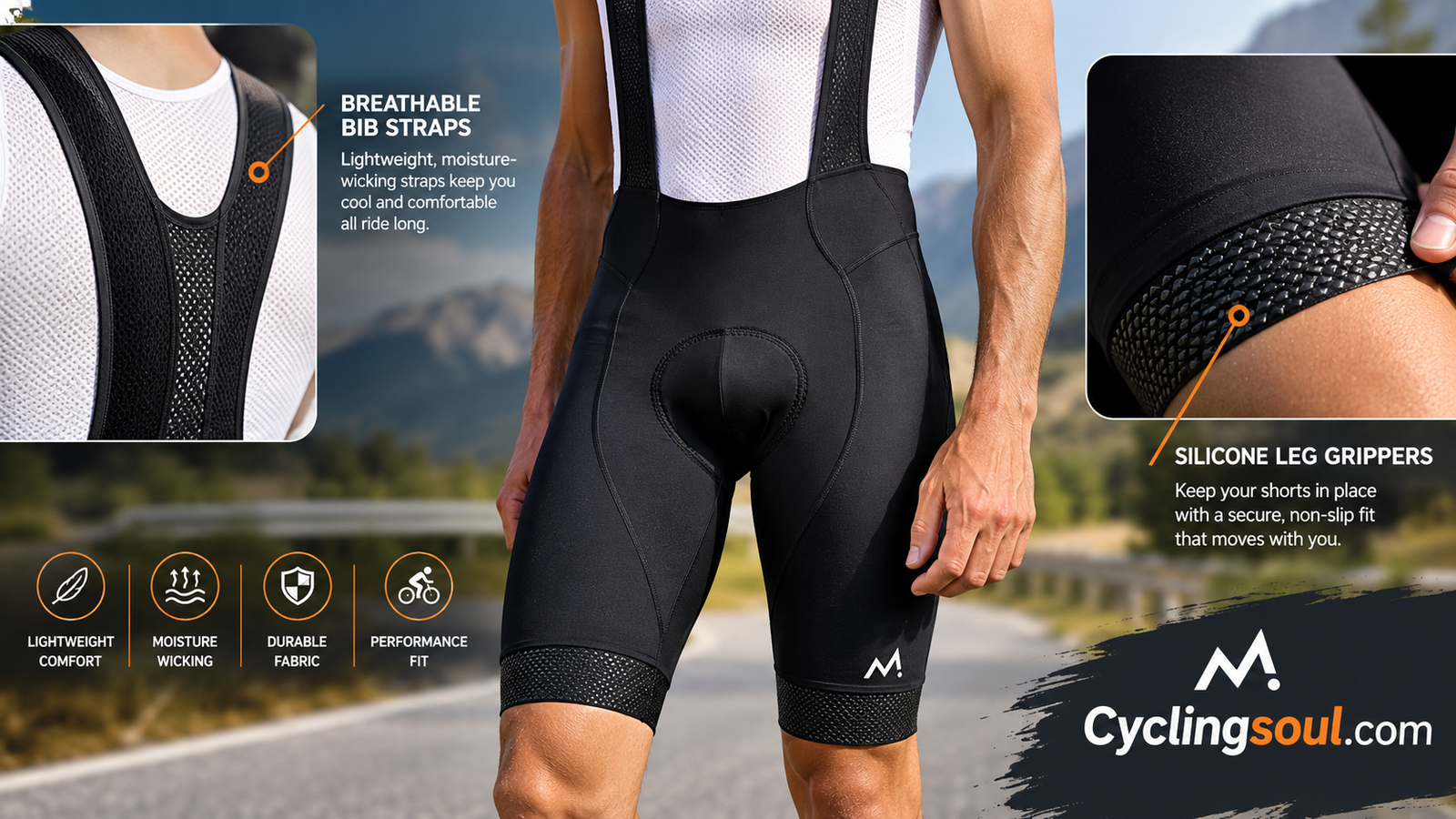
01Why Bibs Beat Regular Cycling Shorts
Walk into any group ride and you will see a clear dividing line: experienced riders almost universally wear bib shorts, while newcomers often default to standard waist shorts. This is not snobbery or tradition. Bib shorts solve three very specific mechanical problems that ordinary shorts cannot.
Problem one is the waistband. When you are bent into an aggressive riding position, a conventional elastic waistband rolls, digs, and presses into your abdomen exactly when you are trying to breathe deeply. Over four hours of sustained effort, that pressure becomes genuinely uncomfortable and can even restrict your diaphragm. Bib shorts replace the waistband with shoulder straps, leaving your midsection completely free. The result is a garment that holds the pad in place through the straps rather than through compression around your waist.
Problem two is pad migration. A chamois only works when it sits exactly where your sit bones meet the saddle. In waist shorts, the pad shifts every time you stand, stretch, or reach for a bottle. Each millimetre of drift is a millimetre of pressure in the wrong place. Bib straps anchor the entire garment to your shoulders, so the pad stays registered to your anatomy no matter how much you move. Once you experience a pad that does not creep, you cannot go back.
Problem three is the gap. Anyone who has worn waist shorts on a windy day knows the draft that appears between jersey and shorts when you stretch for the bars. Bib shorts extend higher up the torso with a mesh or woven upper, sealing that gap and adding a small but real layer of core temperature regulation. In cool conditions the extra coverage is welcome; in heat, a well-designed mesh upper breathes so freely you forget it is there.
The trade-offs worth knowing
Bibs are not perfect. Bathroom stops require a bit of choreography — most riders pull the straps down rather than attempting any complicated arrangement, and female riders in particular should look for designs built with that reality in mind. Bibs also cost slightly more to manufacture because of the extra fabric and strap hardware, so at the very bottom of the price range the compromises show up sooner. And they are strictly a next-to-skin garment: no underwear beneath them, ever, because a second layer of fabric creates seams and friction exactly where you least want them.
For riders using cycling as a fitness tool, the comfort advantage compounds quickly. Comfortable riders ride longer, and longer rides are what drive the aerobic adaptations that make cycling such an effective training stimulus. Our articles on why cycling is superb cardio and cycling for weight loss both circle back to the same simple truth: the best training plan in the world fails if you cannot sit on the saddle long enough to execute it.
02How We Evaluate Every Pair
Marketing copy for cycling kit is a fog of proprietary acronyms. Every brand has a cooling technology, a weight-saving weave, and a pad with a number in its name. Strip away the trademark language and every bib short is judged on six fundamentals. These are the pillars we use to rank everything in this guide, and they are the same criteria you should apply when you shop.
1. Chamois quality and placement
The pad is the product. We assess density layering, surface fabric, edge profile, breathability channel design, and how well the pad is stitched into the short. A great pad in a poor pattern is still a poor short, so we also check that the pad sits correctly across a range of riding positions, from upright endurance posture to a slammed race stance.
2. Fabric compression and recovery
Good leg fabric supports the muscles without feeling like a tourniquet. We look for a four-way stretch weave with meaningful elastane content, a soft brushed inner face, and a matte exterior that resists pilling. Cheap fabrics feel fine in the first week and bag out at the knee and thigh after a month; better knits hold their shape through hundreds of washes.
3. Strap construction
Straps should be wide, flat, and soft, with minimal seaming over the shoulders. Laser-cut or bonded edges beat folded-and-stitched edges under a jersey. We also test how the straps behave when wet with sweat, and whether they stay put through out-of-the-saddle efforts.
4. Leg grippers
The gripper is a small component with an outsized effect on comfort. Silicone print or woven elastic bands must hold the leg in place without creating the dreaded thigh sausage effect. We prefer wide, low-tension grippers with multiple silicone dots rather than a single aggressive band.
5. Seam architecture
Flatlock stitching is table stakes. The real differentiator is panel count and seam routing — fewer, better-placed seams mean fewer potential hotspots. We pay close attention to the seams running through the inner thigh and under the glutes, where friction is highest.
6. Durability and value
We wash bibs on a regular cycle and inspect for stitching failure, gripper breakdown, fabric thinning, and pad deformation. Value is not simply low price; it is how much usable riding a pair delivers before it needs replacing.
The evaluation checklist at a glance
- Pad comfort over three-plus hours — the only test that really matters for endurance riders.
- Fit consistency across body types — does the sizing chart match reality?
- Thermal behaviour — does the fabric breathe in heat and offer some coverage in cool air?
- Odour resistance — synthetic fabrics that hold smell get worn less, regardless of quality.
- Strap stability while standing and climbing — the moment the pad shifts is the moment comfort ends.
- Wash resilience — gripper elasticity and seam integrity after repeated cycles.
One note on riding context: comfort is only part of performance. Training load, pacing and nutrition shape how a ride feels as much as kit does. Riders chasing structured improvement will benefit from understanding what FTP means in cycling and building a plan around it, because a well-paced ride on average bibs still beats a blown-up ride on the most expensive kit in the shop.
03The Full Comparison Table
Fourteen bib shorts, one screen. Use this table as your orientation map before diving into the detailed reviews below. Tiers reflect typical street pricing relative to the market rather than any single day’s deals, and pad designations are summarised in plain language instead of trademark soup.
| Bib Short | Pad Class | Tier | Best For | Standout Feature |
|---|---|---|---|---|
| Przewalski Men’s 3D Padded | 3D multi-density | Budget | First bibs, indoor trainer | Shocking value for the pad |
| CEROTIPOLAR Men’s 4D MaxCool | 4D multi-density | Value | Hot-weather riding | Cooling fabric with UPF coverage |
| baleaf Men’s 4D Padded | 4D gel hybrid | Budget | Daily training miles | Consistent sizing, huge size range |
| LAMEDA Women’s Padded | 3D women’s specific | Value | Women riders, long days | Female-specific pad placement |
| Bikewa 3D Padded | 3D gel | Budget | Short-to-mid distance | Wide comfort waistband |
| PEARL iZUMi Attack | Multi-density SELECT | Mid | Everyday road riding | Proven race-derived fit |
| PEARL iZUMi PRO | High-end multi-density | Premium | Racing, fast group rides | Compressive premium fabric |
| GOREWEAR C5 | Advanced road insert | Upper-mid | All-round road use | Impeccable panel engineering |
| GOREWEAR C7 Racing | High-end racing insert | Premium | Race day, crits, tempo | Minimalist, locked-in fit |
| GOREWEAR Spinshift | Advanced endurance insert | Upper-mid | Long endurance rides | Recycled content, comfort focus |
| Castelli Entrata | Comfort multi-density | Upper-mid | Entry to Italian fit | Legendary Castelli cut |
| Castelli Competizione | Performance multi-density | Premium | Training races, hard efforts | Compressive Giro-style leg |
| Santic Men’s 4D Padded | 4D gel hybrid | Budget | Value seekers, spinning | Wide elastic bib straps |
| Canari Men’s Cycling Bib | Comfort gel | Budget | Casual road and path riding | Simple, dependable construction |
Choosing a tier that matches your riding
If you ride fewer than three hours at a time and mostly on weekends, a well-chosen budget bib will serve you beautifully and save your money for better tyres or a proper bike fit. If you regularly ride four hours and beyond, the endurance-tuned pads in the mid and premium tiers earn their keep through better pressure distribution over time. Racers and competitive riders will appreciate the compressive fabrics and lower-profile pads of the premium options, which prioritise stability and aerodynamics over plushness.
Kit does not exist in isolation, either. The complete comfort equation includes your saddle, your shoes, your socks, and what you wear against your skin. If you are rebuilding your wardrobe from the ground up, take a look at our guide to what to wear cycling, and consider pairing a new bib with shoes from our best cycling shoes roundup and a few pairs from our best cycling socks picks.
04Budget Kings That Punch Above Their Price
The budget category has transformed in the last decade. Manufacturing improvements that were once exclusive to premium labels have filtered down, and today’s best inexpensive bibs genuinely work for real riding. The five models below all deliver a pad that is honest and comfortable, straps that stay put, and fabric that survives regular washing. What you give up is refinement — simpler panel layouts, heavier fabrics, and grippers that wear faster — not functionality.

Przewalski Men’s 3D Padded Cycling Bib Shorts
The Przewalski is the pair we hand to friends who say they want to try bibs without committing serious money. It is remarkably difficult to fault at its price: the 3D multi-density pad has real channel structure rather than a flat slab of foam, the mesh upper breathes well, and the leg length is modern rather than the awkward short cut that plagues cheap kit.
The fabric is a mid-weight knit with enough elastane to feel supportive without restricting movement. Compression is lighter than premium bibs, which means it will not stabilise muscle tissue on descents the way race kit does, but for steady endurance riding that is a non-issue. The strap edges are stitched rather than bonded, which shows up as slightly more bulk under a fitted jersey, but the straps themselves are soft and wide enough to avoid digging.
What We Like
- Pad quality genuinely outperforms the price bracket
- Breathable mesh upper works well in warm weather
- Reflective accents for low-light visibility
- Excellent first-bib option for new riders
Worth Knowing
- Fabric is heavier than premium alternatives
- Stitched strap edges show under race-fit jerseys
- Grippers lose tension faster with frequent washing

baleaf Men’s 4D Padded Cycling Bib Shorts
baleaf has built its reputation on consistent fit and enormous size coverage, and these 4D padded bibs show exactly why that matters. Where many budget brands treat sizing as an afterthought, this is a garment that behaves predictably across a wide range of bodies — which makes it the safest blind buy in the entire category.
The 4D pad blends gel inserts with multi-density foam, giving it a slightly softer initial feel than purely foam-based designs. That plushness is welcome on moderate-length rides, though riders who prefer a firmer, more supportive platform may find it too forgiving after three hours. Wicking is good: the fabric pulls sweat away efficiently and dries quickly between efforts, which matters enormously on stop-start rides or indoor sessions.
What We Like
- Wide, inclusive sizing with reliable chart accuracy
- Soft gel-blend pad feels good straight away
- Dries fast and handles indoor training sweat well
- Extremely popular — easy to find rider feedback
Worth Knowing
- Gel elements can feel soft for aggressive racing positions
- Fabric durability is adequate, not exceptional
- Fewer premium finishing details

Bikewa 3D Padded Cycling Bib
The Bikewa takes a comfort-first approach with a wide waistband and a plush 3D gel pad that suits riders who spend their time at an upright, endurance-oriented position. If you ride a hybrid, a gravel bike with a tall stack, or simply prefer an easier pace, this is the budget bib most likely to feel right immediately.
Panel construction is relatively simple, which keeps costs down and also keeps seams away from high-friction zones. The trade-off for that plushness is a pad that compresses more over very long rides than firmer alternatives, so riders heading out for four-hour epics may want to step up a tier. For two-hour coffee runs and daily exercise rides, though, the Bikewa is genuinely pleasant to wear.
What We Like
- Wide waistband adds comfort when off the bike
- Soft pad suits upright riding positions
- Light compression feels natural, not restrictive
- Great value for casual and fitness riders
Worth Knowing
- Plush pad compresses on very long rides
- Not ideal for aggressive, low race positions
- Fewer technical details than performance-focused options

Santic Men’s 4D Padded Cycling Bib Shorts
Santic has been quietly equipping club riders for years, and their 4D padded bib is a strong performer where budget kit often falls apart: strap comfort. The wide elastic straps distribute pressure across a broad area of the shoulder, which makes a real difference on the turbo trainer where you are locked in one position for an hour at a time.
The pad is a gel and foam hybrid with generous coverage under the sit bones, and the mesh upper handles heat build-up well. On the road it is a capable two-to-three-hour short; indoors, where comfort constraints are amplified by the inability to coast or shift weight, it performs above its price point. Seams are flatlocked throughout, and the leg grippers use a moderate-tension silicone print that holds without pinching.
What We Like
- Wide straps genuinely reduce shoulder pressure
- Strong breathability for indoor sessions
- Well-placed flatlock seams
- Excellent price-to-comfort ratio
Worth Knowing
- Gel pad is better for steady efforts than sprinting
- Styling is understated compared to premium brands
- Fabric recovery softens over extended use

Canari Men’s Cycling Bib Shorts
Canari takes an old-school, no-nonsense approach: straightforward construction, a comfortable gel pad, and a fit that avoids surprises. There is no marketing mythology here, just a bib short that does the fundamental job well for riders who want something dependable without analysing spec sheets.
The gel pad prioritises all-day softness, which makes the Canari particularly appealing to riders returning to cycling after a break or transitioning from heavily padded hybrid shorts. Panel layout is classic rather than aero-optimised, so the fit is relaxed through the thigh without feeling loose. Durability is a strong point: the fabrics and stitching handle frequent washing better than most competitors at this level.
What We Like
- Forgiving fit that suits a wide range of riders
- Soft gel pad reduces saddle discomfort quickly
- Sturdy construction that washes well
- Great option for riders new to bibs
Worth Knowing
- Less compressive and less aero than performance bibs
- Pad is soft rather than supportive on long climbs
- Basic aesthetics with limited colour options
Who should buy budget bibs?
Budget bibs make sense for three groups: new riders who are still discovering their fit preferences, indoor trainers who burn through kit with sweat and washing, and experienced cyclists building a rotation so they are never forced to ride in unwashed shorts. If any of those describe you, spending premium money is unnecessary. And remember that comfort is cumulative — pairing good kit with sensible progression, as outlined in our guide to how to start cycling, matters more than any single garment.
05The Value Sweet Spot: CEROTIPOLAR & LAMEDA
Between the bargain tier and the big-brand mid-range sits a fascinating group of bib shorts that offer technology normally reserved for premium kit. These value-sweet-spot models are where smart shopping pays the biggest dividend: you get genuine pad engineering, thoughtful fabric selection, and rider-focused features without the brand premium.

CEROTIPOLAR Men’s 4D MaxCool Cycling Bib Shorts
If you ride in heat, humidity, or relentless summer sun, the CEROTIPOLAR MaxCool deserves your attention. The fabric is engineered for cooling and sun protection rather than pure weight savings, and the 4D pad is one of the most sophisticated you will find outside premium brand territory.
The pad features multiple density zones with a pronounced central relief channel and perforated sections for airflow. Under sustained effort in warm conditions, that ventilation genuinely reduces the clammy feeling that plagues many budget pads. The main fabric offers meaningful sun protection, which matters more than most riders realise: long days in the saddle accumulate serious UV exposure, and covered skin stays cooler as well as safer.
What We Like
- Sophisticated 4D pad with genuine ventilation
- Excellent thermal performance in hot conditions
- UPF-rated fabric protects on long sunny rides
- Fit is athletic without being punishingly tight
Worth Knowing
- Cooling fabric is slightly thicker than ultralight race knits
- Style is sporty rather than minimalist
- Limited retail presence means sizing research matters

LAMEDA Women’s Padded Cycling Bib Shorts
Women’s bib shorts have historically been an afterthought, and that is slowly changing. The LAMEDA is one of the strongest value options designed around female anatomy from the pad up — which is the only way a bib short can truly work for women riders.
The pad is shaped and placed for female sit-bone spacing and pressure patterns rather than being a resized men’s insert. Strap geometry is designed to sit comfortably across the chest and shoulders, and the upper coverage makes layering straightforward. Compression is moderate and supportive, and the fabric provides sun protection for long days out. We cover this topic in much greater depth in our guide to the best women’s cycling shorts, but the LAMEDA earns its place here as a genuine best-in-class value pick.
What We Like
- Genuinely female-specific pad geometry
- Comfortable strap design for all-day wear
- Supportive compression without restriction
- Outstanding value in an underserved category
Worth Knowing
- Size range is narrower than some competitors
- Fabric finish is functional rather than luxurious
- Availability can vary through the season
Why the value tier rewards research
Value-tier brands spend less on marketing and retail presence and more on components. That is why a mid-priced bib from a specialist brand can outperform a premium big-name product in pure pad comfort. The compromise is usually in finishing details, long-term fabric recovery, and size consistency — all of which are manageable if you read reviews carefully and follow sizing charts closely. We will cover sizing in detail later in this guide.
06PEARL iZUMi: Attack & PRO
Few brands have done more to define modern cycling apparel than PEARL iZUMi. Their approach is engineering-led: fabric technologies developed in one tier filter down to the next, and even their accessible models benefit from decades of race feedback. The Attack and the PRO represent two ends of that philosophy — one is the intelligent everyman’s bib, the other is uncompromising performance kit.

PEARL iZUMi Attack Bib Shorts
The Attack is the bib short we recommend most often to riders who want brand-name engineering without paying race-day prices. It inherits fit philosophy and fabric know-how from PEARL iZUMi’s higher tiers, and the result is a garment that feels considered in every detail: strap width, seam placement, pad positioning, and leg length all feel deliberate.
The fabric strikes an excellent balance between compression and comfort. It holds the muscles firmly enough to feel supportive on descents and sustained efforts, yet it never feels like it is squeezing. The pad is a proven multi-density design with excellent moisture management, and its shape works across both upright endurance positions and lower, more aggressive postures — versatility that budget pads rarely achieve.
What We Like
- Excellent balance of compression and comfort
- Pad performs well across multiple riding positions
- Refined strap and seam design
- Proven durability across many wash cycles
Worth Knowing
- Firmer pad feel than plush comfort-focused bibs
- Fit is athletic — sizing up may suit some riders
- Styling is deliberately understated

PEARL iZUMi PRO Cycling Bib Shorts
The PRO is what happens when a manufacturer stops cutting corners. Every component — from the high-end multi-density chamois to the compressive premium knit to the bonded strap edges — is selected for performance rather than price. This is the bib short for riders who race, ride fast group events, or simply want the best tool for the job.
Compression is the defining characteristic. The fabric supports the muscles noticeably, reducing the micro-oscillations that contribute to fatigue over long, hard efforts. The pad is thinner than comfort-oriented designs yet more supportive, because it uses higher-grade foams with better density separation. In an aggressive riding position it feels superb: stable, dry, and completely unobtrusive.
What We Like
- Outstanding pad stability in aggressive positions
- Meaningful muscle compression reduces fatigue
- Premium finishing with minimal seam bulk
- Excellent moisture management at high intensity
Worth Knowing
- Firm fit demands accurate sizing
- Premium investment compared with mid-tier options
- Thin pad feel is not for riders who prefer plushness
Attack or PRO: which suits you?
Choose the Attack if your riding is varied — weekend group rides, charity events, the occasional sportive, daily training loops. Choose the PRO if you race, ride hard, and value stability and compression over softness. Either way, the ecosystem matters: a good bib works best alongside proper footwear and contact points, so consider upgrading shoes and socks alongside your kit. Our cycling shoes guide and cycling socks guide cover those companion upgrades.
07GOREWEAR: C5, C7 Racing & Spinshift
GOREWEAR brings a materials-science pedigree to cycling apparel that few brands can match. Their range is structured in clearly defined tiers, and each of the three bibs here represents a different philosophy: the C5 as the do-everything road short, the C7 Racing as the uncompromising race weapon, and the Spinshift as the endurance-focused comfort machine. Understanding the differences between them is the key to spending wisely.

GOREWEAR C5 Cycling Bib Shorts
The C5 is the benchmark against which we judge panel engineering. GOREWEAR’s pattern-making is exceptional: the shorts wrap the leg with minimal bunching, seams sit exactly where they should, and the pad interface feels seamless. It is a bib short that flatters almost every body shape, which is rarer than it sounds.
The pad is an advanced multi-density road insert with a shape tuned for sustained road riding — dense enough under the sit bones for five-hour days, with enough surface softness to avoid hotspots early in a ride. The fabric has a slightly more substantial hand than ultralight race knits, which translates directly into durability; these are shorts that hold their compression and appearance far longer than average.
What We Like
- Exceptional panel engineering and fit consistency
- Excellent long-ride pad support
- Outstanding durability and shape retention
- Works across a wide range of riding styles
Worth Knowing
- Fabric is warmer than featherweight race options
- Fit runs athletic and precise
- Price sits above entry-level brand-name bibs

GOREWEAR C7 Racing Bib Shorts
The C7 Racing is designed with a single objective: disappear at race pace. Every element is minimised — the pad is low-bulk and high-density, the fabric is compressive and smooth, and the grippers use precise silicone placement rather than heavy bands. It is a short-sleeved jersey of the bib world: lean, purposeful, and fast.
At race intensity, the C7 is superb. The pad stays perfectly registered to the sit bones through sprints, surges, and out-of-the-saddle climbing, and the compression genuinely helps the legs feel more controlled during repeated hard efforts. Where it differs from endurance bibs is in its philosophy: this is not the plushest short for a six-hour social ride, and riders who prize softness above all should look elsewhere in the range.
What We Like
- Pad stability at race intensity is outstanding
- Compressive fabric supports hard efforts
- Minimal bulk under a race-fit jersey
- Precise gripper placement without pressure points
Worth Knowing
- Not the plushest choice for ultra-long social rides
- Aggressive fit leaves no room for sizing errors
- Race-focused pricing

GOREWEAR Spinshift Bib Shorts
The Spinshift line takes GOREWEAR’s engineering and points it at comfort over distance, with a strong emphasis on responsible materials. It is the bib we reach for on big days out — long climbs, long descents, and the kind of rides where you finish with more hours on the clock than you planned.
The endurance insert is tuned for hours rather than minutes: slightly more generous under the sit bones, with a wider support platform that distributes pressure as the ride gets long. The fabric incorporates recycled content without feeling compromised — the hand is soft, the stretch is natural, and the recovery after washing has been strong in our testing. Straps are wide and gentle, which matters enormously after hour four.
What We Like
- Designed from the ground up for long-distance comfort
- Wide support platform reduces pressure over time
- Responsible materials without performance compromise
- Soft straps that stay comfortable all day
Worth Knowing
- Endurance tuning is less minimal than race bibs
- Fabric is warmer than pure summer race knits
- Slightly heavier construction overall
Fast rides, long rides, and fuel
Ride duration shapes kit choice more than any other variable, and it shapes fuelling too. If your rides are getting longer, your nutrition strategy needs to keep pace; our roundup of the best energy gels for cycling covers the products that keep long days in the saddle from turning into bonk-fests. Comfortable shorts get you to hour four; proper fuel gets you home from it.
08Castelli: Entrata & Competizione
Castelli occupies a unique place in cycling culture. The Italian brand helped invent the modern racing kit, and its bib shorts still carry a distinctive character: a close, racy fit, leg lengths that follow European styling, and an attention to the aesthetics of speed. Both the Entrata and the Competizione express that heritage at different price points, and both demand respect for how Italian sizing works.

Castelli Entrata Bib Shorts
The Entrata is Castelli’s gateway bib short, and it delivers the essential Castelli experience: a cut that follows the body closely, leg styling that looks right with modern kit, and a comfort-oriented pad that works for everyday road riding. It is the least intimidating way to experience Italian fit philosophy.
The pad is a comfort-focused multi-density insert with a surface fabric that stays pleasant against the skin even when wet. Compression is lighter than Castelli’s race bibs, which makes the Entrata more forgiving for riders carrying a little extra weight or riding in an upright position. The leg grippers use the brand’s familiar flat-band design, holding position reliably without over-compressing the thigh.
What We Like
- Authentic Castelli fit at an accessible tier
- Comfort pad suits everyday riding beautifully
- Reliable grippers and clean leg lines
- Strong brand track record and resale ecosystem
Worth Knowing
- Italian sizing runs smaller than many brands
- Lighter compression than race-focused models
- Pad is comfort-tuned rather than race-tuned
Castelli Competizione Bib Shorts
The Competizione is a race-bred bib short with training-day durability. It sits in that sweet zone where performance features become affordable: higher-grade pad, compressive leg fabric, and the kind of fit that makes you want to ride faster just because of how the kit feels.
The pad steps up meaningfully from the Entrata, with denser support under the sit bones and better separation between zones. That shows up as noticeably better comfort in an aggressive position and during hard, sustained efforts. The leg fabric is more compressive and thinner, giving that locked-in race feel without sacrificing durability, and the gripper band is a wide flat design that holds beautifully over hours of pedalling.
What We Like
- Excellent pad upgrade over entry-level models
- Compressive race fit with real performance benefit
- Versatile enough for training and racing
- Beautiful leg styling and clean aesthetics
Worth Knowing
- Race fit demands honest sizing decisions
- Thinner fabric is less forgiving on rough roads
- Premium-tier pricing
Respecting Italian sizing
Castelli’s sizing philosophy is European and racy. If you are between sizes, the general guidance is to size up for training use and stay true to size for racing use — but always measure your waist and hips and compare against the specific chart rather than guessing. A bib short that is too tight does not become comfortable with break-in; it becomes a source of friction and pressure exactly where you cannot afford it.
09Women’s Bibs: Why Fit Philosophy Matters
For decades, women’s cycling shorts were men’s shorts in different colours. The results were predictable: pads in the wrong places, straps that sat uncomfortably, and a generation of women riders told that discomfort was simply part of the sport. The good news is that this has genuinely changed, and the current market offers real female-specific options at every price level — including excellent value picks like the LAMEDA featured earlier in this guide.
What actually differs in a women’s bib short
Three things, and all three matter. First, the chamois shape and placement: women generally have wider sit-bone spacing and different soft-tissue pressure patterns, so a female-specific pad is wider at the rear, has a different relief channel geometry, and is positioned further forward in the short. Second, the strap architecture: straps need to route around the chest and shoulders comfortably, and many women’s bibs now use a drop-tail or halter design that simplifies bathroom stops. Third, the torso length and hip ratio: women’s bibs are patterned for longer torsos and different hip-to-waist proportions, which changes how the upper sits and how the pad is registered to the body.
The fit checklist for women riders
- Straps should lie flat without crossing painfully — wide, soft straps distribute pressure better than narrow elastic.
- The pad must sit still when you stand up — stand beside the bike and check that the pad does not migrate forward or bunch.
- Leg grippers should grip without digging — if you see bulging above the gripper, the band is too tight or the leg opening too small.
- Torso length matters as much as hip size — if straps pull the pad out of position when you stand, the torso is too short for your build.
- Bathroom practicality is a legitimate design feature — drop-tail and halter designs save real-world hassle on long rides.
Building a complete women’s kit
Bib shorts are the foundation, but the rest of the kit completes the comfort equation. A jersey that fits properly, socks that manage moisture, and shoes that match your foot shape all reduce fatigue and friction. We cover padded and unpadded options extensively in our best women’s cycling shorts guide, and the same principles of pad placement and fabric quality apply across the whole category.
It is also worth framing what all this comfort is for. Cycling is one of the most effective low-impact forms of exercise available, and women riders benefit enormously from its combination of cardiovascular conditioning and muscular development. Our articles on whether cycling builds your glutes and which muscles cycling works explain the physiology behind that, and both make the case that riding more comfortably means riding more often — which is where the real results come from.
10Chamois Science: 3D vs 4D Padding
Open any product listing and you will encounter numbers: 3D pads, 4D pads, gel pads, foam pads, multi-density pads. Some of this is genuine engineering, some is marketing vocabulary, and the difference matters when you are deciding where to spend. Let us decode what the terminology actually means and how it translates to comfort in the saddle.
What “3D” really means
A 3D pad is one that is moulded into a three-dimensional shape rather than being a flat sheet of foam. The moulding creates variable thickness — thicker under the sit bones, thinner at the edges and through the perineal relief channel — so that pressure is distributed across a shaped surface instead of concentrated on a flat one. Good 3D pads use multiple foam densities bonded together: a softer top layer for surface comfort, a firmer base layer for structural support, and sometimes a gel section for additional damping.
What “4D” adds
4D is not a regulated industry term, but in practice it usually describes a pad with an additional dimension of engineering: variable density zones mapped to specific pressure points, perforations or channels for ventilation, and a more anatomically sculpted shape. In our testing, well-executed 4D pads do feel more refined over long rides because they breathe better and adapt to position changes more gracefully. That said, a superb 3D pad from a premium brand will outperform a mediocre 4D pad every time — the number is a hint, not a guarantee.
| Pad Type | Construction | Ride Feel | Best Suited To |
|---|---|---|---|
| 3D Multi-Density | Moulded foam layers, shaped profile | Supportive, progressive cushioning | Everyday riding, two-to-four hour rides |
| 4D Multi-Density | Zoned densities, channels, perforations | Adaptive, ventilated, refined | Hot weather, long days, varied positions |
| Gel Hybrid | Foam base with gel inserts | Plush initial comfort, softer platform | Upright riding, casual distances |
| Low-Bulk Race | High-density foam, minimal thickness | Firm, stable, unobtrusive at intensity | Racing, fast group rides, aggressive positions |
| Endurance | Wide platform, multi-density, soft surface | Pressure distribution over many hours | Gran fondos, all-day rides, touring |
Density matters more than thickness
The most common misconception in cycling comfort is that thicker means more comfortable. In reality, a thick low-density pad compresses completely under load and offers little protection after the first hour, while a thinner high-density pad maintains its structure and keeps your sit bones elevated above the saddle surface. This is why premium race pads feel almost disappointingly thin out of the box and then perform brilliantly at hour four, whereas budget plush pads feel amazing in the shop and fail on the road.
Surface fabric and moisture
The layer touching your skin matters as much as the foam beneath it. Look for smooth, fast-wicking surfaces with minimal texture — any raised seam or rough patch on a chamois surface becomes a hotspot over distance. The best pads also incorporate antimicrobial treatments, though these diminish with washing and should be treated as a bonus rather than a long-term solution. Proper washing technique, which we cover below, preserves far more comfort than any chemical treatment.
There is also a physiological angle here. Long rides impose sustained load on the glutes, hamstrings, and lower back, and the way you sit affects how those muscles work. Our deep dive into the muscles cycling works explains how saddle pressure and pedalling mechanics interact — and why a pad that supports the sit bones correctly helps your muscles perform instead of fighting discomfort.
11Fit, Straps & Sizing: Getting It Right
You can buy the best bib short in the world and still have a terrible ride if it does not fit your body. Fit is the multiplier on every other feature: pad placement, fabric compression, gripper function, and strap comfort all depend on the garment sitting exactly where it was designed to sit. This section is the practical guide to making that happen.
How cycling bibs should fit
When you first pull on a pair of bib shorts, they should feel snug — noticeably more snug than casual clothing, and slightly more snug than feels natural while standing upright. That is correct. Cycling kit is designed for the riding position, and it will relax into place once you are bent over the bars. What you should never feel is restriction of breathing, pinching at the hip crease, or a pad that shifts when you walk around the room.
The five-minute fit test
- Stand upright: straps should feel secure without pulling the pad out of position; if the pad rides forward, the torso length is wrong.
- Adopt a riding position on the edge of a chair: the pad should sit under your sit bones, not under soft tissue.
- Check the grippers: they should hold the leg gently; visible bulging means the opening is too small.
- Reach for the bars: nothing should dig into your stomach or shoulders at full stretch.
- Walk around briefly: any bunching at the front or rear signals a shape mismatch worth resolving before riding.
Strap design: the overlooked hero
Straps do more than hold shorts up — they set the position of the entire pad. Wide, flat, soft straps are universally better than narrow, elasticated ones. Bonded or laser-cut edges disappear under a jersey; stitched edges are more durable but bulkier. Mesh straps breathe better in heat, while woven straps offer a slightly more secure hold during hard efforts. If you have experienced shoulder discomfort from bibs in the past, strap width is almost always the culprit.
Sizing charts: trust the measurements
Ignore your usual trouser size and measure your waist and hips with a tape measure. Compare against the brand’s specific chart, not a general conversion. European race brands typically run smaller than value brands; women’s-specific models use different ratios entirely. When you fall between two sizes, the deciding factor is riding style: size down for racing and compression, size up for endurance and comfort.
Body position and comfort over time
Fit is not static. As fitness improves, riding positions get lower and more aggressive, and what felt comfortable upright may become uncomfortable in an aero posture. Riders who are working on their endurance and power — whether following a structured plan or building base miles — often find their kit preferences shift as their position evolves. If you are progressing in the sport, our guide to how to train for cycling covers the training side of that journey.
Joint comfort deserves a mention too. A properly positioned saddle and a well-fitted pair of bibs reduce the compensatory movements that contribute to knee and hip strain, which is one reason kit fitting and bike fitting go hand in hand. Riders dealing with knee concerns should read our article on whether cycling is good for your knees — the short answer is yes, with the right setup.
12Care & Making Your Bibs Last
Bib shorts are the hardest-working garment in your wardrobe and the most mistreated. They absorb sweat, chamois cream, road spray, and friction, then get thrown in a hot wash with abrasives and fabric softener. With a slightly better routine, a good pair of bibs can deliver two to three times more usable life — which transforms the economics of every product in this guide.
The washing rules that matter
- Rinse or wash soon after riding. Dried salt crystals are abrasive and degrade elastane fibres over time.
- Wash at cool temperature — thirty degrees or less is plenty for technical fabrics and far gentler on grippers.
- Use a technical or mild detergent. Avoid fabric softener completely: it coats fibres, destroys wicking, and traps odour.
- Fasten velcro and turn bibs inside out to protect the outer fabric and the pad surface.
- Never tumble dry. Heat is the fastest way to kill elastane and crack silicone grippers.
- Hang dry in shade. Direct sun degrades elastic fibres and fades fabrics.
Chamois cream: use it correctly
Chamois cream reduces friction between skin and pad, which prevents saddle sores and hotspots. Apply it to your skin rather than the pad, use it for rides over about ninety minutes, and always pair it with a clean pad — cream on a dirty chamois accelerates bacterial growth. If you develop persistent soreness despite cream and clean kit, the problem is usually saddle choice or bike fit rather than the bibs themselves.
Rotation: the professional habit worth copying
Professional riders never wear the same bibs two days running, and neither should you. Elastane fibres need recovery time between wears to return to their original length, and rotating between two or three pairs dramatically extends the life of each. This is the single most cost-effective piece of advice in this entire guide: buying two mid-range pairs and rotating them will outlast and outperform one premium pair worn continuously.
When to retire a pair
Watch for three signs of the end. First, fabric transparency at the seat and inner thigh — thinning fabric loses compression and eventually becomes indecent. Second, pad deformation — if you can feel the saddle through the chamois where you could not before, the foam has broken down. Third, gripper failure — leg bands that no longer hold position cause the pad to migrate, and no amount of adjustment fixes it. Retiring bibs at the right moment protects both your comfort and your dignity.
Finally, remember the bigger picture. Consistent riding delivers transformative health benefits — cardiovascular, metabolic, and mental — and comfortable kit is what makes consistency possible. Whether your goals involve fitness, weight management, or performance, the articles on cycling for weight loss and cycling as cardio show just how much is on the table when you ride regularly and comfortably.
13Frequently Asked Questions
What is the difference between bib shorts and regular cycling shorts?
Bib shorts use shoulder straps instead of a waistband to hold the garment and pad in place. This eliminates waistband pressure while riding in an aggressive position, prevents the chamois from migrating during pedalling, and seals the gap between jersey and shorts. Regular cycling shorts rely entirely on waist compression, which can dig into the abdomen, restrict breathing, and allow the pad to shift over time. For rides beyond about an hour, bibs are the clear comfort winner.
Are expensive cycling bibs really worth the money?
Yes, but with nuance. Premium bibs offer genuinely better pad engineering, compressive fabrics, refined strap construction, and longer lifespans. Where they stop paying off is for short rides, indoor training, or riders still working out their fit preferences. The smartest strategy is to match your spend to your ride length: budget bibs for up to two hours, mid-range for three to five, and premium for all-day and race use. Value-tier brands in this guide deliver remarkable performance at mid-range prices.
How tight should cycling bibs fit?
Snugger than feels natural while standing. Cycling bibs are designed for the riding position, so they should feel close-fitting and slightly restrictive upright, then comfortable once bent over the bars. Warning signs of a poor fit include the pad shifting when you walk, visible bulging above leg grippers, straps digging into shoulders, and any restriction of deep breathing. When between sizes, choose smaller for racing and larger for endurance comfort.
What does 3D versus 4D padding mean on cycling bibs?
A 3D pad is moulded into a three-dimensional shape with variable thickness — thicker under the sit bones, thinner at the edges — usually combining multiple foam densities. A 4D pad typically adds further engineering: zoned density mapping, ventilation channels, perforations, and a more anatomical sculpt. Because the terms are marketing-driven rather than regulated, a well-made 3D pad from a premium brand can outperform a mediocre 4D pad. Judge pads by density, shape, and surface fabric rather than the number alone.
Should I wear underwear under cycling bibs?
No. Bib shorts and their chamois are designed to be worn directly against the skin. Adding underwear introduces seams and fabric layers that create friction, trap moisture, and cause saddle sores. The chamois is the only layer that should contact your skin. If the pad feels uncomfortable against bare skin, the issue is usually pad quality or fit rather than the need for an extra layer.
How do I wash cycling bib shorts properly?
Turn them inside out, fasten any closures, and wash on a cool, gentle cycle with mild or technical detergent. Never use fabric softener, which damages wicking performance. Do not tumble dry: hang dry in the shade, as heat and direct sun degrade elastane and silicone grippers. Washing soon after riding prevents salt crystals from abrading the fibres, and rotating between several pairs extends each one’s lifespan considerably.
How long do cycling bib shorts typically last?
It depends on quality, care, and riding frequency. Budget bibs may deliver one to two seasons of regular use, while premium bibs with proper care can last several seasons. The limiting factors are fabric thinning at the seat, foam breakdown in the pad, and gripper elasticity loss. Rotating pairs, washing cool, and air drying dramatically extend usable life. When you can see through the fabric or feel the saddle through the pad, it is time to replace them.
Are women’s cycling bibs really different from men’s?
Yes, and the differences are anatomical rather than cosmetic. Female-specific pads are wider at the rear with different relief channel geometry, positioned further forward in the garment. Straps are routed for comfort around the chest, and torso and hip proportions are patterned differently. Many women’s bibs also feature drop-tail or halter designs for easier bathroom stops. Wearing properly designed kit makes a substantial difference to comfort and saddle health.
Can I wear bib shorts for indoor training?
Absolutely — and you should. Indoor training concentrates pressure and heat because you cannot coast, stand, or vary position as much as outdoors, so a good chamois matters even more on the trainer. Look for breathable mesh uppers and pads with ventilation channels. Budget and value-tier bibs perform particularly well indoors, and rotating multiple pairs makes sense given how much sweat indoor sessions generate.
Do I need chamois cream with good bib shorts?
For rides longer than roughly ninety minutes, most riders benefit from chamois cream. It reduces friction between skin and pad, helping prevent saddle sores and hotspots, especially in heat and humidity. Apply it to your skin rather than the pad, and only ever use it with clean shorts. For short rides, many riders skip it without issues. Persistent soreness despite cream usually indicates a saddle or bike fit problem rather than a bib problem.
Should I size up or down when buying cycling bibs online?
Measure your waist and hips and follow the brand’s own chart rather than relying on your usual clothing size. European race brands generally run smaller than value brands. If you fall between two sizes, size down for race and compression fit, and size up for endurance riding and all-day comfort. Reviews from riders with similar builds are extremely helpful, and buying from retailers with straightforward returns takes the risk out of the decision.
Are budget bibs good enough for long rides?
For many riders, yes — modern budget pads have improved enormously, and some deliver surprising comfort up to three hours. Beyond that, the limitations of lower-density foam and simpler construction usually become noticeable. The practical approach is to own a mix: budget pairs for short rides and indoor training, and at least one mid-range or premium pair for your longest days. Rotation saves money and always leaves you with a clean, dry pair ready to go.
What should I wear with bib shorts for a complete outfit?
A cycling jersey that fits close to the body, cycling-specific socks that manage moisture, and shoes matched to your pedal system complete the kit. Avoid loose shorts over bibs unless you prefer the look and they do not create friction seams — many liners cause more problems than they solve. If you are building a wardrobe from scratch, start with bibs and shoes first, since those two contact points deliver the biggest comfort gains.
14Conclusion: Which Bibs Should You Buy?
After riding in all fourteen pairs, a few truths stand out. Pad quality matters more than brand prestige. Fit consistency matters more than feature lists. And the smartest money in cycling apparel is almost always spent on rotation rather than on a single flagship garment. The right bib short for you is the one that matches your ride length, your riding position, and your body — not the one with the most impressive specification sheet.
Our picks, distilled
- Best budget overall: Przewalski Men’s 3D Padded — unmatched comfort-per-dollar for new riders and indoor training.
- Best value workhorse: baleaf Men’s 4D Padded — reliable fit, huge size range, honest performance.
- Best for hot weather: CEROTIPOLAR 4D MaxCool — genuine cooling engineering and sun protection.
- Best women’s value: LAMEDA Women’s Padded — real female-specific anatomy at a sensible price.
- Best mid-range all-rounder: PEARL iZUMi Attack — brand-name engineering without the flagship price.
- Best premium performance: PEARL iZUMi PRO and GOREWEAR C7 Racing — for riders who race and ride hard.
- Best for long days: GOREWEAR Spinshift — purpose-built endurance comfort with responsible materials.
- Best Italian fit: Castelli Competizione — race heritage with training-day versatility.
If you take one thing from this guide, make it this: sit on the best pad you can afford for the distances you actually ride, take the fit seriously, wash the shorts properly, and rotate pairs. Do those four things and saddle discomfort stops being part of cycling — which means you ride more, ride further, and get more out of every kilometre.