
What Muscles Does Cycling Work? A Complete Head-to-Toe Breakdown
From quads and glutes to core and shoulders: here is exactly which muscles power every pedal stroke, and how to train them better.
Ask a room full of riders which muscles cycling works and most will point straight at their thighs. They are not wrong, but they are only telling a small part of the story. Every revolution of the cranks recruits a coordinated chain of muscles from your toes to your shoulders, and the balance between them changes with your terrain, your cadence, your bike fit, and even how hard you are gripping the bars.
This guide walks through every major muscle group involved in cycling, what each one does during the pedal stroke, how different kinds of riding shift the workload, and which areas get left behind. If you are new to the sport, you may also want to read our guide on how to start cycling alongside this one, so you can match the muscle knowledge with a practical first plan.
1. The Short Answer: Muscles Cycling Works at a Glance
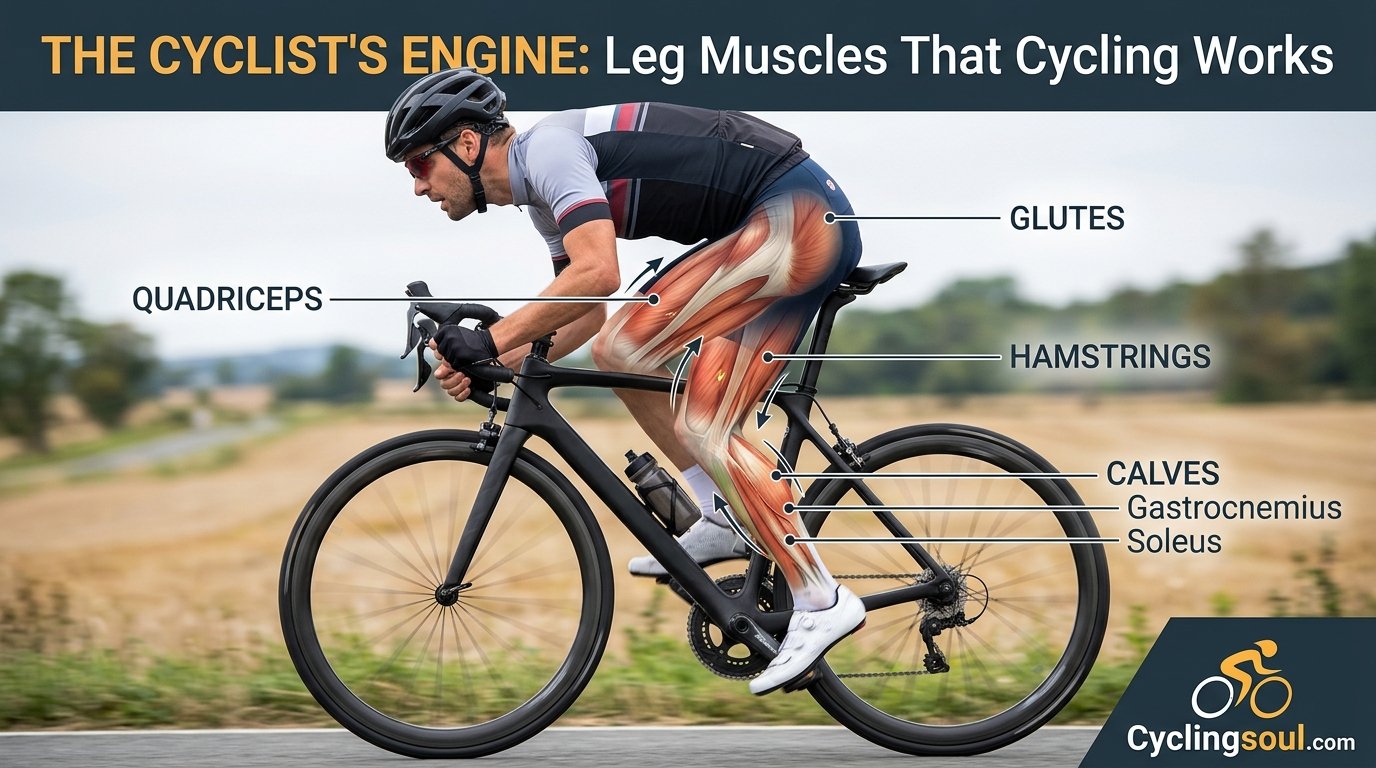
Cycling is primarily a lower-body exercise, but it is far from lower-body only. The legs generate nearly all the power that moves the bike, while the core, back, shoulders, and arms hold you in a stable, efficient position so that power can be transferred without wasting energy. Think of the legs as the engine and everything above the hips as the chassis.
The muscles doing the heaviest lifting are the quadriceps, glutes, hamstrings, and calves. Supporting them are the hip flexors, the deep abdominal muscles, the spinal erectors, and the muscles of the upper back, shoulders, and arms. Here is a quick overview before we dig into each one.
| Muscle Group | Main Role in Cycling | Workload |
|---|---|---|
| Quadriceps | Extend the knee to drive the pedal down | Very high |
| Glutes | Extend the hip, deliver power on the downstroke, stabilize the pelvis | High |
| Hamstrings | Pull the pedal through the bottom and back, assist hip extension | Moderate to high |
| Calves | Transfer force through the ankle, stabilize the foot | Moderate |
| Hip flexors | Lift the leg on the upstroke | Moderate |
| Core (abs, obliques, lower back) | Stabilize the torso, anchor leg power | Moderate, constant |
| Shoulders, arms, upper back | Support body weight on the bars, steer, absorb vibration | Low to moderate |
One important point: cycling is non-weight-bearing and low impact, which makes it gentle on joints but also means the muscles get less of the loading stimulus that builds strong bones and large muscle fibers. We will come back to that in a later section.
Ready to ride more comfortably while you build leg strength?
Shop Cycling Gear on Amazon2. How a Pedal Stroke Works: The Four Phases
To understand which muscles cycling works, it helps to slow a single pedal revolution down and look at what is happening. Imagine the crank as a clock face. Each leg travels through a full 360 degrees, and different muscles take the lead at different points. The two legs are always offset by 180 degrees, so while one leg is pushing, the other is recovering.
The Downstroke (roughly 12 o’clock to 5 o’clock)
This is the power phase, and it accounts for most of the force you put into the pedals. The glutes and quadriceps fire hard to extend the hip and knee simultaneously. If you have ever felt your thighs and backside burning on a climb, this is the phase responsible.
The Bottom of the Stroke (roughly 5 o’clock to 7 o’clock)
As the pedal reaches its lowest point, the work transitions. The calves and hamstrings begin to contribute, helping move the foot from pushing down to scraping backward, much like wiping mud off the bottom of a shoe. Smooth riders spend more effort in this phase than beginners, who tend to simply mash straight down.
The Upstroke (roughly 7 o’clock to 11 o’clock)
Here the hamstrings and hip flexors lift the leg back up. With flat pedals, you are mostly just unweighting the rising pedal. With clipped-in shoes, you can actively pull, which recruits the hip flexors and hamstrings more. A proper pair of cycling shoes that connect you firmly to the pedal makes this phase more effective.
The Top of the Stroke (roughly 11 o’clock to 1 o’clock)
At the top, the quads and hip flexors push the foot forward over the dead spot, setting up the next downstroke. Higher cadences and good technique shrink this dead spot, which is why experienced riders feel smoother.
Clip in for a more connected, efficient pedal stroke.
Browse Clipless Pedals3. Quadriceps: The Main Engine of Cycling
The quadriceps are the four muscles on the front of your thigh: the rectus femoris, vastus lateralis, vastus medialis, and vastus intermedius. Together they straighten your knee, and straightening the knee against pedal resistance is the single biggest source of cycling power. That is why quads are usually the first muscle to complain on a long climb or a hard interval session.
What the quads do on the bike
During the downstroke, the three vastus muscles contract strongly to push the pedal away from you. The rectus femoris, which crosses both the hip and the knee, assists with knee extension and also helps lift the thigh at the top of the stroke. Because the quads are working against a relatively constant load for hours at a time, they develop impressive endurance, and with high resistance they gain real strength too.
Why your quads burn on climbs
Climbing and low-cadence, high-gear efforts increase the force required per pedal stroke. Slow, forceful contractions limit blood flow in the muscle for a moment with each push and build up metabolic byproducts, which is the burning sensation riders know well. Spinning an easier gear at a higher cadence shifts some of the load toward your cardiovascular system and spares your quads.
How cycling changes your quads
Regular riding gives most people noticeably more defined, firmer thighs, especially around the outer quad and the teardrop-shaped vastus medialis just above the knee. Sprinters and track riders, who generate huge forces in short bursts, often develop very large quads. Endurance riders tend to build leaner, more fatigue-resistant ones. Neither group is wrong; muscle adaptation follows the demands you place on it.
Quad care tips
- Keep your saddle height dialed in; too low overloads the quads and the front of the knee.
- Include easy spinning days so quads can recover between hard efforts.
- Stretch or foam roll the front of the thigh after long rides.
- Add squats or leg presses off the bike for extra strength.
Speed up quad recovery after hard rides.
Shop Foam Rollers4. Glutes: The Underrated Power Source
The gluteal group, made up of the gluteus maximus, medius, and minimus, is the largest and most powerful muscle group in the body, and it plays a bigger role in cycling than many riders realize. The gluteus maximus extends the hip, driving the thigh downward and backward during the first half of the downstroke. When you stand out of the saddle to climb or sprint, the glutes take on even more of the job.
Glute max versus glute med
The gluteus maximus provides raw power. The gluteus medius and minimus sit on the side of the hip and keep your pelvis level so that your knees track straight over the pedals instead of wobbling inward. Weak glute medius muscles are a common reason for knee tracking problems and hip drop in cyclists, which in turn can waste energy and lead to overuse injuries.
Does cycling build glutes?
It does, with caveats. Hill riding, big-gear work, and out-of-the-saddle efforts all load the glutes meaningfully, and many regular riders notice firmer, stronger glutes. However, cycling alone rarely produces dramatic muscle growth in this area because the resistance per stroke is lower than in a heavy squat or hip thrust. We cover this question in depth in our article on whether cycling builds glutes.
Waking up lazy glutes
Many people who sit all day have glutes that do not fire well, so the quads and hamstrings pick up the slack. If you feel almost nothing in your backside while riding, try these cues: push through the heel slightly at the bottom of the downstroke, keep the hips stable on the saddle, and add a few minutes of bridges or clamshells before your ride.
- Hill repeats: climb seated at a low cadence to load the glutes.
- Standing climbs: alternate between seated and standing positions.
- Off-bike work: hip thrusts, step-ups, and Romanian deadlifts.
Add simple glute activation work to your warm-up.
Shop Resistance Bands5. Hamstrings: The Pull-Through Muscles
The hamstrings run down the back of the thigh and consist of three muscles: the biceps femoris, semitendinosus, and semimembranosus. They do two jobs on the bike. They help the glutes extend the hip in the downstroke, and they flex the knee to pull the pedal through the bottom and back up.
Hamstrings and pedal technique
Recreational riders often under-use their hamstrings because they push straight down and let the pedal rise on its own. Riders who focus on a smooth circle, especially when clipped in, recruit the hamstrings far more during the sweep through the bottom of the stroke. This is a big part of what makes elite cyclists look so fluid.
Why hamstrings get tight
Cycling keeps your hamstrings in a shortened, semi-contracted state for long periods, particularly with an aggressive, forward-leaning posture. Over time this can leave them feeling tight, which may tug on the pelvis and contribute to lower back discomfort. Regular stretching and mobility work help, and so does a bike position that is not overly stretched out.
Quad and hamstring balance
Because cycling heavily favors the quads, many riders end up with strong fronts of the thighs and comparatively weaker hamstrings. This imbalance can raise injury risk, especially if you also run or play field sports. Deadlifts, hamstring curls, and single-leg bridges are good ways to rebalance.
Stay flexible between rides with the right recovery tools.
Shop Stretching Mats6. Calves and Ankles: The Final Link in the Chain
The calf complex consists of the gastrocnemius, the larger muscle you see bulging at the back of the lower leg, and the soleus, which lies underneath it. Both attach to the heel via the Achilles tendon and pull the foot into plantar flexion, pointing the toes downward.
How calves contribute to power
The calves do not generate the majority of cycling power, but they act as a rigid bridge that transfers force from the big thigh muscles into the pedal. During the downstroke, the calf muscles contract isometrically to stop the ankle from collapsing, which allows the energy from the quads and glutes to reach the pedal. At the bottom of the stroke they also help carry the foot through.
Calf fatigue and cramping
Calves can tighten or cramp during long rides, especially in heat, when dehydrated, or when your cleats are poorly positioned. If the cleat is too far forward or the saddle is too high, you may overuse the calves to reach the pedal, leading to soreness and even Achilles irritation. Small adjustments often resolve these problems quickly.
Do cyclists get big calves?
Typically not. Most cyclists develop lean, defined calves rather than bulky ones. Sprinters and track specialists may build more size, but endurance riding tends to emphasize endurance fibers that do not grow dramatically.
The foot and ankle stabilizers
Smaller muscles in the shin (the tibialis anterior) and around the ankle also work to keep the foot stable on the pedal. Stiff-soled shoes and supportive cycling socks reduce foot fatigue and hot spots, which in turn helps these small stabilizers last longer.
Keep your feet comfortable on every ride.
Shop Cycling Socks7. Hip Flexors and Hip Stabilizers
The hip flexors, which include the iliopsoas (psoas major and iliacus), the rectus femoris, and the tensor fasciae latae, lift your thigh toward your chest. In cycling they are responsible for raising the leg on the upstroke and moving the knee over the top of the pedal circle.
Why the hip flexors work harder than you think
When you ride clipped in and pull up on the pedal, the hip flexors become active contributors rather than passive passengers. They also remain in a shortened position for the whole ride, because your hips are flexed in the saddle. Add a desk job to that and you have a recipe for chronically tight hip flexors.
Signs of tight hip flexors
- Pinching or tightness at the front of the hip when you stand up after a ride.
- A tendency for your lower back to arch when you walk or stand.
- Difficulty fully extending the hip in a lunge stretch.
The deep hip stabilizers
Beneath the glutes sit smaller muscles including the piriformis and other external rotators. They keep the hip joint centered and help your femur stay aligned with your pedal path. When these muscles are weak, riders often see their knees drift inward or outward on every stroke, which wastes power and can strain connective tissue.
Simple fixes
Low lunge stretches, couch stretches, and glute bridges all help keep this region healthy. Strengthening exercises such as lateral band walks and single-leg stands improve stability. A gradual fitness base, as outlined in our guide on how to train for cycling, ensures these smaller muscles adapt along with the big ones.
Loosen tight hips after long days in the saddle.
Shop Massage Balls8. Core and Lower Back: Your Stable Platform
You do not pedal with your abs, but you cannot pedal well without them. Every time a leg pushes down on a pedal, the force has to be resisted somewhere. If your torso is wobbly, part of that force turns into pelvis movement instead of forward motion. A strong, stable core acts as the anchor that lets your legs push against something solid.
Which core muscles are involved?
- Transverse abdominis: the deep corset-like muscle that stabilizes the spine.
- Rectus abdominis: the “six-pack” muscle, working isometrically to hold your posture.
- Obliques: resist rotation as your legs alternate left and right.
- Erector spinae and multifidus: keep the back extended while you lean forward over the bars.
- Quadratus lumborum: stabilizes the pelvis side to side.
Lower back fatigue on long rides
Holding a forward-leaning position for hours loads the spinal erectors continuously. When the core is weak, the lower back picks up the slack and begins to ache, which is one of the most common complaints among cyclists. Better core strength, a sensible bike fit, and occasional position changes all help.
Does cycling flatten your belly?
Cycling strengthens the core stabilizers but does not directly “burn” belly fat from that area, since fat loss is systemic rather than local. What riding does do is burn calories and build fitness, which supports fat loss when paired with sensible eating. Our deeper explanation in does cycling burn belly fat and our overview of cycling for weight loss go further on this.
Build a stronger core for a more comfortable ride.
Shop Core Trainers9. Upper Body: Shoulders, Arms, Chest, and Back
The upper body plays a quieter role in cycling, but it is never idle. Your hands, arms, shoulders, and upper back support a portion of your body weight, steer the bike, and absorb road vibration. How much load they bear depends heavily on your position and the type of riding you do.
Shoulders and traps
The deltoids and upper trapezius hold your arms in position on the bars. On a long ride, especially with a stretched-out aggressive position, tension in the neck and shoulders builds up. Relaxing your grip and keeping a slight bend in the elbows reduces strain considerably.
Arms: triceps, biceps, and forearms
The triceps work isometrically to keep your arms from collapsing under body weight, particularly on descents or when braking. Biceps and forearm muscles help you pull on the bars during standing climbs and grip the brakes. Forearm and hand fatigue is especially noticeable on rough surfaces and mountain bike descents.
Chest and upper back
The pectorals help brace your upper body, while the lats, rhomboids, and mid-trapezius work to hold your shoulder blades stable and your posture upright. When you sprint or climb out of the saddle, you actively pull on the bars, and these muscles contribute noticeably to the effort by anchoring the force coming up from the legs.
Will cycling build big arms?
Not by itself. The upper body loads in cycling are mostly isometric and low in intensity, which is excellent for endurance but not for muscle size. If you want a balanced physique, push-ups, rows, and overhead presses are useful additions.
Add padded support for happier hands and shoulders.
Shop Cycling Gloves10. Muscles Worked by Riding Style
Not all cycling hits the same muscles equally. A relaxed coffee-shop spin, a punchy mountain bike descent, and an indoor interval session each tilt the workload differently. Understanding these differences helps you pick the kind of riding that matches your goals.
| Riding Style | Most Worked Muscles | Notes |
|---|---|---|
| Road cycling | Quads, glutes, hamstrings, core | Long, steady efforts build endurance in leg and core muscles. |
| Climbing | Glutes, quads, calves, upper back | Higher resistance and out-of-saddle efforts raise muscle demand. |
| Sprinting | Glutes, quads, hamstrings, arms, core | Explosive, full-body effort with strong upper-body involvement. |
| Mountain biking | Whole body: legs, core, arms, shoulders, grip | Technical terrain forces constant stabilization and body movement. |
| Indoor or spin cycling | Quads, glutes, hamstrings, core | Steady resistance with less balance work; can add upper-body moves. |
| Commuting or casual riding | Quads, calves, hip flexors | Lower intensity, a gentle general conditioning effect. |
Cadence and gear choice
High-cadence spinning in an easier gear trains cardiovascular fitness and muscular endurance with less strain on any one muscle. Low-cadence, high-resistance riding shifts demand to the muscles themselves, building strength, particularly in the quads and glutes. Skilled riders use both on purpose.
Seated versus standing
Staying seated keeps most of the effort in the quads, glutes, and hamstrings. Standing lets you use your body weight, engaging more of the glutes, calves, core, and upper body, but it costs more energy. Mixing positions on climbs spreads the load across more muscles and delays fatigue.
Take your riding indoors when the weather turns.
Shop Indoor Trainers11. What Cycling Does Not Work (And the Trade-Offs)
Cycling is wonderful exercise, but no single activity trains everything. Being honest about what it misses helps you cover the gaps.
Where cycling shines
- Low impact and easy on joints
- Excellent leg endurance and aerobic base
- Builds lean, functional leg muscle
- Scales easily from gentle to intense
- Strengthens core stabilizers over time
Where cycling falls short
- Limited upper-body strength development
- Little weight-bearing stimulus for bones
- Can create quad dominance and tight hips
- Minimal lateral and rotational movement
- Posture can round the upper back over time
Bone density
Because your body weight is supported by the saddle, cycling does not load the skeleton the way running or lifting does. Riders who rely only on cycling may want to add strength training or some weight-bearing exercise to protect bone health, especially with age.
Muscle imbalances
The repetitive forward-and-back motion of pedaling trains the same range of motion thousands of times. Muscles that spend most of their time shortened, such as the hip flexors and pecs, may tighten, while stabilizers like the glute medius and mid-back can lag. Cross-training addresses these patterns before they become pains.
Neglected areas
- Chest and pushing muscles beyond basic bracing
- Rotational core strength
- Side-to-side leg movement, such as the adductors and abductors
- Fast, plyometric power and bone-loading
Round out your training with simple home equipment.
Shop Dumbbells12. Working Your Muscles Smarter: Training, Fit, and Strength
Knowing which muscles cycling works is only useful if you can apply it. Here is how to get more from every ride, protect yourself from overuse, and build a balanced body.
Get your bike fit right
Saddle height, saddle fore-aft position, cleat placement, and handlebar reach all shape which muscles work and how hard. A saddle that is too low overloads your quads and knees, one that is too high stretches your hamstrings and rocks your hips, and a reach that is too long strains your back and shoulders. A professional fit session is one of the best investments a rider can make.
Structure your riding
Mix easy endurance rides, tempo efforts, hill work, and intervals across the week. Understanding your threshold power, which we explain in what is FTP in cycling, helps you decide how hard to push and keeps muscle fatigue manageable. Beginners should build gradually; a few sessions a week with rest days between is plenty.
Strength train off the bike
Two short strength sessions per week make an obvious difference. Focus on movements that mirror and support riding:
- Squats and lunges for quads and glutes.
- Romanian deadlifts for hamstrings and the posterior chain.
- Hip thrusts and bridges for glute power.
- Planks and side planks for core stability.
- Rows and push-ups for the upper body.
- Calf raises for lower-leg strength.
Stretch and recover
Finish rides with a few minutes of gentle stretching for the quads, hamstrings, hip flexors, and calves. Prioritize sleep, protein, and hydration, and take an easy day when your legs feel heavy. Good recovery is where muscle adaptation really happens.
Dress for comfort so you can ride longer
When you are comfortable, you can focus on pedaling technique and muscle engagement rather than saddle discomfort. A well-fitting pair of padded women’s cycling shorts or men’s equivalents can transform long rides.
A simple weekly template to work every muscle group
You do not need a complicated schedule to hit all the muscles we have covered. A balanced week for a recreational rider might combine a few different ride types with two short strength sessions, leaving enough room for recovery so your muscles can actually adapt and grow stronger.
| Day | Session | Muscles Emphasized |
|---|---|---|
| Monday | Rest or gentle stretching | Recovery for all groups |
| Tuesday | Interval ride with hard efforts | Quads, glutes, calves, core |
| Wednesday | Strength: squats, deadlifts, planks | Posterior chain, core |
| Thursday | Easy spin, high cadence | Quads, hamstrings, hip flexors |
| Friday | Rest or mobility work | Hips, hamstrings, lower back |
| Saturday | Long endurance ride with some hills | Whole leg, core, upper back |
| Sunday | Strength: rows, push-ups, lunges, band work | Upper body, glute medius |
Common mistakes that shortchange your muscles
- Always riding the same gear and cadence. Variety challenges different muscle fibers and prevents your body from plateauing.
- Gripping the bars too tightly. This overworks the forearms and shoulders and wastes energy that your legs could use.
- Ignoring recovery. Muscles repair between sessions, not during them. Back-to-back hard days without rest lead to stalled progress and sore, tired legs.
- Skipping the warm-up. Five to ten minutes of easy spinning raises blood flow and prepares the quads, glutes, and calves for harder efforts.
- Neglecting nutrition. Carbohydrates fuel the work and protein supports repair. Underfueling leaves muscles unable to rebuild properly.
- Only riding, never lifting. Even a small amount of strength training reduces injury risk and boosts power on the bike.
Listen to your body, and treat persistent sharp pain, as opposed to ordinary muscle fatigue, as a signal to ease off and, if it continues, to speak with a qualified professional. Muscle soreness that fades within a couple of days is a normal part of building fitness, while joint pain or soreness that keeps getting worse is a different story.
Get comfortable so you can enjoy more time in the saddle.
Shop Cycling ShortsFrequently Asked Questions About the Muscles Cycling Works
What muscles does cycling work the most?
The quadriceps and glutes do the most work, since they drive the pedal down with every stroke. The hamstrings and calves follow closely, while the core and hip flexors support the movement. If you ride out of the saddle or on rough terrain, your arms, shoulders, and upper back become more involved as well.
Does cycling work your abs?
Yes, but mostly as stabilizers. The deep abdominal muscles and obliques tighten continuously to keep your torso steady while your legs push. You will not feel the same burn as you would from crunches, but the constant low-level engagement does build core endurance, especially on climbs and long rides.
Does cycling build leg muscle?
It certainly can. High-resistance riding such as hill climbs, big-gear intervals, and sprints builds strength and some size in the quads, glutes, and hamstrings. Long, easy endurance riding tends to build stamina and lean, toned muscle rather than bulk. Pairing cycling with squats or deadlifts speeds up muscle growth.
Does cycling tone your thighs and glutes?
Regular cycling firms and defines the thighs and, to a lesser degree, the glutes, particularly when you include hills and standing efforts. Visible changes depend on your overall body composition, nutrition, and consistency. For more on this topic, see our guide to whether cycling builds glutes.
Is cycling a good full-body workout?
It is a strong lower-body and cardiovascular workout with meaningful core involvement, but it is not a complete full-body workout by itself. The upper body gets only light isometric work. Adding two short strength sessions a week covers the gaps and makes the overall routine far more balanced.
Which muscles hurt after a long bike ride?
Quads, glutes, and calves are the usual culprits, especially after a long climb or a harder-than-normal effort. You may also feel soreness in your lower back, shoulders, neck, and hands if your position is not ideal or the ride was very long. Gentle movement, stretching, hydration, and sleep help recovery.
Does cycling work more muscles than running?
Running engages a broad set of muscles through weight-bearing, impact-based movement, including the quads, hamstrings, glutes, calves, and core, with greater demands on stabilizers and bones. Cycling is gentler on joints and loads the leg muscles more steadily and in a seated, supported position. Neither is strictly better; they complement each other well.
Does stationary biking work the same muscles as outdoor cycling?
Largely yes. An indoor bike works the quads, glutes, hamstrings, calves, and core in much the same way. Outdoor cycling adds balance, steering, and terrain changes, which recruit more stabilizers and upper-body muscles. Indoor sessions are excellent for controlled intervals and consistent resistance.
Does cycling help burn belly fat?
Cycling burns calories and improves fitness, which supports overall fat loss when combined with a sensible diet. It cannot target fat from one area, so belly fat changes as total body fat comes down. Our articles on belly fat and cycling for weight loss explain this in more detail.
How often should I cycle to see muscle changes?
Most people notice improved endurance within a few weeks and firmer legs within a couple of months when riding three to four times a week. Adding intervals, hills, and strength work accelerates muscle adaptation. If you are just starting out, our guide on how to start cycling lays out a sensible ramp-up.
Can cycling cause muscle imbalances?
It can if it is your only exercise. Quads often become stronger than hamstrings, hip flexors can tighten, and the upper back and chest may round forward if you ride long hours without cross-training. Strength training, stretching, and varying your riding position keep things balanced.
What exercises help cyclists work their muscles better?
Squats, lunges, Romanian deadlifts, hip thrusts, planks, rows, and calf raises cover the key muscle groups used in cycling. Short, consistent sessions twice a week are enough. A structured plan, like the one in our guide on how to train for cycling, can help you combine them with your rides.
Conclusion: Cycling Works More Muscles Than You Think
So, what muscles does cycling work? The honest answer is almost all of the lower body and a good portion of the middle and upper body too. The quads and glutes drive the pedals, the hamstrings and calves smooth and transfer the power, the hip flexors lift the leg, and the core, back, shoulders, and arms hold you steady so none of that effort is wasted.
The best part is that you can shape which muscles work hardest. Climb more to challenge your glutes and quads, spin faster to build endurance, ride mountain trails to engage your whole body, and add a bit of strength training to cover what cycling leaves out. Pair that with a proper bike fit, comfortable gear, and good recovery habits and you will ride stronger, longer, and with fewer aches.
Whether you are pedaling for fitness, weight loss, commuting, or pure joy, understanding the muscles behind each stroke makes you a smarter rider. Get out there, listen to your body, and enjoy the ride.
Gear up and put your muscle knowledge to work on your next ride.
Shop Cycling Essentials