
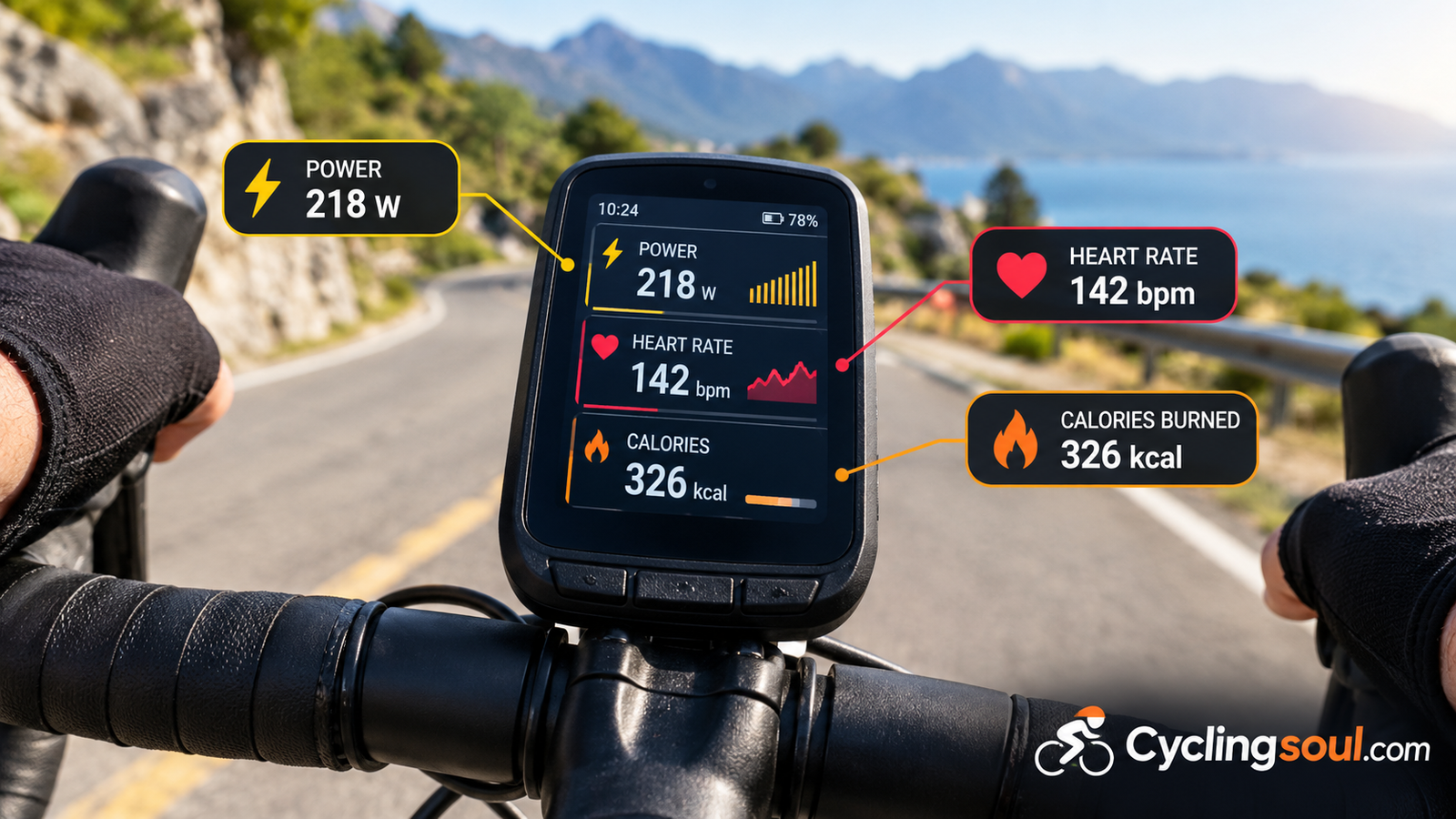
How Many Calories Does Cycling Burn? The Real Numbers by Speed, Weight, and Terrain
From a lazy Sunday spin to a hard interval session, here is what your ride actually costs your body in energy, and how to use that number wisely.
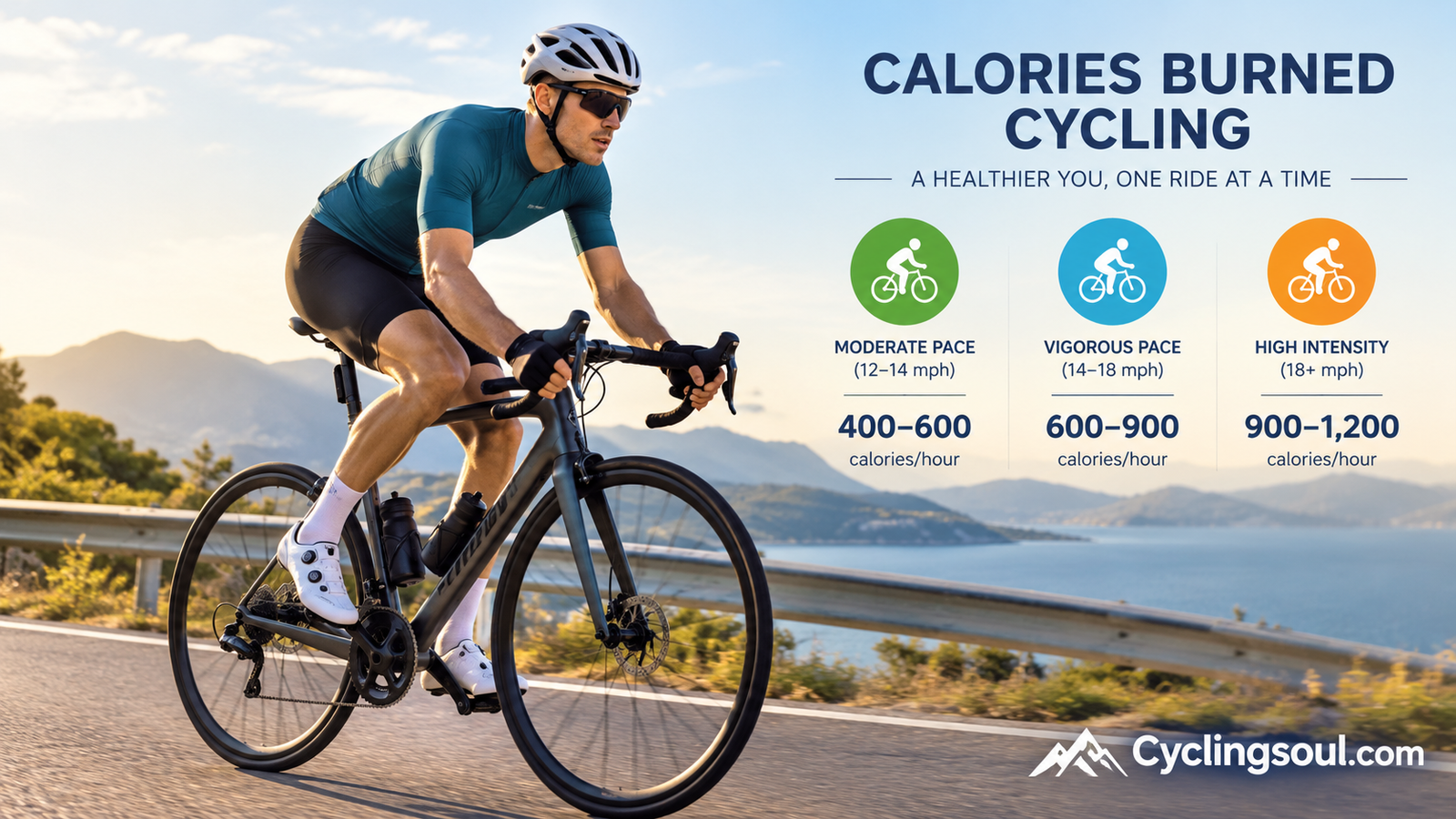
Ask ten cyclists how many calories an hour on the bike burns and you will probably hear ten different answers. One swears by the number on her watch. Another trusts the figure on a spin bike screen. A third just eats a big breakfast and hopes for the best. The truth is more interesting, and far more useful, than a single number.
A relaxed hour of riding can burn around 300 calories for one person and well over 900 for another. The gap comes down to a handful of factors you can understand, measure, and even control. In this guide we will walk through the science in plain language, give you tables you can actually use, and show you how to turn all of it into smarter training, fueling, and weight management.
Quick answer: most adults burn roughly 400 to 700 calories per hour at a moderate pace, and 700 to 1,000 or more at a hard, sustained effort. Keep reading to find your own range.
1. The Short Answer: How Many Calories Does Cycling Burn?
Let’s start with the number most people are searching for. For a person weighing about 155 pounds (70 kg), riding at a comfortable, conversational pace of roughly 12 to 14 miles per hour burns somewhere around 560 calories per hour. Slow it down to a casual pedal along a flat path and you are closer to 280 calories an hour. Push to a fast, breathless effort and the number can climb past 1,000.
Those figures are estimates, not promises. Your own burn depends on your body size, the effort you sustain, the terrain, the wind, your bike, and even how efficient you are at turning food into motion. The good news is that cycling sits comfortably in the upper-middle range of popular exercises for calorie burn, and unlike many alternatives, it is gentle enough that most people can do it for a long time without breaking down.
If you are brand new and still figuring out how to build the habit, our guide on how to start cycling is a friendly place to begin before you worry about the numbers. And if you want the bigger picture on what regular riding does for your health, see is cycling good for you.
| Effort Level | Typical Speed | Approx. Calories per Hour (155 lb rider) |
|---|---|---|
| Easy, leisurely | Under 10 mph | About 280 |
| Light to moderate | 10 to 12 mph | About 480 |
| Moderate | 12 to 14 mph | About 560 |
| Vigorous | 14 to 16 mph | About 700 |
| Very hard | 16 to 19 mph | About 845 |
| Racing effort | 20+ mph | 1,100 or more |
2. How Your Body Burns Calories on a Bike
A calorie, in the nutrition sense, is a unit of energy. When you pedal, your muscles convert chemical energy from the food you eat into two things: mechanical work that moves the pedals, and heat. Here is the part that surprises many people. Human muscles are only about 20 to 25 percent efficient. That means for every 100 calories your body burns, roughly 20 to 25 go into turning the cranks and the remaining 75 or so become heat. This is exactly why you sweat so much on a hard ride.
That efficiency number matters because it gives us a surprisingly neat shortcut. For a typical cyclist, one kilojoule of mechanical work on the pedals is close to one food calorie burned. The match is not accidental. The roughly 4.18 kilojoules in a calorie, multiplied by around 24 percent efficiency, lands very near one-to-one. We will use this later when we talk about power meters.
Your three energy systems
Cycling pulls energy from fat and carbohydrate in different proportions depending on effort. At an easy pace, your body leans heavily on fat. As intensity rises, the share from carbohydrate climbs quickly. At a hard effort, carbohydrate stored in your muscles and liver does most of the work. This is why the same hour can feel effortless or devastating, and why fueling strategy matters so much on longer rides.
- Aerobic system: the workhorse for most rides. It burns fat and carbs with oxygen and can run for hours.
- Glycolytic system: kicks in during harder efforts such as climbs and sprints, burning carbohydrate faster.
- Phosphocreatine system: powers very short, explosive bursts of a few seconds.
Which muscles do the burning?
The big players are your quadriceps, hamstrings, glutes, and calves, with your core and upper body helping stabilize you. The more muscle you recruit, the more energy you spend. Standing on the pedals, climbing, and sprinting recruit more muscle than a seated spin. If you are curious about the full breakdown, we cover it in detail in what muscles does cycling work.
Resting burn versus exercise burn
Remember that your body burns calories all day just to stay alive. When a tracker reports “calories burned,” it is sometimes giving you the total including your resting burn during that period, and sometimes only the extra calories from exercise. Knowing which number you are looking at prevents a lot of confusion. For weight management, the number that matters is the extra energy you spent above resting, often called active or net calories.
3. Calories Burned by Speed and Intensity
Speed is the easiest proxy for intensity, and it is the one most casual riders know. Researchers rate activities using a number called a MET, short for metabolic equivalent. One MET is what you burn sitting still. Easy cycling is around 4 METs, moderate cycling is roughly 8, and hard, fast cycling can top 15. Your hourly calorie burn is approximately your MET value multiplied by your body weight in kilograms.
Using that formula, here is how the estimates look across common speeds for three body weights. Treat these as solid starting points, not laboratory measurements.
| Speed / Effort | MET | 125 lb (57 kg) | 155 lb (70 kg) | 185 lb (84 kg) |
|---|---|---|---|---|
| Under 10 mph, leisure | 4.0 | ~227 | ~281 | ~336 |
| 10 to 11.9 mph, light | 6.8 | ~386 | ~478 | ~571 |
| 12 to 13.9 mph, moderate | 8.0 | ~454 | ~562 | ~671 |
| 14 to 15.9 mph, vigorous | 10.0 | ~567 | ~703 | ~839 |
| 16 to 19 mph, very hard | 12.0 | ~680 | ~844 | ~1,007 |
| 20+ mph, racing | 15.8 | ~896 | ~1,111 | ~1,326 |
All values are calories per hour. For a 30-minute ride, cut them in half. For 90 minutes, multiply by one and a half.
Speed is not the whole story
Here is where speed misleads. Riding 15 mph with a strong tailwind on a flat road takes far less effort than 15 mph into a headwind or up a rolling hill. Two riders can post the same average speed and burn very different amounts of energy. That is why many serious cyclists prefer to measure effort in watts or heart rate rather than miles per hour. Speed is a decent shortcut on a calm, flat route, and a poor one almost everywhere else.
Steady effort versus intervals
Interval workouts, where you alternate hard bursts with easy recovery, tend to produce a high average burn for the time spent. They also create a larger afterburn effect, which we will discuss later. Steady endurance riding burns fewer calories per minute but lets you ride for much longer, so the total can end up higher. Neither is better. They simply do different jobs. For a structured approach to mixing them, see our guide on how to train for cycling.
Pros of Hard Efforts
- Higher calories per minute
- Time-efficient for busy schedules
- Builds fitness and power quickly
Cons of Hard Efforts
- Harder to recover from
- Higher injury and burnout risk if overdone
- Can spike appetite afterward
4. Why Body Weight Matters So Much
Moving a heavier body takes more energy, so heavier riders burn more calories doing the same ride. A 185-pound rider covering ten miles at a given pace will burn noticeably more than a 125-pound rider covering the same ten miles at the same pace. The table in the previous section shows this clearly: the gap between the lightest and heaviest columns is more than 40 percent at every speed.
This has a few interesting consequences. First, if you are heavier and just starting out, you may be pleasantly surprised at how much energy even gentle rides use. Second, as you lose weight, your calorie burn at the same speed drops slightly. That is not a failure. It simply means your body is moving less mass. Many people hit a plateau for exactly this reason and respond by adding time or intensity.
The climbing exception
On climbs, weight matters even more, because you are lifting your whole mass against gravity. This is why lighter riders tend to climb faster at a given power, but heavier riders burn more total calories reaching the top. On flat ground, wind resistance becomes the bigger factor and body size matters a bit less for speed, though it still matters for energy.
Age, sex, and fitness
Other personal factors nudge the numbers up or down. Men generally burn slightly more than women of the same weight because of higher average muscle mass. Younger riders tend to have a slightly higher metabolic rate than older ones. And fit riders are often more efficient, which means they may burn a little less at a given pace than a beginner but can sustain a much higher pace overall. A bigger engine lets you work harder for longer, so total burn often rises with fitness even if efficiency improves.
- More muscle mass: raises resting and exercise burn modestly.
- Higher fitness: lets you sustain intensities that burn more per hour.
- Efficiency gains: a smoother pedal stroke can slightly lower energy cost per watt.
- Body temperature and climate: riding in heat or cold adds small extra costs.
5. Using Power (Watts) for the Most Accurate Numbers
If you want the most trustworthy calorie estimate possible, forget speed and heart rate and look at power. A power meter measures the actual mechanical work you are doing on the pedals in watts. Because human cycling efficiency is fairly consistent across people, that work translates into energy burned with surprisingly little error.
The simple version works like this. Watts are joules per second. Multiply your average power by the number of seconds you rode and you get total joules. Divide by 1,000 and you have kilojoules. Thanks to the efficiency math from earlier, kilojoules of work are close to the calories you burned.
| Average Power | Work in 1 Hour | Approx. Calories Burned |
|---|---|---|
| 100 watts | 360 kJ | ~360 |
| 150 watts | 540 kJ | ~540 |
| 200 watts | 720 kJ | ~720 |
| 250 watts | 900 kJ | ~900 |
| 300 watts | 1,080 kJ | ~1,080 |
Notice what is missing from this calculation: your body weight. Power-based estimates depend on what you actually did, not on who you are. That makes them excellent for comparing rides and for planning fuel. A 120-pound rider and a 200-pound rider holding 200 watts for an hour both burn about 720 calories, give or take efficiency differences.
Understanding FTP and training zones
Your functional threshold power, usually shortened to FTP, is the highest power you can roughly sustain for an hour. Training zones are built as percentages of that number. Knowing your FTP lets you choose rides that burn a target amount while staying in a sensible intensity range. If this is new to you, read what is FTP in cycling for a clear walkthrough.
Do you need a power meter?
Not at all. Plenty of people ride happily and make progress using nothing but heart rate or perceived effort. But if calories, pacing, or structured training are important to you, a power meter is the single most informative piece of data you can add. Many indoor trainers and smart bikes include one built in, which is one reason indoor calorie numbers tend to be more precise.
Pros of Power Meters
- Most accurate calorie estimate
- Unaffected by heat, sleep, or caffeine
- Perfect for pacing and fueling
Cons of Power Meters
- Higher upfront cost
- Needs occasional calibration
- Data can feel overwhelming at first
6. Terrain, Wind, and Road Surface
Where you ride changes how hard you have to work, and therefore how much you burn, often more than any other variable you control. Think of every ride as a negotiation with gravity, air, and the ground beneath your tires.
Hills
Climbing is the great calorie multiplier. On a steady climb, almost all of your effort goes into lifting your body and bike against gravity, and you cannot coast to recover. A ride with 2,000 feet of climbing can burn 20 to 40 percent more than a flat ride of the same distance. Descents give some of that back in speed rather than saved energy, because you often coast or brake and burn very little.
Wind
Above roughly 12 mph, air resistance becomes the biggest force you fight. It grows with the square of speed, and the power needed to overcome it grows with the cube. In plain terms, doubling your speed needs about eight times the power to beat the wind. A strong headwind can make a flat road feel like a climb. Riding in a pack, tucking into an aerodynamic position, and wearing close-fitting kit all reduce drag and lower the energy cost of speed.
Surface and tires
Smooth pavement is efficient. Gravel, dirt, sand, and wet roads create rolling resistance that drains energy. Fat, low-pressure tires on rough ground absorb some effort but make the bike feel slow, so you work harder to maintain the same speed. Properly inflated, supple road tires on clean asphalt are the cheapest way to go fast, and the cheapest way to burn fewer calories per mile.
Temperature and altitude
Heat raises your heart rate and perceived effort for the same power, and your body spends extra energy cooling itself. Cold weather makes you shiver and burn extra calories to stay warm, though most of the real extra burn comes from heavier clothing and sluggish muscles. High altitude reduces oxygen, so power drops for the same effort even though your heart works harder.
| Condition | Effect on Effort | Effect on Calories per Hour |
|---|---|---|
| Flat, calm, smooth road | Baseline | Baseline |
| Rolling hills | Moderately higher | Up about 10 to 25% |
| Sustained climbing | Much higher | Up about 25 to 50% |
| Strong headwind | Higher at same speed | Up at the same speed, but speed usually drops |
| Gravel or dirt | Higher resistance | Up about 10 to 30% |
| Heat and humidity | Higher heart rate | Small increase, more fluid loss |
7. Indoor Cycling, Spin Classes, and Trainers
Indoor cycling is popular for good reason. It is weatherproof, scheduled, and easy to measure. The question is whether it burns more or fewer calories than riding outside, and the honest answer is: it depends on how hard you work.
Stationary bike and spin class numbers
A moderate stationary bike session burns roughly 400 to 600 calories per hour for most adults. A high-energy spin class with a coach pushing intervals can reach 500 to 800 or more. Because there are no downhills to coast and no traffic lights, indoor riding tends to produce continuous pedaling, which is excellent for calorie burn per minute. Outdoors, you typically coast for 10 to 20 percent of a ride, which lowers the real average.
| Indoor Effort | Typical Power | Approx. Calories per Hour (155 lb rider) |
|---|---|---|
| Very light | 30 to 50 watts | ~245 |
| Light | 51 to 89 watts | ~335 |
| Moderate | 90 to 100 watts | ~480 |
| Moderately hard | 101 to 160 watts | ~620 |
| Hard | 161 to 200 watts | ~770 |
| Very hard | 201 to 270 watts | ~985 |
Beware the screen number
Many bike consoles estimate calories using generic formulas that can run high, sometimes by 20 percent or more. If your bike shows measured watts, trust the watts and use the kilojoule shortcut from earlier. If it only shows resistance levels with no true power reading, treat its calorie figure as a rough guide.
Smart trainers and virtual rides
Smart trainers pair with training apps and control resistance automatically. Because they measure power directly, their calorie estimates are among the most reliable you can find. Virtual group rides can also make you push harder than you would alone, which quietly increases your burn. Many riders find they do their hardest efforts indoors simply because the environment removes excuses.
Indoor versus outdoor, side by side
Pros of Indoor Riding
- Continuous pedaling, no coasting
- Precise, repeatable workouts
- Weather and traffic never matter
Cons of Indoor Riding
- Less cooling airflow, so you overheat
- Can feel monotonous
- Console calorie numbers may be inflated
8. Mountain Bikes, E-Bikes, and Commuting
Not every ride is a road ride, and the type of bike and the purpose of the trip change the math in useful ways.
Mountain biking
Mountain biking is among the most demanding forms of cycling. Constant changes in terrain, technical steering, standing climbs, and bursts of power keep your whole body working. Typical estimates run from 500 to 900 calories per hour depending on trail difficulty and your weight. The stop-and-go nature means your average speed is low, but your effort is high, which is a perfect example of why speed alone misleads.
E-bikes
An e-bike adds a motor that assists your pedaling. Studies of e-bike riders consistently find they still get a meaningful workout, often burning somewhere around 15 to 30 percent fewer calories than on a regular bike at the same speed, though results vary widely with the assist level you choose. The big win is that many people ride farther and more often on an e-bike. A slightly lower hourly burn multiplied by far more weekly riding can mean a bigger total.
- Eco or low assist: close to a normal bike’s effort on hills, a bit easier on flats.
- High assist: a gentle workout, ideal for recovery or commuting in work clothes.
- No assist: heavier bike means slightly more effort than a standard bike.
Commuting
Commuting by bike is a quiet calorie-burning machine. A 30-minute each-way commute at a moderate pace burns roughly 450 to 600 calories per day for a typical adult. Over a work week that is easily 2,000 to 3,000 calories, with no extra gym time. Stop lights and intersections reduce the average, but riding to work still counts as real exercise and carries documented health benefits.
Casual and recreational riding
Family rides, beach cruisers, and coffee-shop spins have a small hourly burn, around 200 to 350 calories, but they are one of the easiest ways to stay active, especially for beginners or anyone returning from a break. If you are comparing activities, our article on cycling vs running explains how the calorie burn and joint impact differ.
| Type of Riding | Typical Calories per Hour | Best For |
|---|---|---|
| Casual cruiser | 200 to 350 | Beginners, social rides |
| Bike commute | 350 to 600 | Building daily activity |
| E-bike (medium assist) | 300 to 450 | Longer or more frequent rides |
| Road cycling, moderate | 500 to 700 | Fitness and weight management |
| Mountain biking | 500 to 900 | Full-body challenge |
| Interval or race effort | 800 to 1,200 | Performance training |
9. How Accurate Are Trackers and Bike Computers?
You have a number on your wrist or handlebar. Should you believe it? The honest answer is: believe it as a trend, not as gospel.
Wrist-based fitness trackers
Wearables estimate calories using your heart rate, age, weight, sex, and movement. Heart rate is a reasonable stand-in for effort, but wrist sensors can struggle during hard intervals and on bumpy rides, and the formulas behind them are generalized. Independent testing of popular devices has found calorie errors that can be substantial, often overestimating by a noticeable margin. Treat the figure as a ballpark.
Chest straps and bike computers
A chest strap measures heart rate more precisely than most wrist sensors, which improves the estimate. A bike computer that combines heart rate with speed, elevation, and temperature can refine it further. The best of all is a computer paired with a power meter, because it can base calories on actual work rather than a guess.
App-based estimates
Phone apps that estimate calories from GPS speed alone are the least reliable. They cannot tell the difference between 15 mph on a flat road and 15 mph on a gentle downhill. They are fine for general motivation, but do not build a diet plan on them.
How to improve your estimates
- Enter your weight, age, and height accurately in the device settings.
- Use a chest strap if your device allows it.
- Use a power meter whenever possible and rely on kilojoules.
- Compare rides to your own past rides instead of to other people.
- Round down your numbers when planning how much to eat afterward.
10. Cycling, Weight Loss, and the Calorie Math
Many people look up calorie burn because they want to lose weight. Cycling can absolutely help, and it does so with a low risk of injury, which makes it easier to stay consistent. But the math is less tidy than the internet suggests.
The old 3,500 calorie rule
You may have heard that a pound of body fat equals about 3,500 calories, so a 500-calorie daily deficit produces a pound lost per week. It is a decent rough guide, but real bodies adapt. As you lose weight, your metabolism and your calorie burn on the bike both drop, so progress usually slows. Think of the rule as a starting estimate rather than a guarantee.
What cycling can realistically do
Say you ride four times a week for 60 minutes at a moderate effort, burning about 550 calories each time. That is roughly 2,200 calories per week from riding, equal to about two-thirds of a pound of fat if nothing else changes. Over three months, that adds up to more than eight pounds on its own. Combined with sensible eating, the result is much stronger. Our dedicated guide to cycling for weight loss builds a full weekly plan around this idea.
Does cycling target belly fat?
Spot reduction is a myth. You cannot choose where your body burns fat. What cycling does is create an overall energy deficit and improve your fitness, and belly fat often falls as total body fat falls. We explore this in detail in does cycling burn belly fat.
The compensation trap
A very common problem is eating back more than you burned. A 600-calorie ride can be erased by a large recovery smoothie, a pastry, and a well-deserved afternoon snack. Exercise also tends to make you hungrier, and your brain happily rewards you with food. This does not mean you should avoid fueling. It means you should be intentional about it.
Afterburn and muscle
After hard rides, your body keeps burning slightly extra calories while it recovers, a effect known as excess post-exercise oxygen consumption, or EPOC. For most rides the effect is small, usually a few dozen calories, though it is larger after very intense intervals. A more meaningful long-term benefit is that regular cycling supports muscle, and a bit more muscle raises your daily resting burn.
| Weekly Riding Plan | Approx. Weekly Burn (155 lb rider) | Approx. Fat Equivalent |
|---|---|---|
| 3 rides x 45 min, easy to moderate | ~1,000 to 1,300 | ~0.3 to 0.4 lb |
| 4 rides x 60 min, moderate | ~2,000 to 2,300 | ~0.6 to 0.65 lb |
| 5 rides x 60 min, mixed with intervals | ~2,900 to 3,500 | ~0.8 to 1.0 lb |
| 6 rides x 75 min, structured training | ~4,000 to 4,800 | ~1.1 to 1.4 lb |
These are exercise-only estimates. Your food choices will make or break the final result. For the cardio side of the story, read is cycling good cardio.
11. Fueling Your Rides Without Undoing the Work
Knowing how many calories you burn only helps if you use it to eat sensibly. Fueling is where good intentions often go sideways, either because riders under-eat and bonk, or because they over-eat and stall.
Short rides: under about 60 to 75 minutes
For most easy to moderate rides of an hour or less, you do not need to eat during the ride. Water is enough. A normal meal a couple of hours before is plenty. This is where many riders overdo it, grabbing a sports drink and a bar for a 40-minute spin that did not require either.
Medium rides: 1.5 to 3 hours
Now carbohydrate matters. A common guideline is 30 to 60 grams of carbohydrate per hour, which equals roughly 120 to 240 calories. You will burn far more than you eat, and that is fine. You are not trying to match your burn during the ride. You are trying to keep blood sugar steady so your legs keep turning.
Long rides and hard efforts
Beyond about two or three hours, or during hard racing efforts, many riders aim for 60 to 90 grams per hour from a mix of carbohydrate sources. Training your gut to tolerate that amount takes practice. Energy gels, chews, drink mixes, bananas, and simple sandwiches all work. To compare options, see our roundup of the best energy gels for cycling.
Recovery eating
After a long or hard ride, a balanced meal with protein and carbohydrate helps your muscles recover. Aim for something reasonable rather than a reward feast. A decent target is 20 to 30 grams of protein with a good serving of carbohydrate and some vegetables or fruit.
Hydration
You can lose a liter or more of fluid per hour in warm weather. Drink steadily rather than waiting until you are thirsty, and add electrolytes on long or hot rides. Dehydration lowers your power, which lowers your calorie burn and your enjoyment.
| Ride Length | Fueling Approach | Carbs per Hour |
|---|---|---|
| Under 60 minutes | Water, pre-ride meal | 0 to 15 g |
| 1 to 2 hours | Water plus light snack if hard | 20 to 40 g |
| 2 to 3 hours | Drink mix, bars, or chews | 40 to 60 g |
| 3+ hours or racing | Gels, drink mix, real food | 60 to 90 g |
If you have a medical condition that affects how you handle food or blood sugar, check with a doctor or dietitian before changing your fueling plan.
12. Ways to Burn More Calories on the Bike Safely
If your goal is a higher burn per ride, there are several proven, sensible ways to raise it. None require superhuman effort, and most work best when applied gradually.
1. Ride a little longer
Duration is the simplest lever. Adding ten minutes to three rides per week quietly adds hundreds of calories over a month. If you are a beginner, build time before intensity. Our guide on how to start cycling covers a sensible progression.
2. Add intervals
Try a simple structure: after a warm-up, alternate one minute hard with two minutes easy for six to ten rounds, then cool down. Intervals raise your average power without needing a longer ride.
3. Find the hills
Pick a route with rolling terrain or hill repeats. Even short climbs add significant energy cost and build leg strength.
4. Improve your cadence and form
Pedaling smoothly at a cadence around 80 to 95 revolutions per minute is easier on your knees and keeps power consistent. A bike fit can also make you both comfortable and more powerful.
5. Include strength training
Two short strength sessions per week for the legs, core, and back can improve power and protect against injury. More power means more sustainable intensity.
6. Mix up your rides
Combine long steady rides, interval days, and relaxed recovery spins. Variety prevents burnout and keeps your body adapting. If you also love other forms of exercise, our breakdown of cycling vs running shows how they can complement each other.
7. Prioritize recovery
Sleep and rest days are part of training. Overtraining can reduce power, lower motivation, and increase injury risk, all of which reduce your calorie burn over time.
What Works
- Consistent weekly riding
- A mix of easy and hard days
- Steady fueling and hydration
What Backfires
- Sudden jumps in volume
- Under-eating before big rides
- Trusting inflated calorie screens
Frequently Asked Questions
How many calories does cycling burn in 30 minutes?
For a 155-pound adult, 30 minutes of cycling burns roughly 140 for a leisurely pace, about 280 at a moderate pace, and 420 or more at a hard effort. Heavier riders burn more and lighter riders burn less.
How many calories does cycling burn in an hour?
A typical adult burns about 400 to 700 calories in an hour at a moderate pace. Easy riding falls closer to 250 to 350, while vigorous or interval riding can exceed 800 to 1,000.
How many calories does a 10-mile bike ride burn?
It depends on speed and weight. For a 155-pound rider, a 10-mile ride at around 12 mph takes about 50 minutes and burns roughly 470 calories. At 16 mph the ride takes about 38 minutes and burns around 530, because the effort per minute is higher.
Does cycling burn more calories than walking?
Per hour, moderate cycling usually burns more than brisk walking, often about 20 to 50 percent more, because it uses larger muscle groups at a higher effort. Walking, however, is weight-bearing and easier to fit into daily life, so both have value.
Is indoor cycling better for burning calories than outdoor cycling?
Indoor sessions often feel more efficient because you pedal continuously without coasting or stopping at lights. Outdoor rides can burn just as much or more when there are hills, wind, or longer durations. The best choice is the one you will actually do consistently.
How many calories does an e-bike burn?
Riding an e-bike typically burns about 15 to 30 percent fewer calories than a regular bike at the same speed, depending on the assist level. Many riders make up the difference by riding farther and more often.
Can I lose weight by cycling alone?
Many people do, especially when they ride regularly and avoid overeating afterward. Cycling creates a calorie deficit and builds fitness, but diet plays an equally large role. Pairing consistent rides with sensible eating gives the best results. Our guide on cycling for weight loss explains how to combine them.
How accurate is the calorie count on my watch or spin bike?
Estimates can be off by 20 percent or more, and they tend to run high. Power meter data is the most reliable source. Use device numbers to compare your own rides over time rather than as an exact measurement.
How many miles do I need to cycle to burn 500 calories?
For a 155-pound rider at a moderate pace, about 10 to 12 miles. A heavier rider needs a little less distance, a lighter rider a little more. Hills and headwinds shorten the distance required.
Does cycling burn belly fat?
Cycling burns calories and supports overall fat loss, and belly fat often decreases along with total body fat. It cannot target one area on its own. Read more in does cycling burn belly fat.
Should I eat during a ride to avoid losing calories?
You do not need to eat on short rides, but for anything beyond about 75 minutes, taking in carbohydrate helps maintain energy and performance. You will still burn more than you eat, so you are not cancelling out your workout.
Is cycling good cardio?
Yes. Cycling raises your heart rate, strengthens your heart and lungs, and improves endurance with low joint impact. See is cycling good cardio for the full picture.
How often should I ride to see results?
Three to five rides per week, mixing easy and harder days, is a solid target for most people. Consistency over weeks and months matters more than any single heroic ride.
Conclusion: Make the Number Work for You
So, how many calories does cycling burn? For most riders, somewhere between 300 and 1,000 an hour, with a comfortable moderate effort landing around 500 to 700. Your weight, your effort, the terrain, the wind, and the type of ride all move that number up or down. Measure it with watts if you can, treat watch and screen estimates with healthy skepticism, and focus on the trend rather than any single ride.
More important than the number is the habit. The best calorie-burning ride is the one you actually enjoy enough to repeat. Start where you are, build gradually, fuel sensibly, and let consistency do the heavy lifting. For deeper reading on the wider benefits, explore is cycling good for you and how to train for cycling.