
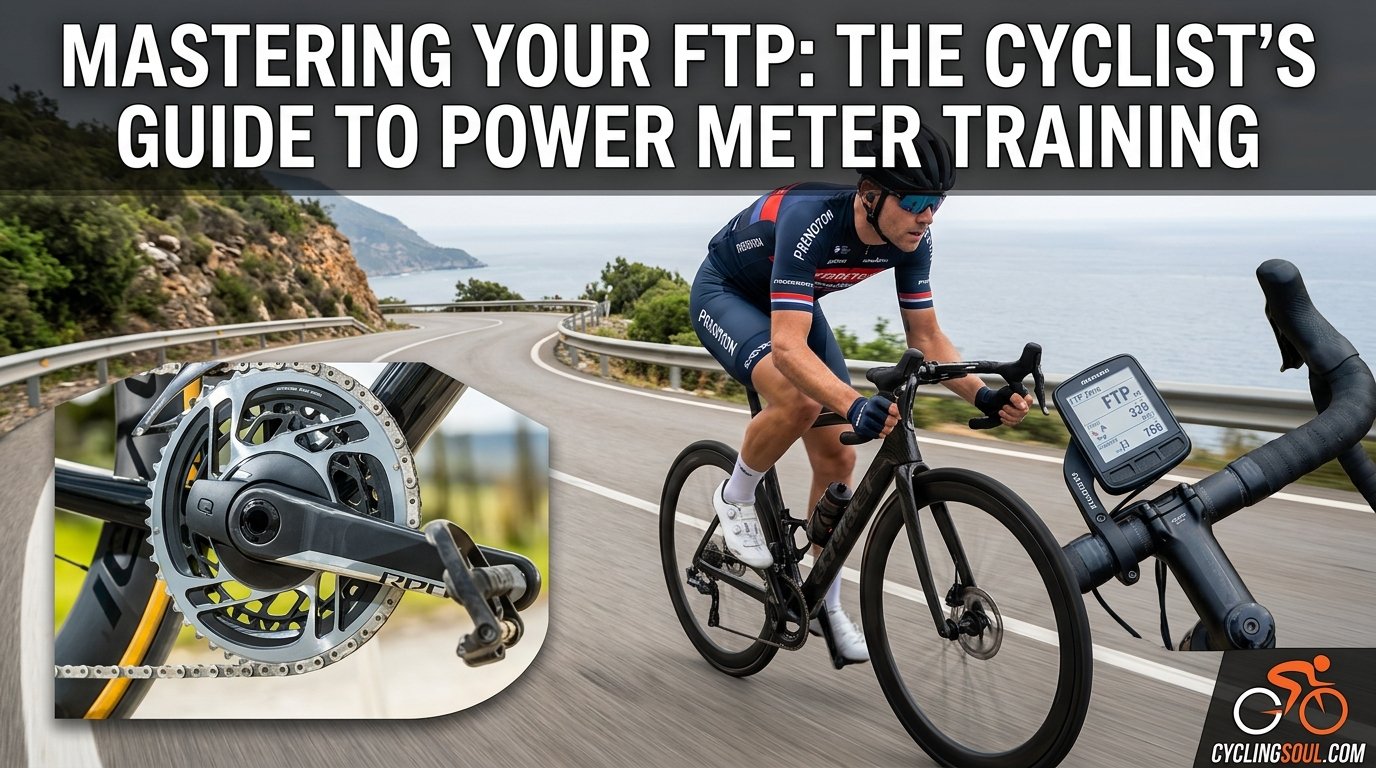
What Is FTP in Cycling? The Complete Guide to Functional Threshold Power
It’s the single number that shapes how thousands of riders train, pace, and measure progress. Here’s exactly what it means, how it’s measured, and how to put it to work.
If you’ve spent any time around serious cyclists, you’ve heard the acronym tossed around like it’s common knowledge: “My FTP just went up ten watts,” or “I’m retesting my FTP on Saturday.” For newer riders, it can sound like insider jargon. It isn’t. FTP is one of the most useful ideas in modern cycling, and once you understand it, a lot of confusing training advice suddenly makes sense.
This guide walks through what FTP stands for, where the number comes from, how to measure it, how to build training zones around it, and how to raise it over time. Whether you’ve just bought your first power meter or you’ve been riding for years and never quite understood the fuss, you’ll leave with a clear, practical picture.
1. What FTP Actually Means in Cycling
FTP stands for Functional Threshold Power. In plain language, it’s the highest average power, measured in watts, that you can sustain for roughly one hour of all-out, steady effort. It sits right on the border between effort you can hold for a long time and effort that will force you to slow down fairly quickly.
Break the term into its three parts and it becomes easier to grasp:
- Functional means it’s a practical, real-world measurement rather than something that can only be found in a lab with expensive equipment.
- Threshold refers to the tipping point where your body shifts from working at a sustainable pace to working at a pace that builds fatigue rapidly.
- Power is the actual output at the pedals, measured in watts, which is the product of how hard you push and how fast you turn the cranks.
The concept was popularized by exercise physiologist Dr. Andrew Coggan and endurance coach Hunter Allen, whose work on power-based training helped move the sport away from guesswork. Before power meters became common, riders relied on heart rate, perceived effort, and speed. All three are useful, but all three are easily distorted by heat, caffeine, sleep, terrain, and wind. Watts don’t lie. A hundred watts is a hundred watts on a flat road, a steep climb, or a stationary trainer in your garage.
Quick example: Suppose your FTP is 220 watts. That means you could theoretically hold around 220 watts for about an hour if you paced yourself perfectly and had a fresh set of legs. Riding at 150 watts would feel comfortable and conversational. Riding at 260 watts would feel hard enough that you’d be hanging on for dear life after a short while.
It’s worth emphasizing that FTP is an estimate, not a divine truth. Almost nobody actually rides a full hour at their threshold during a normal test, because that would be brutal and impractical. Instead, shorter tests are used and the result is adjusted by a formula. We’ll get into those protocols later, but the key takeaway for now is that FTP is a reference point, a ruler you use to measure and prescribe effort.
Another subtle point: FTP isn’t a fixed property of your body. It changes with fitness, fatigue, nutrition, sleep, altitude, and even the time of day. Think of it as a snapshot of what you can do right now, in your current condition, rather than a permanent label.
2. Why FTP Matters for Every Kind of Rider
You don’t need to be a racer for FTP to be valuable. In fact, recreational riders, commuters, gran fondo enthusiasts, and indoor-trainer devotees often get the most dramatic benefits, because they’ve never had an objective way to measure effort before.
It turns vague effort into precise targets
“Ride at a moderate pace” means something different to everyone. “Ride at 70 percent of your FTP” means exactly one thing. Once you know your threshold, every workout can have a clear target, and you can stop wondering whether you went too hard on an easy day or too easy on a hard day. Those two mistakes, by the way, are the most common reasons riders plateau.
It lets you track real fitness changes
Speed on the road is a terrible measure of fitness. A tailwind can add three miles per hour without any improvement in your legs. FTP is far more honest. If your threshold climbs from 180 to 200 watts over a few months, your engine genuinely got stronger, regardless of weather or route.
It helps you pace long events
Blow past your threshold early in a long climb or time trial and you’ll pay for it dearly later. Knowing your FTP helps you set ceilings. Many experienced riders cap their effort at a percentage of FTP for the first half of a big ride and only open the throttle when the finish is near.
It makes comparisons fair
When combined with body weight, FTP gives you power-to-weight ratio in watts per kilogram, the number that largely determines how fast you climb. That ratio is why a lighter rider with a modest FTP can still drop a heavier rider with a bigger FTP on a mountain pass. If you’re riding partly for body composition changes, our guide on cycling for weight loss explains how losing excess weight and building power work together to improve this ratio.
It keeps training honest and efficient
Time is the limiting factor for most adult cyclists. With six or seven hours a week, you can’t afford junk miles. FTP-based zones let you spend your limited hours in the specific intensities that produce the adaptations you want, whether that’s endurance, sustained power, or short explosive efforts.
3. The Science Behind Functional Threshold Power
To really understand FTP, it helps to know what’s happening inside your body when you ride near it. You don’t need a physiology degree, but a basic picture will make training advice far less mysterious.
Energy systems at work
Your muscles run on a mix of fuel sources, primarily fat and carbohydrate, processed through different energy pathways. At low intensities, your body leans heavily on aerobic metabolism, using oxygen to burn fat and carbs cleanly and efficiently. As intensity rises, you recruit more muscle fibers and lean harder on carbohydrate, producing metabolic byproducts faster.
Lactate and the threshold idea
Lactate is often blamed for sore legs, but it’s actually a fuel your body can reuse. During moderate effort, your body produces lactate and clears it at roughly the same rate, so levels stay steady. Push past a certain intensity and production outpaces clearance, causing levels to climb steadily. That crossover point, often called the lactate threshold or maximal lactate steady state, is closely related to FTP.
The word “closely” matters. FTP is not identical to the lab-measured lactate threshold, and different labs define threshold differently. But as a practical, field-based stand-in, FTP lands in the same neighborhood and behaves in similar ways. Ride below it and you can go for a long time. Ride above it and the clock starts ticking.
Why the hour matters
The one-hour definition exists because that duration is long enough that the body’s energy systems must settle into a sustainable balance, but short enough to serve as a standardized benchmark. A rider who can hold 250 watts for a full hour is operating at a pace that’s right on the edge of sustainability. Hold 300 and you’d collapse long before sixty minutes. Hold 200 and you’d likely keep going past an hour with relative ease.
The role of muscle fiber and fitness
Your threshold reflects several things working together: how much oxygen your heart and lungs deliver, how many mitochondria your muscles contain to use that oxygen, how efficiently your capillaries feed the working fibers, and how well your muscles resist and clear fatigue-causing byproducts. Training can improve all of these. That’s why FTP responds so well to structured work, particularly in beginners.
If you’re curious about which muscles carry the load during hard pedaling efforts, our breakdown of what muscles cycling works covers the quads, glutes, hamstrings, and calves that determine how much power you can produce and sustain.
Good to know: Your body doesn’t have a sharp cliff at threshold. It’s more like a gradual slope that steepens. That’s why a rider sitting at 95 percent of FTP can feel quite different from one at 105 percent. The first can stay put for a long time, the second begins to feel the burn within minutes.
4. FTP vs. Other Common Cycling Metrics
FTP is one of several numbers that show up in cycling conversations. Understanding how they differ keeps you from mixing them up or expecting one to do the job of another.
| Metric | What It Measures | Typical Duration | Best Used For |
|---|---|---|---|
| FTP | Highest sustainable steady power | About 1 hour | Setting zones, pacing, tracking fitness |
| VO2 max | Maximum oxygen uptake capacity | 3 to 8 minutes of all-out effort | Describing aerobic ceiling |
| Maximal aerobic power (MAP) | Power at VO2 max | 3 to 6 minutes | Setting hard interval targets |
| Critical power (CP) | Modeled boundary between heavy and severe intensity | Derived from several efforts | Modeling intervals and repeatability |
| Lactate threshold heart rate (LTHR) | Heart rate at threshold effort | Steady 20 to 30 minute effort | Training by heart rate when power isn’t available |
| Power-to-weight (W/kg) | Power divided by body mass | Any duration | Predicting climbing performance |
FTP vs. VO2 max
VO2 max is your body’s ceiling for using oxygen, largely determined by genetics and trainable only within limits. FTP is the percentage of that ceiling you can actually use over a sustained period. Two riders with identical VO2 max values can have very different FTPs, and the one with the higher threshold will usually be faster over long distances. That’s good news: threshold is more trainable than the raw ceiling.
FTP vs. critical power
Critical power is a mathematical model drawn from several maximal efforts of different lengths. It typically lands slightly above FTP, and some coaches prefer it because it avoids the arbitrary one-hour framing. For most riders, though, FTP remains the simpler and more widely supported number across apps, head units, and training platforms.
FTP vs. average power
Average power for a ride is simply total work divided by time. It includes soft pedaling, coasting, and descents, so it says little about threshold on its own. Normalized power, a related measure, tries to account for the physiological cost of variable efforts and is often compared against FTP to gauge how hard a ride really was.
5. Tools for Measuring Power: What You Need to Find Your FTP
You can’t measure FTP without measuring watts, and measuring watts requires a power source. Fortunately, the market offers options at nearly every budget.
Power meters on the bike
These are strain-gauge devices that measure the force you apply and multiply it by your pedaling speed. They come in several forms:
- Pedal-based meters are easy to move between bikes and simple to install. They’re popular for riders who own more than one bicycle.
- Crank-arm and spider-based meters are built into the crankset and tend to be durable and accurate. They’re a common choice for riders who stick with one main bike.
- Hub-based meters measure at the rear wheel and are less common today, though still available.
- Crank-arm add-ons measure on a single side and double the reading, offering a lower-cost entry point.
Smart trainers
If you ride indoors, a smart trainer measures power and adjusts resistance automatically. Many riders do their FTP tests indoors precisely because conditions are controlled: no traffic, no wind, no hills, no coasting. A good trainer paired with training software can run the whole test for you and calculate the result.
Single-sided vs. dual-sided
Single-sided meters measure one leg and double it. This is fine for most riders, since most people’s left-right balance is close enough for training purposes. Dual-sided meters measure both legs separately, which can be helpful for riders recovering from injury or working on pedaling symmetry, though the extra cost isn’t necessary for everyone.
What if you don’t have a power meter?
You can still estimate your threshold using heart rate or perceived exertion, though with less precision. Many training apps also provide estimated FTP based on past rides, and some smart bikes and indoor cycling machines display power. If you’re still deciding whether to invest, it may be wise to build a consistent riding habit first. Our guide on how to start cycling covers getting rolling before you get technical.
Pros of Training With Power
- Instant, objective feedback
- Unaffected by wind, heat, or terrain
- Precise training zones
- Clear long-term progress tracking
- Better pacing on climbs and events
Cons of Training With Power
- Upfront equipment cost
- Learning curve with new terminology
- Risk of obsessing over numbers
- Battery and calibration upkeep
- Readings can differ between devices
6. FTP Test Protocols: Which One Fits You?
Because a full one-hour test is brutal and unrealistic for most people, several shorter protocols have been developed. Each applies a formula to estimate your hourly power. None is perfect, but all are useful when performed consistently.
| Test | Format | FTP Estimate | Who It Suits |
|---|---|---|---|
| 20-minute test | Warm-up, short hard effort, rest, then a steady 20-minute all-out effort | About 95% of 20-minute average power | Riders comfortable pacing a long maximal effort |
| Ramp test | Stepwise increases every minute until you can’t continue | About 75% of best one-minute power | Beginners and riders who dislike pacing guesswork |
| 8-minute test | Two 8-minute maximal efforts with recovery between | About 90% of the higher average | Riders who struggle with a full 20-minute effort |
| 60-minute test | One full hour at maximal steady effort | Average power for the hour | Experienced riders or time trialists |
| Automatic estimates | Algorithms analyze existing rides | Software-generated | Riders who want a low-effort starting point |
The 20-minute test
This is the classic. After a thorough warm-up, you ride as hard as you can sustain for twenty minutes, then multiply your average power by 0.95. The reduction accounts for the fact that you can hold a higher output for twenty minutes than for sixty. It’s demanding, and pacing matters enormously: start too hard and you’ll fade, start too easy and you’ll leave watts on the table.
The ramp test
In a ramp test, the resistance rises by a fixed amount every minute until you can no longer turn the pedals. Your FTP is estimated as a percentage of your best one-minute power. It’s shorter and removes the need to pace, which is why many beginners prefer it. The tradeoff is that riders with strong short-burst ability but weaker endurance can end up with an inflated number, while diesel-style endurance riders may see theirs underestimated.
The 8-minute test
Two shorter efforts reduce the mental burden of a 20-minute grind. Some riders find this easier to execute well. The estimate is a bit less direct, so it works best when you use the same test each time for comparison.
The full hour
The gold standard in theory, the toughest in practice. Few people test this way except time trialists who ride long, steady efforts anyway.
Consistency beats perfection. The most important rule is to use the same protocol, under similar conditions, every time you retest. A ramp test result and a 20-minute test result will often differ. That doesn’t mean one is wrong. It means they’re different rulers. Pick one and stick with it.
7. Test Day Preparation and Pacing Strategy
A test result is only as good as the conditions in which you produced it. A few smart choices can make the difference between a number you can trust and one that sends your training zones off course.
Be fresh
Don’t test after a hard week. Ride easy or take a rest day beforehand, so your legs are not carrying accumulated fatigue. A tired test produces an artificially low FTP, which makes your zones too easy and slows progress.
Fuel and hydrate
Eat a familiar meal a couple of hours before, and sip fluids steadily. Showing up under-fueled drains power. Many riders also find that a bit of caffeine, if they tolerate it, helps with focus and perceived effort.
Warm up properly
Start with easy spinning, add some progressive builds, then include a few short, hard bursts to open up your legs and lungs. The idea is to arrive at the main effort primed but not drained. A rushed warm-up often leads to a rough first few minutes and a worse result.
Pace like a metronome
For a 20-minute effort, the most common mistake is going out too hard. Aim for a steady, controlled start in the first few minutes, settle into a rhythm you believe you can hold, and save something for the final third. If you have energy left in the last two minutes, spend it. Even pacing almost always beats a big fade.
Control the environment
Test in a similar setup each time: the same trainer or road, the same time of day, similar temperature, and the same bike position. Indoor tests are easier to standardize, while outdoor tests require a steady climb or flat road with minimal interruptions from traffic.
Don’t judge it by feel alone
Plenty of riders feel awful during a good test and fine during a bad one. Look at the numbers afterward rather than trusting your impressions. And if a test feels off because of illness, poor sleep, or a bad day, it’s perfectly acceptable to repeat it later in the week.
Footwear and comfort matter. Hot spots or numb feet can ruin a hard 20-minute effort. If your shoes aren’t dialed in, check out our roundup of the best cycling shoes for options that transfer power efficiently and stay comfortable under load.
8. Training Zones Built From Your FTP
Here’s where FTP earns its keep. Once you have a number, you can divide your effort into zones, each corresponding to a range of percentages of FTP and producing different training adaptations. The widely used seven-zone model looks like this.
| Zone | Name | % of FTP | Feels Like | Main Benefit |
|---|---|---|---|---|
| 1 | Active Recovery | Below 55% | Very easy spinning | Recovery, blood flow |
| 2 | Endurance | 56 to 75% | Comfortable, conversational | Aerobic base, fat metabolism |
| 3 | Tempo | 76 to 90% | Steady, slightly breathless | Muscular endurance |
| 4 | Threshold | 91 to 105% | Hard, sustained discomfort | Raises FTP directly |
| 5 | VO2 Max | 106 to 120% | Very hard, short bursts | Aerobic ceiling |
| 6 | Anaerobic Capacity | 121 to 150% | Extremely hard, under 2 minutes | Short, powerful surges |
| 7 | Neuromuscular Power | Max effort | All-out sprints | Peak power, explosiveness |
How to read the zones
Most of your riding should live in Zones 1 and 2. This is the foundation, where you build aerobic capacity and the endurance to handle everything else. Zone 3 is the grey area many riders overuse: hard enough to tire you, not quite hard enough to deliver the gains of true threshold work. A bit of tempo has its place, but too much of it makes many riders stale.
Zone 4 is where threshold training lives. Intervals of ten to thirty minutes at this intensity are a direct stimulus for raising FTP itself. Zone 5 and above build the top end, adding to your ability to attack, bridge gaps, and recover from surges.
The sweet spot
Between upper Zone 3 and lower Zone 4, roughly 88 to 94 percent of FTP, sits a popular training range known as the sweet spot. It’s hard enough to drive meaningful adaptation yet manageable enough that you can accumulate a lot of time there without burning out. For time-crunched riders, sweet spot intervals offer excellent return on effort.
Zones by heart rate
You can build a parallel set of zones based on heart rate, though the two don’t always match. Heart rate lags behind effort, drifts upward during long rides, and varies with heat and hydration. Power responds instantly, which is why most structured plans prioritize it. Using both together gives you a richer view of how your body is coping on a given day.
9. What Counts as a Good FTP?
This is the question almost everyone asks the moment they get their first number. The honest answer: it depends on your body weight, age, training history, and goals. A raw wattage figure doesn’t tell the whole story, which is why most coaches talk in watts per kilogram.
Power-to-weight ratio
Divide your FTP by your body mass in kilograms to find your ratio. A 70 kg rider with a 210-watt FTP has a ratio of 3.0 watts per kilogram. Because climbing speed depends heavily on this ratio, it’s a better predictor of performance on hills than raw power alone. Flat riding, by contrast, favors raw watts, since aerodynamic drag depends more on frontal area than weight.
| Rider Category | Approximate W/kg (Men) | Approximate W/kg (Women) |
|---|---|---|
| Beginner / untrained | Below 2.0 | Below 1.7 |
| Recreational | 2.0 to 3.0 | 1.7 to 2.6 |
| Fit enthusiast | 3.0 to 3.8 | 2.6 to 3.3 |
| Strong amateur / club racer | 3.8 to 4.8 | 3.3 to 4.2 |
| Elite amateur | 4.8 to 5.5 | 4.2 to 4.9 |
| Professional level | 5.5 and above | 4.9 and above |
Treat these ranges as rough guides, not strict categories. Different sources draw the lines differently, and individual riders vary enormously. A rider who’s new to the sport might start in the lowest bracket and move up one or even two levels in the first year of consistent training, which is one of the most encouraging things about FTP.
Age and sex differences
Power typically peaks in the twenties and thirties and declines gradually after that, but dedicated riders can maintain high thresholds well into their fifties and beyond. On average, men have higher absolute FTPs than women because of differences in muscle mass, but women can and do build impressive ratios. What matters most is your own trajectory.
Compare yourself to yourself
The healthiest way to use FTP is as a personal benchmark. Comparing your number to a friend’s, or to a stranger’s online, is mostly a recipe for frustration. Measure where you are now, build a plan, and see how far you can move the needle over the next few months.
10. Raising Your FTP: Proven Training Strategies
The good news is that threshold power responds well to consistent, structured work. The less glamorous news is that there’s no shortcut. Gains come from a combination of volume, intensity, and recovery applied patiently over time. If you want a broader roadmap beyond threshold work, our guide on how to train for cycling lays out the bigger picture.
Build the aerobic base
Long, steady Zone 2 rides are the bedrock of endurance. They improve your body’s ability to burn fat, expand capillary networks, and build mitochondria. A bigger base supports harder training later. Many riders neglect this because it feels too easy, but those easy hours pay compounding dividends.
Sweet spot intervals
Intervals at roughly 88 to 94 percent of FTP are a time-efficient way to lift your threshold. A common session is two or three blocks of fifteen to twenty minutes, with short recoveries between. Progress by adding time to each block before raising the power.
Threshold intervals
Efforts at 95 to 105 percent of FTP directly target the system you’re trying to improve. Typical formats include two blocks of twenty minutes or three blocks of ten to fifteen minutes. These are demanding, so most riders include only one or two such sessions per week.
Over-unders
Over-under intervals alternate between slightly below and slightly above threshold, for example two minutes at 95 percent followed by one minute at 105 percent, repeated for ten to twenty minutes. They teach your body to clear and reuse lactate while riding right at the limit, mimicking the surges of a real race or group ride.
VO2 max intervals
Raising your aerobic ceiling lifts the roof on what threshold can reach. Efforts of three to five minutes at 106 to 120 percent of FTP, repeated four to six times with equal recovery, are a classic format. Use these sparingly, as they’re taxing.
Muscular strength off the bike
Strong legs and a stable core help you produce and transfer power. Squats, lunges, deadlifts, and hip bridges strengthen the same muscles that drive the pedals. If glute development is on your radar, take a look at whether cycling builds glutes for insight into how pedaling and strength training complement each other.
Recovery, sleep, and fueling
You don’t get fitter during the workout. You get fitter when you recover from it. Sleep, adequate protein, enough carbohydrate to support hard sessions, and planned rest days are not optional extras. An easy week every third or fourth week helps absorb training stress and prevents the slow slide into overtraining.
A sample weekly structure
| Day | Session | Intensity |
|---|---|---|
| Monday | Rest or very easy spin | Zone 1 |
| Tuesday | Threshold or sweet spot intervals | Zones 3 to 4 |
| Wednesday | Endurance ride | Zone 2 |
| Thursday | VO2 max or over-under intervals | Zones 4 to 5 |
| Friday | Rest or recovery spin | Zone 1 |
| Saturday | Long endurance ride | Zone 2, optional tempo |
| Sunday | Moderate ride or strength session | Zones 2 to 3 |
This is a template, not a prescription. Adjust it around your work, family, and energy levels. The best plan is the one you can repeat consistently for months.
What Works Well
- Consistent weekly structure
- Progressive overload over weeks
- Mixing intensities across the week
- Planned recovery weeks
- Retesting every 6 to 8 weeks
What Backfires
- Riding hard every single day
- Skipping easy days
- Chasing numbers on bad days
- Ignoring sleep and nutrition
- Changing plans every week
11. Common FTP Mistakes and Myths
Because FTP is so widely used, a surprising number of misunderstandings have grown around it. Clearing them up can save you months of frustration.
Myth: FTP is the only number that matters
FTP describes one slice of fitness. A rider with a strong threshold but weak sprint, or excellent endurance but poor repeatability, may struggle in certain situations. Think of FTP as the anchor of a broader power profile that includes your best efforts at five seconds, one minute, five minutes, and twenty minutes.
Myth: A higher FTP always means a faster rider
Fast riding involves bike handling, aerodynamics, tactics, pacing, nutrition, and plenty of other skills. A rider with a moderate FTP who corners well, sits aero, and paces smartly can beat someone with bigger numbers and poorer technique.
Mistake: Testing too often
Retesting every week wears you down and gives noisy results. Most riders do well testing every six to eight weeks, or at the start and end of a training block.
Mistake: Using outdated zones
If your fitness has improved but your zones haven’t been updated, your workouts will be too easy to drive progress. On the flip side, using a zone set based on an unusually good test can leave you struggling through sessions you can’t complete.
Mistake: Treating the test as a verdict
A test result is a data point. A single poor test doesn’t mean you’ve lost fitness, and a single great one doesn’t mean you’re suddenly elite. Look at trends across several months.
Mistake: Ignoring the mental side
Hard efforts are as much mental as physical. Being willing to sit in discomfort is part of building threshold. Techniques like breaking intervals into smaller chunks, using music or video indoors, and focusing on breathing and cadence can help.
Myth: You can’t improve past a certain point
Beginners can gain quickly, sometimes dramatically, in their first year. Experienced riders see slower gains, but with smart training, they can keep nudging upward for years. Progress is rarely linear, but it’s real.
Myth: FTP is the same on every bike
Your threshold on a road bike, a time trial bike, and an indoor trainer can differ because of position, muscle recruitment, cooling, and comfort. Many riders find their indoor FTP is a bit lower than outdoors, largely thanks to heat. Don’t be surprised if numbers don’t match perfectly across setups.
Don’t forget the basics. Comfort on the bike affects how long and hard you can ride. Chafing, numb hands, and sore feet can all cut a threshold session short, so pay attention to your contact points. Well-fitting cycling apparel, such as the shoes mentioned earlier, can make a noticeable difference during hard efforts.
12. Gear That Supports Serious FTP Training
You don’t need a garage full of equipment to improve your threshold, but a few well-chosen pieces make the process easier, more accurate, and more enjoyable.
| Gear | Why It Helps | Priority |
|---|---|---|
| Power meter | The foundation of FTP measurement and zone training | Essential |
| Cycling computer | Displays live power, intervals, and zones | Essential |
| Smart trainer | Controlled indoor testing and structured workouts | Highly recommended |
| Heart rate monitor | Adds context to power data | Recommended |
| Indoor fan | Keeps core temperature down during hard efforts | Recommended |
| Quality shoes and cleats | Efficient power transfer and comfort | Recommended |
| Bib shorts with a good chamois | Comfort for long, hard sessions | Recommended |
| Training app or software | Guided workouts and automatic tracking | Optional but helpful |
Start where your budget allows
If you can only buy one thing, make it a reliable power source. Everything else is built around it. If an indoor trainer is within reach, it opens the door to year-round training regardless of weather, and many riders find it makes structured workouts easier to complete consistently.
Don’t overlook apparel
Hard intervals demand good contact points. Well-fitting shorts, supportive shoes, and moisture-managing socks may seem like small details, but they can be the difference between finishing a session strong and cutting it short. Compare the options in our guides on the best cycling shoes and the other apparel picks featured at the end of this article.
Keep it simple
Gadgets are fun, but they don’t ride the bike for you. The most effective training setup is often the simplest one you’ll actually use regularly. A basic power meter, a head unit, consistent effort, and patience will take most riders further than a pile of unused tech.
Frequently Asked Questions About FTP in Cycling
What does FTP stand for in cycling?
FTP stands for Functional Threshold Power. It’s the highest average power, measured in watts, that a rider can sustain for roughly one hour of steady, maximal effort.
How do I find my FTP without a power meter?
Without a power meter, you can estimate your threshold using perceived exertion, heart rate during a hard 20 to 30 minute effort, or training apps that estimate from past rides. These methods are less precise than direct power measurement, but they can provide a workable starting point.
Is a 20-minute test or a ramp test better?
Neither is universally better. The 20-minute test is more demanding and requires good pacing, while the ramp test is shorter and easier to execute. The most important thing is to use the same test consistently so your results are comparable over time.
What is a good FTP for a beginner?
Many beginners start somewhere between about 1.5 and 2.5 watts per kilogram. The exact figure matters less than the trend. With consistent training, new riders often see significant improvements within the first several months.
How often should I retest my FTP?
Most riders retest every six to eight weeks, or at the end of a training block. Testing too frequently adds fatigue and produces noisy results, while testing too rarely can leave you training with outdated zones.
Why is my indoor FTP lower than my outdoor FTP?
Heat is the usual culprit. Indoors, there’s less airflow to cool your body, so core temperature rises faster and power drops. Position differences, trainer calibration, and motivation can also play a role. A strong fan helps narrow the gap.
Can I raise my FTP quickly?
Beginners can see noticeable gains in a matter of weeks. More experienced riders typically improve more slowly. Consistent training, good recovery, and a mix of endurance and interval work are the most reliable path forward.
Does losing weight increase FTP?
Losing excess body fat doesn’t necessarily raise your raw FTP, but it can improve your power-to-weight ratio, which matters most on climbs. Cutting weight too aggressively can reduce power and hurt recovery, so it’s best done gradually while maintaining adequate fuel for training.
Is FTP the same as lactate threshold?
They’re closely related but not identical. FTP is a practical, field-based estimate of sustainable power, while lactate threshold is a physiological concept measured in a lab. The two usually land in a similar range, though definitions vary between researchers and coaches.
Should I train by heart rate or power?
Power is generally more precise because it responds instantly and isn’t affected by heat, caffeine, or fatigue the way heart rate is. Heart rate still offers valuable context about how your body is coping, so using both together gives a fuller picture.
Can women and older riders use FTP effectively?
Absolutely. FTP is a personal benchmark that works for riders of any age, sex, or background. Zones are based on your own number, so they scale to your fitness. Many riders continue to improve their thresholds well into later decades with consistent training.
Do I need to know my FTP to enjoy cycling?
Not at all. Plenty of people enjoy riding purely for fun, fitness, or transportation without ever measuring watts. FTP is a tool for those who want structure, measurable progress, or more efficient training. If it adds to your enjoyment, use it. If it doesn’t, ride freely.
Conclusion: Make FTP Work for You
FTP is, at its core, a simple idea: a number that describes the hardest steady effort you can sustain, and a reference point that lets you train, pace, and measure progress with precision. It won’t tell you everything about your riding, and it shouldn’t turn every spin into a performance review. But as a tool, it’s remarkably powerful.
Start by getting access to power data, whether through a meter on your bike or a smart trainer at home. Pick one test protocol and perform it under good conditions. Use the result to set your zones, build a weekly structure that mixes easy volume with a couple of focused interval sessions, and retest every couple of months. Pay as much attention to recovery as you do to hard efforts, and be patient with the process.
Above all, keep the bigger picture in mind. The best training plan is the one that keeps you riding, improving, and loving the sport. FTP is simply a compass. Where you choose to go with it is entirely up to you.